The Compression-Effectiveness Trade-off in EMI Gasket Design
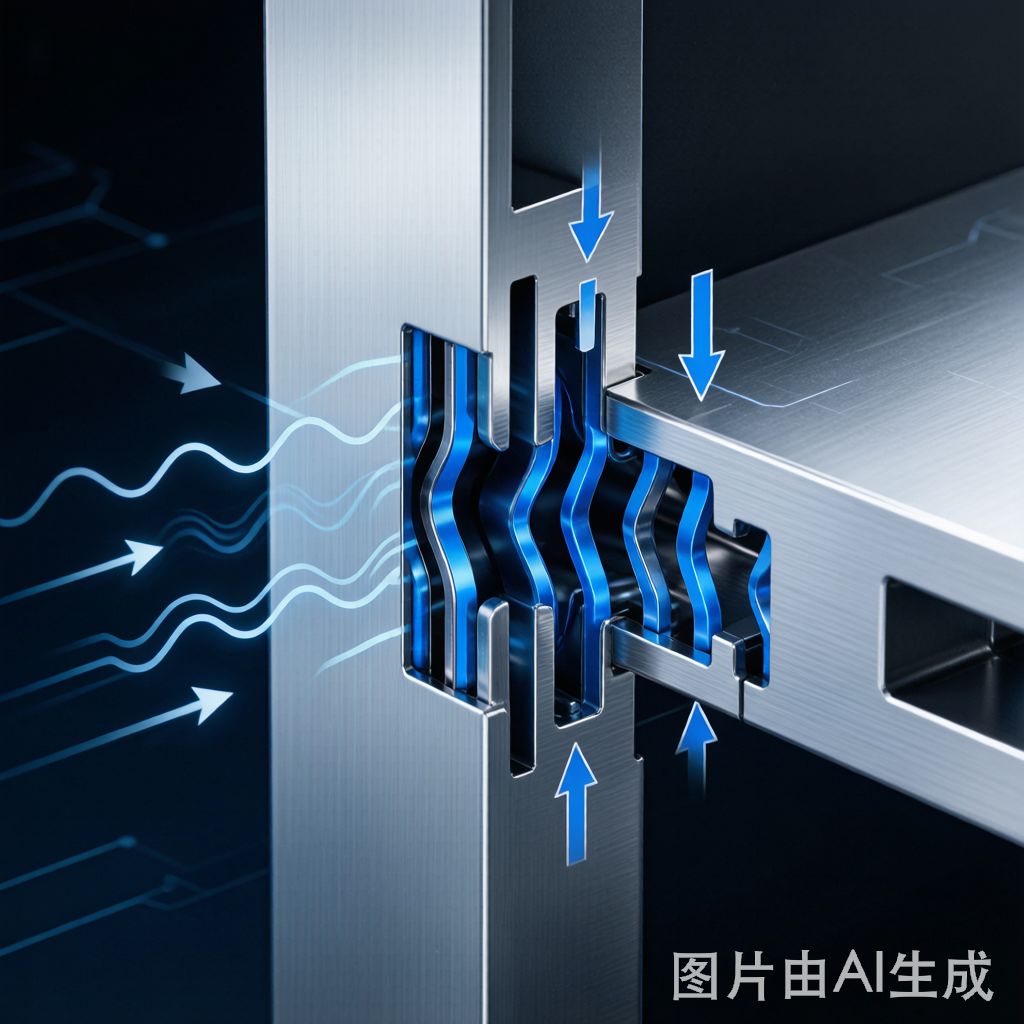
EMI shielding gaskets sit at the mechanical-electromagnetic interface of every shielded electronic enclosure. Their job is deceptively simple: close the gap between mating enclosure surfaces to prevent electromagnetic leakage. In practice, this requires balancing two opposing requirements — enough compression force to ensure consistent electrical contact across the entire gasket length, but not so much force that the enclosure deforms, the gasket takes a permanent compression set, or assembly becomes difficult.
This compression-versus-effectiveness trade-off is one of the most nuanced challenges in EMI enclosure design. Under-compress the gasket and you create slot ante
as that leak at predictable frequencies. Over-compress it and you risk permanent deformation, reduced service life, and excessive assembly forces that complicate manufacturing. Getting it right requires understanding the gasket material’s compression-deflection characteristics, the electromagnetic theory of aperture leakage, and the practical constraints of mechanical enclosure design.
This guide examines the relationship between EMI gasket compression force and shielding effectiveness, providing practical design data and optimization strategies for electronic enclosure designers.
Gasket Material Types and Their Compression Characteristics
Each EMI gasket material has a distinct compression-force-deflection curve that defines its usable operating range:
Beryllium Copper Fingerstock: The highest-performance EMI gasket material for demanding applications. BeCu fingerstock achieves high contact force with relatively low compression (typically 10-40% of free height), providing excellent shielding (>100 dB at 10 GHz for properly designed fingerstock). Compression force per linear inch ranges from 0.5-3.0 lbs at typical working deflections. BeCu fingerstock maintains its spring properties through thousands of compression cycles and is suitable for sliding contact applications.
Conductive Elastomers: Silicone or fluorosilicone elastomer filled with conductive particles (silver-plated aluminum, silver-plated copper, nickel-graphite, or pure silver). Compression range is typically 10-30% of free height, with forces of 5-25 psi depending on material formulation. Conductive elastomers provide both EMI shielding and environmental sealing in a single gasket, making them ideal for outdoor and harsh-environment electronics.
Conductive Fabric-over-Foam (FoF): A polyurethane foam core wrapped in conductive fabric (typically nickel-copper plated or silver-plated nylon fabric). These gaskets operate at low compression forces (0.5-5.0 psi) with typical working deflection of 25-50% of free height. FoF gaskets are the most cost-effective solution for commercial electronics and provide shielding effectiveness of 60-100 dB from 30 MHz to 10 GHz when properly compressed.
Form-in-Place (FIP) Conductive Elastomer: Dispensed directly onto the enclosure surface as a liquid that cures to a resilient conductive bead. Compression range of 20-40%, with force per bead depending on the bead profile (typically D-shaped). FIP gaskets enable complex gasket paths and eliminate gasket inventory, cutting, and placement labor.
Metal Spring-EMI Gaskets (Spira, Bal Seal): Coiled metal springs (stainless steel or beryllium copper) often combined with an elastomer core or jacket. Very high spring-back and cycle life, with compression forces 2-5× that of BeCu fingerstock. Used for military and aerospace applications requiring extreme reliability and thousands of mating cycles.
The Slot Ante
a Principle: Why Gap Size Matters
The electromagnetic mechanism that makes gasket compression critical is the slot ante
a effect. Any gap in an otherwise continuous conductive shield behaves as a slot ante
a, capable of both transmitting and receiving electromagnetic energy:
Leakage Frequency: A slot becomes an efficient radiator when its longest dimension equals approximately one-half wavelength (λ/2) of the interfering frequency. For example, a 15mm gap (≈ λ/2 at 10 GHz) in an enclosure seam can reduce shielding effectiveness by 20-40 dB at that frequency compared to a perfectly sealed enclosure.
Polarization Sensitivity: The slot ante
a radiates most efficiently when the incident E-field is perpendicular to the long axis of the slot. This means that horizontal gaps leak more from vertically polarized fields, and vertical gaps leak more from horizontally polarized fields. In complex EMI environments with mixed polarization, all gap orientations must be addressed.
Gasket Spacing Rule: To maintain effective shielding, the gasket contact points must be spaced no more than λ/20 apart at the highest frequency of concern. For 10 GHz (λ = 30mm), this means contact points must be spaced ≤ 1.5mm apart. This spacing requirement drives the finger pitch for fingerstock gaskets and the required conductivity uniformity for elastomeric gaskets.
Gasket Compliance and Gap Uniformity: The enclosure gap must be uniform along the gasket path within the gasket’s working deflection range. Gaps varying from 0.2mm to 0.8mm along a seam designed for 0.5mm nominal closure will produce locally under-compressed and over-compressed regions, both of which degrade shielding performance.
Designing for Optimal Compression: Practical Guidelines
Achieving the right compression requires systematic design of both the gasket groove and the mating surface:
Gasket Groove Design: The groove (or gland) that holds the gasket must control compression depth precisely. A typical groove design provides 25-30% compression for conductive elastomers and 30-50% for FoF gaskets. Groove depth = free gasket height × (1 – desired compression ratio). For a 3.0mm FoF gasket at 40% compression, groove depth = 3.0 × 0.6 = 1.8mm.
Mating Surface Requirements: The surface against which the gasket compresses must be flat, clean, and conductive. Minimum surface roughness of 0.8μm Ra is recommended for reliable electrical contact. For aluminum enclosures, the mating surface should be chromate conversion coated per MIL-DTL-5541 Class 3 (conductive). Anodized surfaces are non-conductive and must have the anodizing removed or masked in the gasket contact area.
Fastener Spacing: Fasteners (screws, clips, snaps) provide the clamping force that compresses the gasket. For a given enclosure stiffness and gasket type, there is an optimal fastener spacing. Typical spacing guidelines: 30-50mm for rigid aluminum enclosures with FoF gaskets; 20-35mm for plastic enclosures with conductive elastomer; 15-25mm for high-performance BeCu fingerstock.
Compression Stop Features: To prevent gasket over-compression, include positive stops (bosses or ribs machined into the enclosure halves) that bottom out at the designed compression depth. This prevents assembly technicians from overtightening fasteners and crushing the gasket beyond its elastic limit. The stop surface must itself be conductive if it contacts the mating half.
Compression Set and Long-Term Reliability
All polymer-based EMI gaskets experience some degree of compression set — permanent deformation that reduces contact force over time:
Compression Set Definition: Measured per ASTM D395 Method B, compression set is the percentage of original deflection that is not recovered after compression at elevated temperature for a specified time (typically 22 hours at 70°C or 100°C). A compression set of 10% means the gasket lost 10% of its original height permanently.
Material Comparison: Silicone conductive elastomers typically exhibit compression set of 5-15% depending on formulation in standard tests. Fluorosilicone formulations often achieve lower compression set (3-8%) and better high-temperature retention. FoF gaskets are more susceptible to compression set (10-30%) due to the foam core, but this is partially offset by the higher working deflection range.
Design Margin for Compression Set: Specify initial compression to exceed the minimum required contact force by the expected long-term compression set percentage plus a 10% safety margin. If a conductive elastomer requires 10% compression for adequate contact and has a 15% compression set at the service temperature, design for 25-30% initial compression.
Temperature Acceleration: Compression set increases exponentially with temperature. A gasket rated for 10% compression set at 70°C may experience 20-30% compression set at 100°C over the same time period. For electronics operating in high-temperature environments, select gasket materials specifically rated for the expected continuous service temperature.
Measuring and Validating Gasket Performance
Verifying that gasket compression meets design requirements involves both mechanical and electrical measurements:
Compression Force Measurement: Use a force-deflection test system (universal testing machine with compression fixture) to characterize the gasket’s force versus deflection curve across the working range. The measured curve should closely match the supplier’s published data. Significant deviation (>15%) may indicate a material or manufacturing issue.
Contact Resistance Measurement per MIL-DTL-83528: Measure the DC resistance across the gasket-to-enclosure interface at the designed compression. Typical requirements: < 10 mΩ for general commercial, < 5 mΩ for military/aerospace. Perform measurements at multiple points along the gasket to detect contact uniformity issues.
Shielding Effectiveness Verification per IEEE 299: Full-enclosure shielding effectiveness testing with the gasket installed at designed compression. Measure SE from 30 MHz to the maximum frequency of concern (typically 10-18 GHz for commercial, up to 40 GHz for military). The gasket contribution to total SE can be isolated by comparing identical enclosures with and without gaskets at the seams.
Near-Field Probe Sca
ing: For troubleshooting, use a near-field probe co
ected to a spectrum analyzer to scan enclosure seams and identify localized leakage points. This is the most practical method for identifying under-compressed or damaged gasket sections in production units.
Conclusion
The relationship between EMI gasket compression force and shielding effectiveness is both a mechanical and electromagnetic optimization problem. Getting it right requires understanding gasket material properties, the physics of slot ante
a leakage, and the practical constraints of enclosure manufacturing and assembly.
For most commercial electronic enclosures, conductive fabric-over-foam gaskets operating at 30-50% compression provide an excellent balance of shielding performance, low assembly force, and cost-effectiveness. Beryllium copper fingerstock remains the gold standard for applications requiring the highest shielding performance, sliding contact compatibility, and extreme cycle life.
The key takeaway: design the enclosure groove and fastener layout around the gasket manufacturer’s compression recommendations, build in positive stops to prevent over-compression, and verify performance through both mechanical force testing and actual shielding effectiveness measurement. A properly designed and compressed EMI gasket is one of the most cost-effective investments in electronic product EMC compliance.