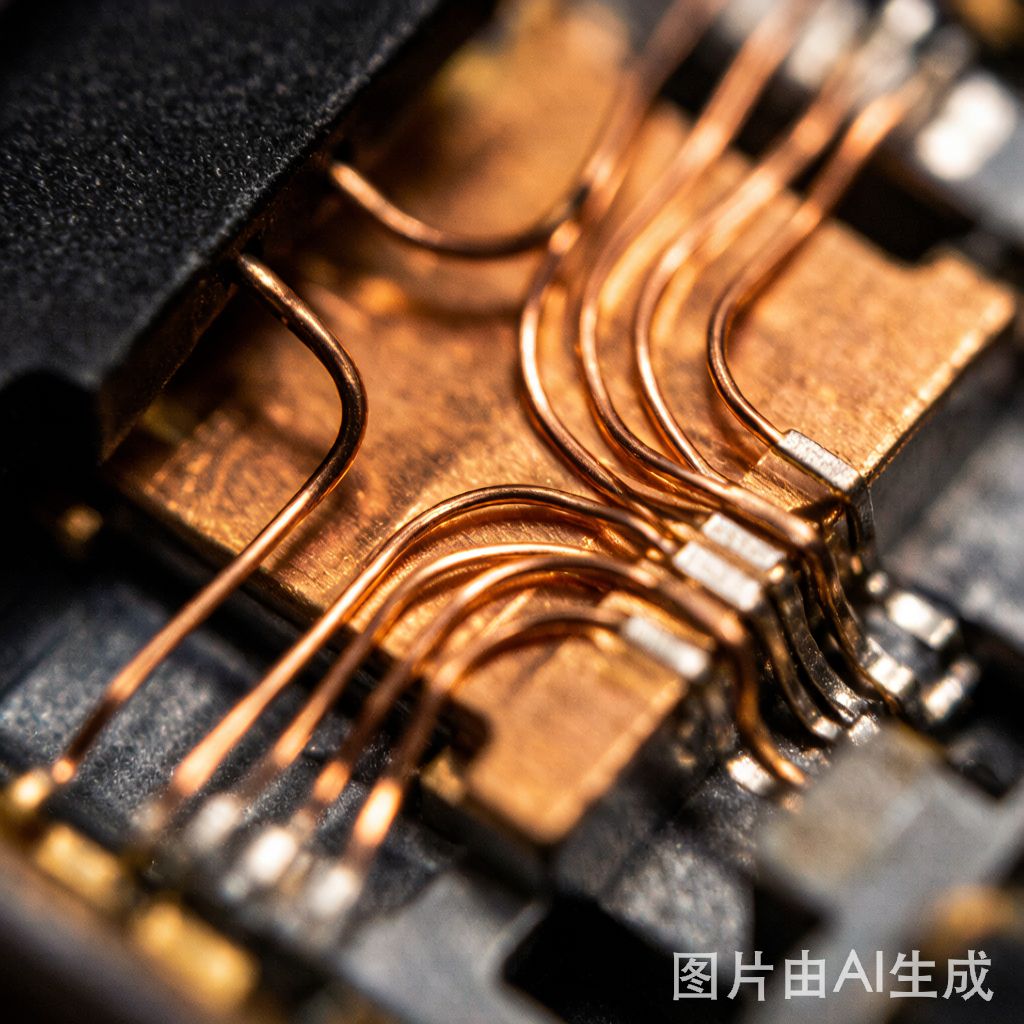
The Industry Shift from Gold to Copper Wire Bonding
For decades, gold wire bonding was the undisputed interco
ect technology for semiconductor packaging. Gold’s exceptional ductility, oxidation resistance, and well-characterized bonding behavior made it the default choice for co
ecting IC die pads to leadframes. However, the dramatic rise in gold prices — from approximately $300/oz in 2000 to over $1,800/oz in recent years — combined with the volume-driven economics of consumer electronics, created an irresistible economic incentive to transition to copper wire bonding.
Today, copper wire bonding accounts for over 70% of all wire-bonded IC packages by volume. The transition has been particularly rapid in the consumer, computing, and automotive sectors, where high pin counts, fine pitches, and aggressive cost targets make the copper advantage compelling.
Copper vs. Gold: Material Property Comparison
Copper offers several inherent advantages over gold as a bonding wire material:
| Property | Gold (4N) | Copper (4N) | Impact |
|---|---|---|---|
| Electrical resistivity | 2.2 μΩ·cm | 1.7 μΩ·cm | Copper: 25% lower resistance → reduced IR drop |
| Thermal conductivity | 320 W/m·K | 400 W/m·K | Copper: 25% better heat dissipation |
| Tensile strength | 120-140 MPa | 200-250 MPa | Copper: better loop stability for long wires |
| Young’s modulus | 78 GPa | 120 GPa | Copper: stiffer loops, less wire sweep |
| Hardness | 60-90 HV | 85-120 HV | Copper: higher risk of pad cratering |
| Oxidation resistance | Excellent | Poor | Copper: requires forming gas (95%N₂/5%H₂) |
| Material cost | $80-100/kft (1 mil) | $2-5/kft (1 mil) | Copper: 95-98% cost savings on wire |
Process Control Requirements
Copper wire bonding demands tighter process control than gold due to copper’s propensity to oxidize and its greater hardness:
Electronic Flame-Off (EFO) and Free Air Ball (FAB) Formation
The FAB is formed by melting the wire tip with an electrical discharge in a protective atmosphere. Copper FAB formation requires:
- Forming gas (95% N₂ / 5% H₂): Essential to prevent copper oxide formation during melting; oxygen levels must be below 10 ppm
- Higher EFO current: Copper’s higher melting point (1085°C vs 1064°C for gold) requires 20-30% more EFO energy
- FAB size control: The ball diameter should be 2.0-2.5× the wire diameter for optimal bond strength
- Consistent FAB shape: An asymmetric or “golf-club” shaped FAB indicates insufficient EFO energy or gas flow issues
Bonding Parameters
Copper requires higher ultrasonic power and bonding force due to its greater hardness. Typical parameters for 25 μm (1 mil) copper wire:
- Bond force: 15-25 gf (vs. 10-18 gf for gold)
- Ultrasonic power: 80-120 mA (vs. 60-90 mA for gold)
- Bond time: 10-15 ms (comparable to gold)
- Stage temperature: 175-220°C (similar to gold, but tighter control needed)
Reliability Challenges and Mitigation
Pad Cratering and Damage
Copper’s higher hardness transfers more stress to the aluminum bond pad during bonding, increasing the risk of pad cratering — micro-cracks in the silicon dielectric layers beneath the pad. Mitigation strategies include:
- Optimize bond pad metallization thickness (Al > 1.2 μm recommended for Cu wire)
- Use a two-stage bond profile with lower initial force
- Implement cratering tests (etch-back method) as part of process qualification
- Consider nickel-palladium (NiPd) or NiPdAu pad finishes for enhanced robustness
Corrosion and Reliability
Copper-aluminum intermetallic compounds (CuAl₂, Cu₉Al₄) are more susceptible to chloride-induced corrosion than the Au-Al IMC system. This is particularly relevant for automotive and industrial applications exposed to humid or corrosive environments. Key defenses:
- Use high-purity molding compounds with low ionic contamination (Cl⁻ < 10 ppm)
- Implement biased HAST (Highly Accelerated Stress Test) per JESD22-A110 as a corrosion screening tool
- Palladium-coated copper (PCC) wire provides a significant improvement in corrosion resistance by forming a protective Pd shell around the Cu core
When to Use Gold vs. Copper
Despite copper’s compelling economics, gold wire remains the preferred choice for:
- Ultra-fine-pitch applications (<40 μm pad pitch): Gold’s lower hardness enables smaller ball sizes without pad damage
- Hermetic ceramic packages: No moisture concern, eliminating copper’s corrosion disadvantage
- Medical implantables and aerospace: Conservative reliability requirements and long qualification cycles favor proven gold technology
- Very small wire diameters (<18 μm): Copper’s stiffness makes ultra-fine wire handling difficult
For the vast majority of commercial and industrial IC packages, copper wire bonding — when properly engineered and controlled — delivers equivalent reliability with dramatic cost savings.