The Case for Low-Temperature Soldering
Traditional lead-free SMT assembly relies on SAC305 (Sn-3.0Ag-0.5Cu) solder paste, which requires a peak reflow temperature of 235-250°C — well above its melting point of 217-220°C. While SAC305 has proven reliable across billions of solder joints, its high processing temperature creates several problems that are becoming more acute with each generation of electronic products:
- Energy consumption: Reflow ovens are among the most energy-intensive equipment in an SMT line. Reducing peak reflow temperature by 40-60°C can cut oven energy consumption by 20-30%
- Component warpage: Large BGA packages, thin substrates, and co
ectors can warp significantly at SAC reflow temperatures, causing head-in-pillow defects and opens
- Heat-sensitive components: MEMS sensors, optical modules, LED packages, and certain polymer capacitors degrade or shift parameters when exposed to 240°C+
- PCB delamination risk: High-layer-count PCBs with multiple reflow cycles are susceptible to pad cratering and delamination at elevated temperatures
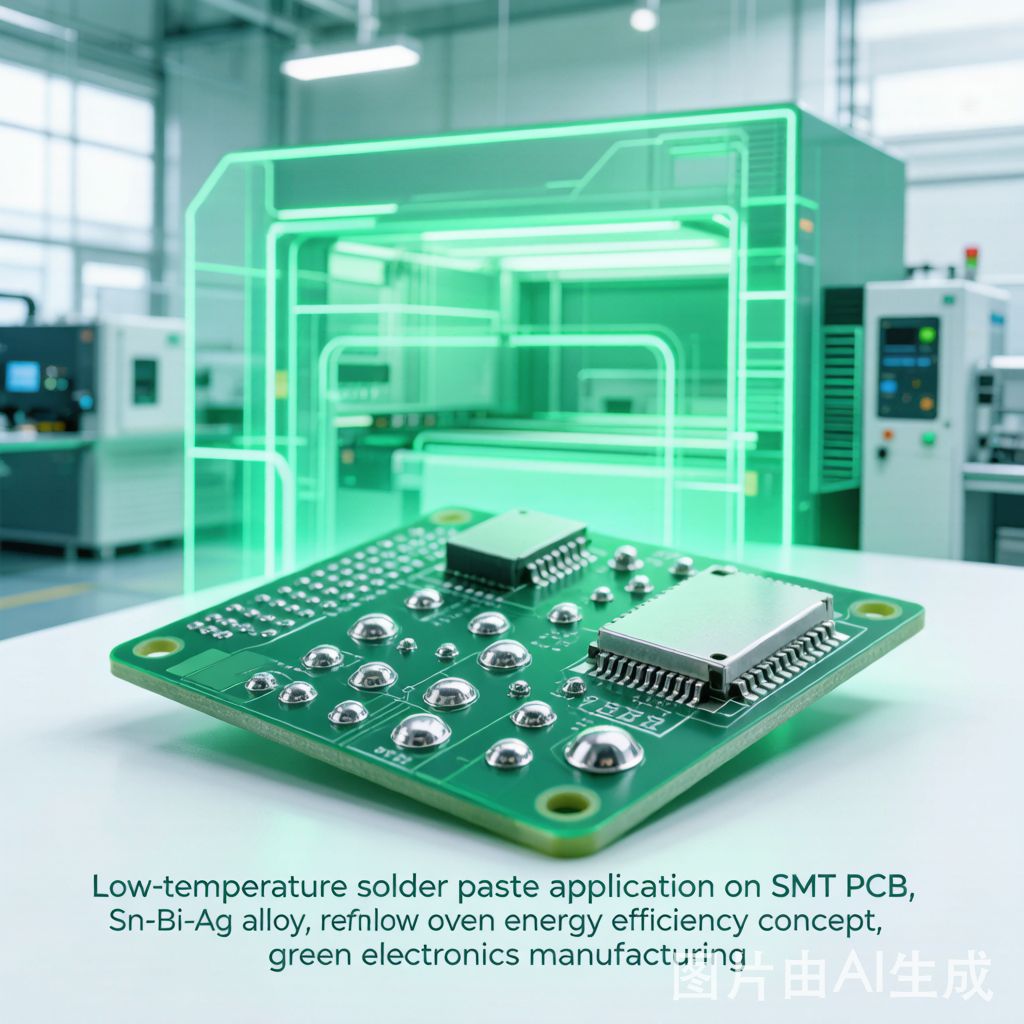
Low-temperature solder (LTS) pastes, based on Sn-Bi or Sn-Bi-Ag alloys with melting points in the 138-180°C range, address all of these concerns by enabling peak reflow temperatures of 170-195°C.
Sn-Bi-Ag Alloy System: Composition and Properties
The most widely adopted LTS alloy is based on the Sn-Bi eutectic system with a small silver addition:
| Alloy | Composition | Melting Point | Peak Reflow |
|---|---|---|---|
| SAC305 | Sn-3.0Ag-0.5Cu | 217-220°C | 235-250°C |
| SnBiAg (LTS) | Sn-57Bi-1Ag | 138-140°C | 170-185°C |
| SnBiAg-X (modified) | Sn-40Bi-1Ag-X | 140-170°C | 175-195°C |
Key properties of the Sn-57Bi-1Ag alloy:
- Melting range: Near-eutectic at ~138°C, with a narrow pasty range that ensures uniform solidification
- Tensile strength: 55-70 MPa — comparable to SAC305 (50-65 MPa) at room temperature
- Ductility: Lower than SAC305 (elongation ~20% vs. ~35%), which is the primary reliability concern
- Wetting: Good wetting on copper, ENIG, and immersion silver finishes; slightly slower spread rate than SAC305
- Silver (1%) role: The small Ag addition improves ductility and thermal fatigue resistance compared to binary Sn-58Bi
Energy and Carbon Footprint Savings
The energy savings from adopting LTS reflow are substantial. A typical 10-zone reflow oven operating at 240°C peak consumes approximately 15-20 kW continuously. Reducing the peak temperature to 180°C:
- Cuts electrical energy consumption by 20-30% per production shift
- Reduces nitrogen consumption (if used) by 10-15% due to lower thermal load on the tu
el
- Decreases factory HVAC load, as less heat is rejected into the production environment
- Reduces the carbon footprint of the SMT assembly process — important for manufacturers reporting Scope 2 emissions
Hybrid Soldering Process
Many products ca
ot be fully converted to LTS because some components (particularly high-reliability BGAs) are only qualified with SAC305 solder balls. The hybrid soldering process addresses this by using LTS paste for the majority of the board while accommodating SAC balls on specific components:
- Print LTS paste (SnBiAg) on all pads
- Place SAC305-balled BGA components on the LTS paste deposits
- Reflow at 195°C peak — the SAC balls do not fully melt but achieve metallurgical bonding through solid-liquid interdiffusion (SLID) with the liquid SnBiAg paste
- For board-level reflow, the SAC balls re-melt while the SnBiAg joints remain solid (beneficial for double-sided assembly)
Reliability Considerations
The primary reliability concern with SnBiAg LTS joints is bismuth embrittlement — bismuth is inherently brittle, and SnBi alloys have lower ductility than SAC solders. Key reliability findings from published studies:
- Thermal cycling (-40 to +125°C): SnBiAg typically achieves 60-80% of SAC305 characteristic life; adequate for consumer and many industrial products
- Drop/shock: Lower performance than SAC305 due to reduced ductility; may require underfill for mobile/handheld applications
- Isothermal aging at 100°C: IMC growth rate is lower than SAC305 (finer grain structure), which can be advantageous for high-temperature storage
- Electromigration: Comparable to SAC305; the Bi-rich phase does not accelerate current-driven diffusion
For consumer electronics, IoT devices, LED lighting, and many industrial products, the reliability of SnBiAg LTS joints is more than adequate — especially when the benefits of reduced warpage, lower energy consumption, and compatibility with heat-sensitive components are factored into the total cost of ownership.