Why SMT PCBs Need Conformal Coating
Surface-mount technology (SMT) assemblies are inherently vulnerable to environmental degradation. The dense component placement, fine-pitch interco
ects, and exposed copper traces that make SMT so powerful also create numerous pathways for failure when exposed to moisture, dust, chemicals, and corrosive atmospheres. Conformal coating — a thin polymeric film applied over the assembled PCB — provides a protective barrier that dramatically extends product lifetime in harsh environments.
Conformal coatings are not optional for electronics deployed in automotive under-hood environments, outdoor telecommunications equipment, marine electronics, industrial controls, aerospace systems, or any application where condensation, salt spray, sulfurous atmospheres, or conductive dust are present. The challenge for design engineers is selecting the right coating chemistry from the four major families: acrylic, silicone, urethane (polyurethane), and parylene.
Acrylic Conformal Coatings (AR)
Acrylic coatings are the most widely used conformal coating type, accounting for approximately 40% of the market by volume. They are solvent-based single-component materials that cure by solvent evaporation at room temperature.
Advantages:
- Excellent moisture resistance — typically withstands 1000+ hours at 85°C/85% RH
- Good dielectric strength: 1000-1500 V/mil (dry)
- Easiest to apply (spray, brush, dip) and fastest drying (5-15 minutes tack-free)
- Easily repairable: Can be removed with common solvents (acetone, IPA, or dedicated strippers) and re-applied locally — a major advantage for rework
- Fluoresces under UV light for easy inspection coverage verification
- Low cost: $0.05-0.15 per square inch in volume
Limitations:
- Temperature range limited to -55°C to +125°C (above 125°C, acrylics embrittle and crack)
- Poor solvent and chemical resistance — attacked by ketones, esters, and aromatic hydrocarbons
- Moderate abrasion resistance
- Not suitable for silicone-sensitive applications (e.g., optical sensors) due to outgassing
Silicone Conformal Coatings (SR)
Silicone coatings are elastomeric, single or two-component materials that cure to a soft, flexible film. They are the coating of choice for high-temperature and high-vibration applications.
Advantages:
- Widest operating temperature range: -65°C to +200°C (some grades to +260°C)
- Excellent flexibility and CTE compliance — minimizes stress on solder joints during thermal cycling
- Superior moisture resistance with good hydrophobicity
- Good dielectric properties that remain stable across temperature and humidity
- UV and ozone resistant; suitable for outdoor applications
- Low modulus prevents component stress
Limitations:
- Lower chemical and abrasion resistance compared to urethanes
- Difficult to repair — silicone strippers are aggressive and can damage components; mechanical removal is tedious
- Higher cost: $0.10-0.30 per square inch
- Can contaminate nearby surfaces through creeping (low surface tension)
- Incompatible with silicone-sensitive applications (optical, some sensors)
- Not paintable; subsequent potting or adhesive bonding requires plasma treatment
Urethane (Polyurethane) Conformal Coatings (UR)
Urethane coatings offer the best chemical resistance among the common conformal coating types. They are available as single-component moisture-cure or two-component systems.
Advantages:
- Best chemical resistance: Excellent protection against solvents, fuels, hydraulic fluids, and cleaning agents — the primary choice for automotive and aerospace fuel-exposed electronics
- Excellent abrasion and mechanical wear resistance
- Good dielectric strength: 1200-2000 V/mil
- Good moisture resistance
- Moderate temperature range: -55°C to +135°C
Limitations:
- Most difficult to repair: Urethanes are highly cross-linked and resistant to chemical stripping; mechanical removal is the only practical rework method
- Longer cure times — moisture-cure types require 24-72 hours to reach full properties
- Moisture-sensitive during application — humidity must be controlled
- Can yellow with prolonged UV exposure (not for outdoor use without UV stabilizers)
- Two-component systems have limited pot life once mixed
Parylene Conformal Coatings (XY)
Parylene is unique among conformal coatings — it is deposited from the vapor phase in a vacuum chamber rather than applied as a liquid. The parylene dimer is vaporized, pyrolyzed into monomer, and polymerizes on all exposed surfaces at room temperature.
Advantages:
- Truly conformal and pinhole-free: Vapor deposition ensures complete coverage of sharp edges, crevices, and under components — impossible with liquid coatings
- Uniform thickness: Typically 5-25 μm, controlled to ±10%
- Excellent dielectric properties: 5000-7000 V/mil for parylene C
- Superior moisture and chemical barrier at extremely thin film thicknesses
- FDA-approved grades (Parylene C) for medical implantable devices
- Room-temperature process — zero thermal stress on components
Limitations:
- Very difficult to repair: Parylene ca
ot be chemically stripped; mechanical micro-abrasion is the only removal method
- High capital cost: Parylene deposition requires specialized vacuum equipment
- Long cycle time: Batch process, 2-8 hours per run depending on thickness
- Highest cost: $0.50-2.00 per square inch (driven by capital amortization)
- Masking is critical — parylene deposits everywhere in the chamber, requiring meticulous masking of co
ectors, switches, and any areas that must remain uncoated
Selection Guide: Application Requirements Matrix
| Requirement | Recommended Coating | Alternative |
|---|---|---|
| General consumer electronics (indoor) | Acrylic | Silicone |
| Automotive under-hood (chemical exposure) | Urethane | Silicone |
| High-temperature (>150°C) | Silicone | — |
| High vibration / thermal cycling | Silicone | Urethane |
| Repairability required | Acrylic | — |
| Ultra-thin, pinhole-free coating | Parylene | — |
| Medical implantable devices | Parylene C | Silicone (selected grades) |
| Outdoor telecommunications | Silicone or Urethane | Acrylic (with UV stabilizer) |
| Lowest cost, high volume | Acrylic | — |
Application Methods and IPC Standards
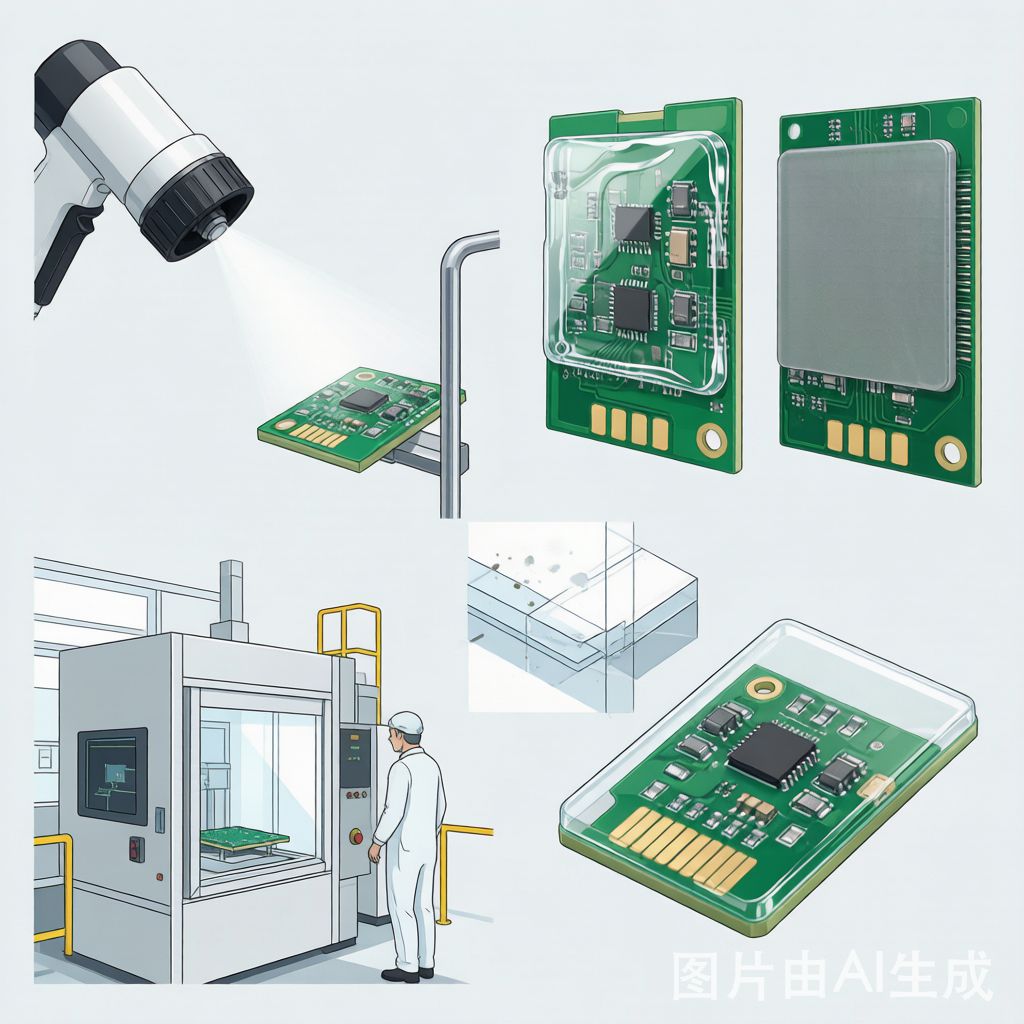
Conformal coating application methods include manual spray, automated selective coating, robotic dispensing, dipping, and brushing. For production volumes, automated selective coating with needle dispensers or spray valves is the dominant method, offering precise application with minimal masking.
Key IPC standards governing conformal coating:
- IPC-CC-830: Qualification and performance specification for conformal coatings
- IPC-HDBK-830: Guidelines for design, selection, and application of conformal coatings
- IPC-A-610: Acceptability criteria (coating coverage, thickness, defects)
- IPC-J-STD-001: Soldering requirements that address coating interaction with solder joints
Selecting the right conformal coating is a system-level decision that should account for the full product lifecycle — from manufacturing throughput and rework capability to field environmental exposure and end-of-life considerations. A well-chosen coating can extend product lifetime by decades; a poorly chosen one can accelerate failure.