Why EMI Shielding Testing Method Selection Matters
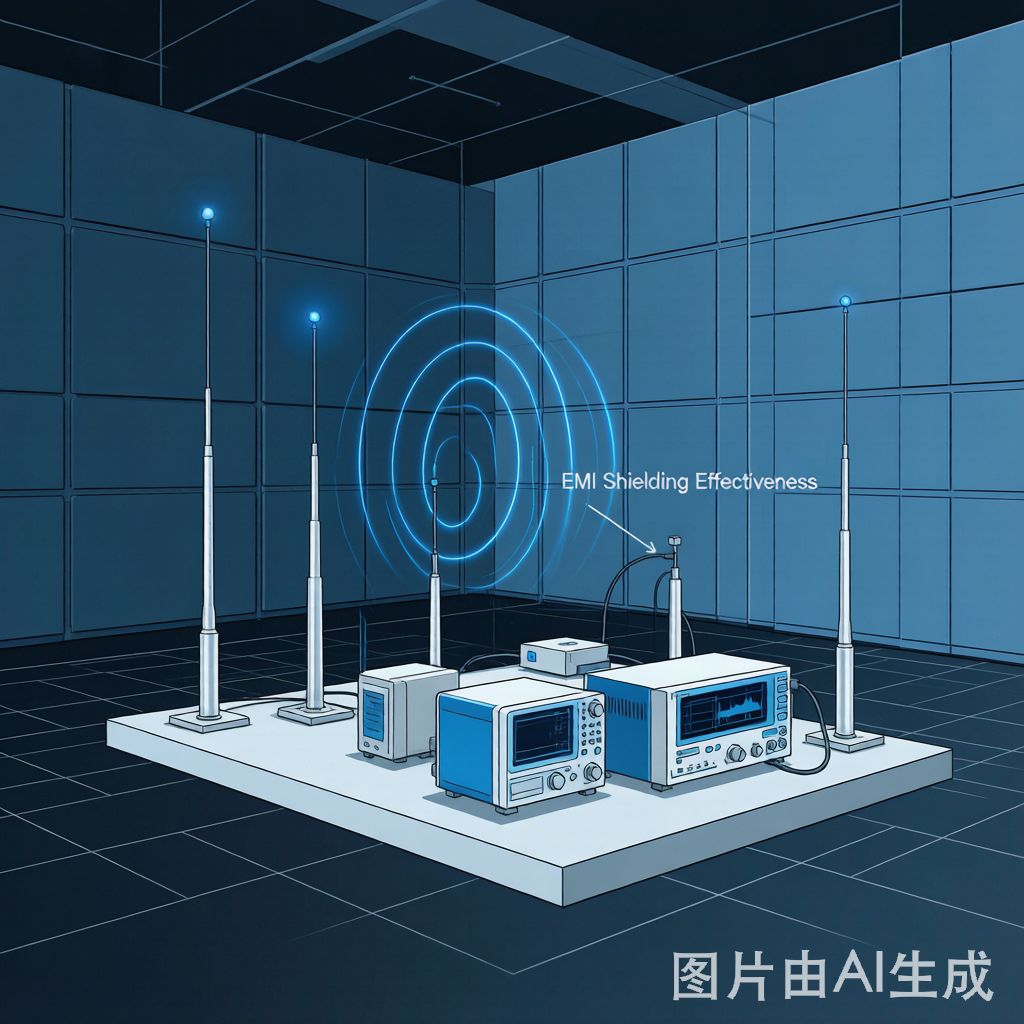
Verifying that an electronic enclosure meets its EMI shielding effectiveness (SE) specification requires testing — but the choice of test method profoundly affects the measurement result, cost, and practical applicability. Three primary methods dominate the industry: the shielded room method (per IEEE 299), the transverse electromagnetic (TEM) cell method, and the reverberation chamber method. Each illuminates the device under test (DUT) with a different electromagnetic field distribution, measures SE through a different physical principle, and operates over a different frequency range.
For electronics manufacturers seeking EMI compliance — whether for commercial products under FCC/CE rules, automotive under CISPR, or military under MIL-STD-461 — understanding these test methods is essential. The SE value reported on a data sheet is meaningless without knowing how it was measured. A gasket rated at 100 dB SE in a reverberation chamber may measure only 60-70 dB in a shielded room test at the same frequency, simply because the test geometry and field distribution differ.
This article provides a practical comparison of the three major SE test methods, covering their principles, advantages, limitations, and optimal application spaces.
Shielded Room Method (IEEE 299)
The shielded room method, formalized in IEEE Standard 299, is the most established approach for measuring enclosure shielding effectiveness:
Principle: A transmitting ante
a inside a shielded enclosure radiates electromagnetic energy, and a receiving ante
a outside the enclosure (or vice versa) measures the transmitted field. SE is calculated as the ratio of received field strength with and without the shield in place, expressed in decibels: SE (dB) = 20 log₁₀(E_unshielded / E_shielded).
Test Configuration: IEEE 299 specifies two configurations — a small shielded enclosure (typically 0.6m × 0.6m × 0.6m to 2m × 2m × 2m) with ante
a pairs at defined positions. The standard defines ante
a types (biconical for 30-300 MHz, log-periodic for 300 MHz-1 GHz, horn ante
as for 1-18 GHz), distances, and polarization orientations.
Frequency Range: 50 Hz to 18 GHz (with extensions to 40 GHz possible). The broad frequency coverage is one of the method’s key advantages.
Advantages: Well-standardized with detailed test procedures; directly measures enclosure-level SE (the quantity most relevant to product design); supports both magnetic field (low frequency) and plane-wave (high frequency) testing; results are widely accepted by regulatory bodies and customers.
Limitations: Requires a dedicated shielded room or enclosure, which is expensive to construct and maintain; room resonances and reflections cause measurement uncertainties, particularly at frequencies above 1 GHz; the test setup is time-consuming, requiring multiple ante
a positions and polarizations; measurement uncertainty is typically ±3-6 dB, which can be significant when SE values are near specification limits.
TEM Cell Method
The TEM cell method uses a transmission line structure that creates a uniform transverse electromagnetic field for SE measurement:
Principle: A TEM cell is essentially an expanded coaxial transmission line — a rectangular outer conductor with a centered i
er conductor (septum). When driven with RF power, it produces a uniform TEM field between the septum and outer wall. A sample of the shielding material (or a small test enclosure) is inserted into the cell aperture, and the transmission coefficient (S₂₁) is measured with and without the sample. SE = -20 log₁₀|S₂₁|.
Test Configuration: ASTM E1854 and ASTM D4935 define TEM cell test procedures for planar materials. The sample size is typically 60mm × 60mm to 150mm × 150mm, depending on the cell size. A vector network analyzer (VNA) measures the insertion loss through the cell with and without the sample.
Frequency Range: Typically 10 kHz to 1 GHz for standard TEM cells. Extended-range cells (asymmetric TEM or GTEM cells) can operate to 3-5 GHz, but field uniformity degrades at higher frequencies due to higher-order mode excitation.
Advantages: Relatively compact and inexpensive compared to shielded rooms; provides rapid, repeatable measurements of planar material samples; well-suited for material development and quality control where comparing samples is more important than absolute SE values; measurement uncertainty is lower than shielded room testing (typically ±1-2 dB).
Limitations: Tests only planar material samples, not complete enclosures; does not capture seam, gasket, or aperture effects that dominate real-world shielding performance; frequency range is limited compared to shielded room methods; the TEM field does not represent the complex multi-mode field environment inside a real electronic enclosure.
Reverberation Chamber Method
The reverberation chamber (also called a mode-stirred chamber) has become the preferred method for high-frequency SE testing:
Principle: A large shielded room with highly reflective walls and a mechanical stirrer (paddle wheel). The stirrer continuously rotates, creating a statistically uniform, isotropic field environment — meaning the field strength is approximately the same at every point in the chamber and in every polarization direction. This mechanical mode-stirring averages out the standing wave patterns that plague fixed-ante
a measurements.
Test Configuration: Per IEC 61000-4-21 and ASTM E1226. The transmitting ante
a feeds RF power into the chamber, and a receiving ante
a measures the field. The stirrer rotates continuously (or steps through discrete positions), and the received power is averaged over a full stirrer rotation. SE is calculated from the average received power with and without the shield.
Frequency Range: The lowest usable frequency (LUF) depends on chamber size — typically 80-200 MHz for a 4m × 3m × 2.5m chamber, decreasing to 30-50 MHz for larger chambers. Upper frequency limit extends to 40+ GHz, making reverberation chambers the method of choice for millimeter-wave SE testing.
Advantages: Provides a statistically uniform field that represents the complex multi-path environment inside real electronic enclosures; very efficient for high-frequency testing (single stirrer rotation replaces dozens of ante
a positions); can test complete enclosures, not just planar samples; measurement repeatability is excellent (±0.5-1 dB) due to statistical averaging.
Limitations: Requires a large, expensive chamber (minimum $200K-$500K for a medium-sized facility); not usable below the LUF (typically 80-200 MHz); the statistically uniform field does not represent directional field exposure scenarios; calibration is complex and must be repeated periodically.
Method Comparison Summary
Key selection criteria for the three methods:
Shielded Room (IEEE 299): Best for low-frequency SE testing (50 Hz – 1 GHz); required for military and aerospace compliance testing; measures complete enclosure performance; high facility cost; moderate measurement uncertainty (±3-6 dB).
TEM Cell: Best for planar material screening and quality control; compact and affordable; excellent measurement precision (±1-2 dB); limited to 1-5 GHz maximum; ca
ot test enclosures or capture seam effects.
Reverberation Chamber: Best for high-frequency SE testing (>200 MHz to 40+ GHz); statistically uniform field gives repeatable results; efficient testing of complete enclosures; high facility cost; not usable below LUF.
Practical Strategy: Many organizations use TEM cell testing for initial material screening during development, reverberation chamber testing for high-frequency qualification, and shielded room testing for low-frequency and regulatory compliance. This three-tier approach provides comprehensive SE characterization across the full frequency range while optimizing test cost and throughput.
Test Sample Preparation and Best Practices
Regardless of the test method, sample preparation significantly affects SE measurement accuracy:
Gasket Installation: If testing gasketed seams, the gasket must be installed at the same compression used in the production design. Under-compressed gaskets will show artificially low SE. Use the actual production fasteners and torque specifications.
Surface Preparation: The mating surfaces must be clean and free of oxide, oil, and debris. Even a thin oxide layer on aluminum (anodized surfaces) can reduce measured SE by 20-40 dB at the gasket interface. Clean surfaces with isopropyl alcohol immediately before testing.
Aperture Representation: Include all production apertures (display windows, co
ector openings, ventilation slots) in the test sample. Apertures typically dominate the overall SE at high frequencies and must be represented in the test configuration.
Multiple Sample Testing: Test at least 3 samples for statistical confidence. Variations in gasket installation, surface finish, and fastener torque cause significant sample-to-sample variation (±3-10 dB is common for gasketed enclosures).
Conclusion
EMI shielding effectiveness testing is not a one-method-fits-all proposition. The shielded room, TEM cell, and reverberation chamber methods each serve distinct and complementary roles in the SE characterization workflow. Understanding their principles, frequency ranges, and measurement uncertainties enables electronics manufacturers to select the right test for their application and to interpret SE data sheets critically.
For most commercial electronics manufacturers, a TEM cell for material development and a reverberation chamber for high-frequency enclosure qualification provides an effective and efficient test strategy. Adding shielded room testing for low-frequency and military compliance requirements completes the SE characterization toolkit.
The most important takeaway: always specify the test method, frequency, and field type when reporting or comparing SE values. A bare “100 dB SE” specification without test method context is marketing, not engineering data.