Electrostatic Discharge (ESD) is an invisible threat that costs the global electronics industry billions of dollars a
ually in latent failures and outright component damage. In SMT assembly environments, a single uncontrolled discharge of as little as 100V can destroy sensitive semiconductor junctions — and most ESD events go completely undetected without proper monitoring. This guide covers the essential ESD control practices mandated by ANSI/ESD S20.20 and IEC 61340-5-1 for modern SMT facilities.
Understanding ESD Sensitivity Classes
Components are classified by their ESD sensitivity threshold under the Human Body Model (HBM) and Charged Device Model (CDM):
| Class | HBM Voltage Range | Typical Components |
|---|---|---|
| Class 0 | < 250V | GaAs FETs, some RF devices |
| Class 1A | 250V – 500V | Advanced CMOS ICs, FPGAs |
| Class 1B | 500V – 1000V | CMOS logic, microcontrollers |
| Class 1C | 1000V – 2000V | Standard CMOS, op-amps |
| Class 2 | 2000V – 4000V | Bipolar transistors, some MOSFETs |
| Class 3A/3B | 4000V – 16000V | Most passive components |
Modern SMT lines handling Class 0 and Class 1A devices — including many BGA processors, RF modules, and fine-geometry ICs — require the strictest EPA (ESD Protected Area) controls.
EPA Setup: The Five Core Elements
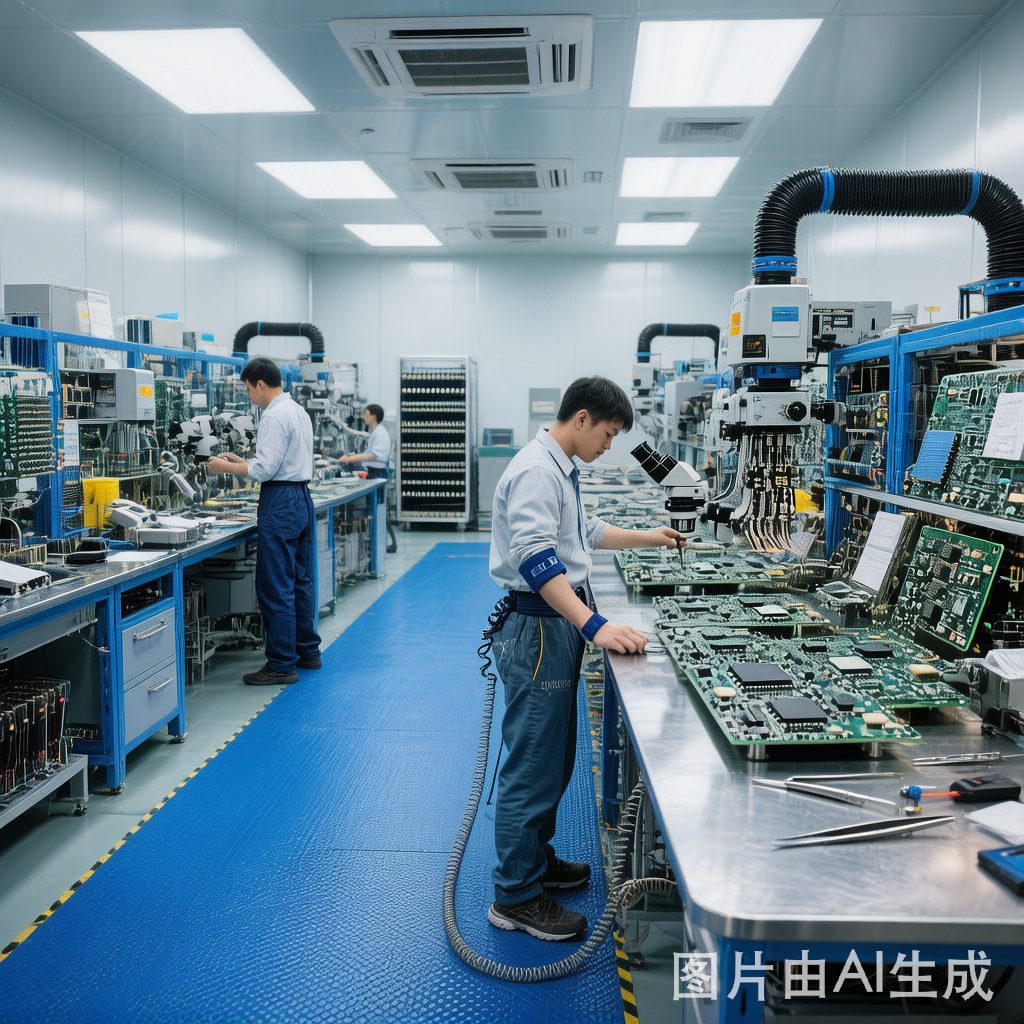
An ESD Protected Area must incorporate five fundamental elements:
- Common ground point (CGP): All ESD control equipment — worksurfaces, wrist straps, flooring, equipment — must co
ect to a single common ground point bonded to the facility electrical ground.
- ESD worksurface: Dissipative surface (resistance 1 MΩ – 1 GΩ) that bleeds charge to ground without a sudden discharge that could damage components.
- Wrist straps: Continuous monitors verify 800 kΩ – 10 MΩ resistance (includes skin resistance). Wrist straps must be tested daily or use continuous monitoring systems.
- ESD footwear/flooring system: Operators walking on ESD floor tiles wearing ESD footwear maintain body voltage below 100V.
- Ionizers: Air ionizers neutralize charge on insulators (PCBs, plastic housings) that ca
ot be grounded directly. Required near pick-and-place and inspection stations.
ESD Packaging and Material Handling
Components must remain in ESD-protective packaging until they are within the EPA:
- ESD shielding bags (metalized): Required for transporting ESDS devices outside the EPA. Provide both shielding and dissipation.
- ESD tote boxes and trays: Conductive or dissipative trays for in-process component storage within the EPA.
- Reels and tape: ESD-sensitive components on SMT feeders should use conductive or dissipative reel covers when removed from the machine.
SMT Machine and Process ESD Controls
ESD hazards exist throughout the SMT process flow:
- Screen printer: Ground the PCB fixture. Stainless steel stencils should be grounded to the machine frame.
- Pick-and-place: Verify machine chassis grounding. Pneumatic nozzles can generate triboelectric charge — use conductive nozzle materials for Class 0 devices.
- Reflow oven: Oven conveyors and support fixtures should be grounded. Use ionized air knives at oven exit to neutralize board charge buildup during cooling.
- AOI and ICT: Test fixture probes and board holders must be at the same ground potential as the board to avoid discharge during contact.
Copper Component Handling and ESD
SMT copper strips and copper-based thermal components are conductors — they can accumulate charge during handling and discharge into adjacent sensitive devices. Key handling rules:
- Store copper strips in conductive or dissipative trays, not loose in cardboard boxes.
- Handle copper components with ESD-safe tweezers at a grounded workstation before placement on the board.
- Gold-plated copper strips have lower contact resistance and can discharge more rapidly — extra care is warranted.
Implementing a comprehensive ESD control program per ANSI/ESD S20.20 is not a regulatory checkbox — it directly impacts production yield, field reliability, and warranty costs. For SMT contract manufacturers in Southeast Asia competing on quality, documented ESD compliance is increasingly a customer requirement in supplier audits.