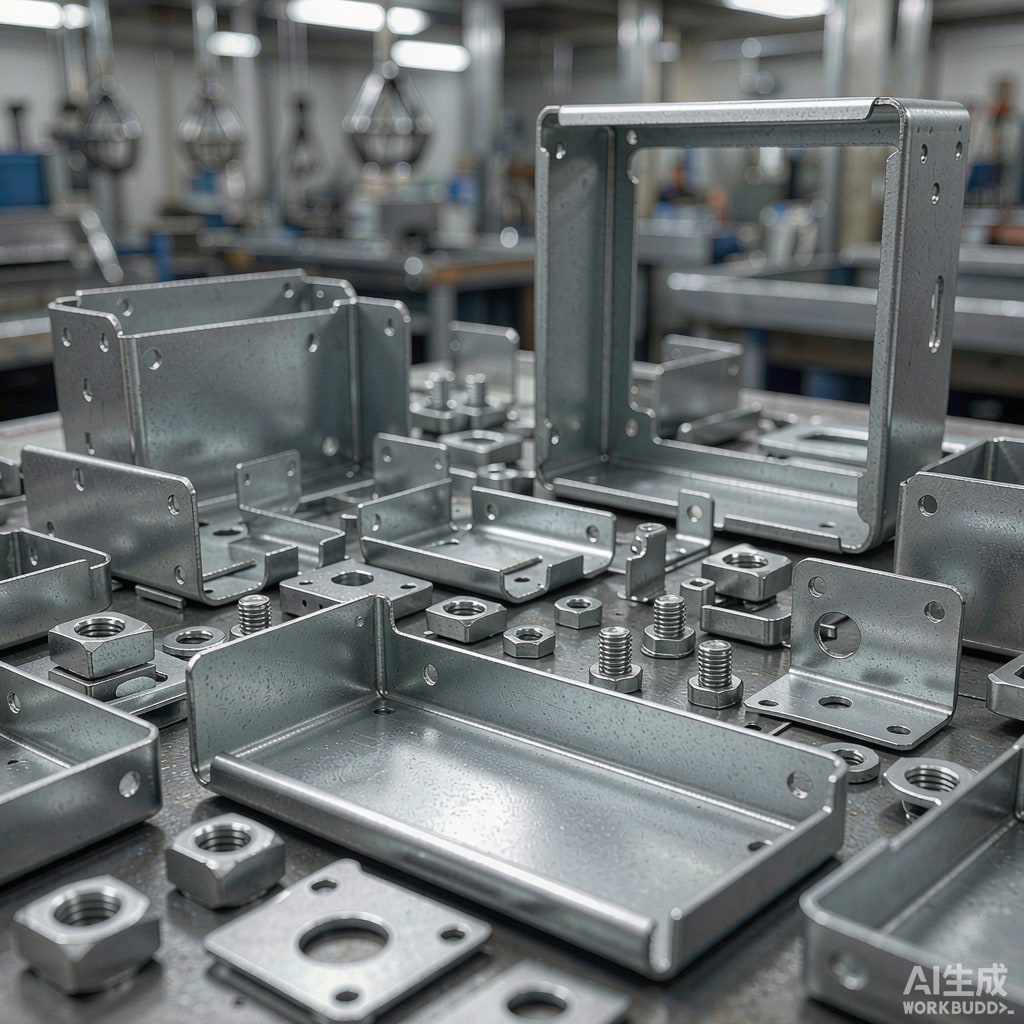
Inside almost every electronics cabinet there is a stamped steel chassis, bracket, or shield frame with a dull grey finish. That finish is zinc, and it is doing far more work than most bills of materials admit. It carries the corrosion budget, it determines whether the enclosure can be grounded reliably after five years in a humid plant, and it decides whether the part can pass a salt spray requirement written into a customer specification. Getting the plating callout right costs little at design stage and saves a great deal later.
Why Zinc, and Why Steel
Zinc protects steel in two ways: it forms a barrier layer that slows electrolyte access, and it acts as a sacrificial anode, corroding preferentially at scratches and cut edges where the steel is exposed. That second mechanism is the reason zinc-plated steel survives handling damage that would start red rust on a painted-only part.
Cold-rolled steel, typically SPCC or DC01, is the substrate for chassis work because it stamps and bends cleanly at 0.5 to 1.5 mm thickness. The zinc coating is then applied either by electroplating or by hot-dip galvanising, and the choice changes everything downstream.
Electroplated Zinc vs Hot-Dip Galvanised
Electroplated zinc
Electrogalvanising deposits 5 to 25 µm of zinc with excellent thickness uniformity and a cosmetic, smooth surface. It is the standard for enclosure panels, brackets, and internal frames because the coating does not interfere with tight tolerances, threaded fasteners, or spot welding. Typical callouts are 8 to 12 µm for indoor electronics and 12 to 15 µm for humid or mildly corrosive environments.
Hot-dip galvanising
Hot-dip coatings run 45 to 85 µm and offer far longer outdoor life, but they add a thick, uneven layer that changes dimensions, fills threads, and requires re-tapping. For electronics enclosures mounted outdoors, hot-dip is best reserved for structural posts and base frames, with the thin-wall panels staying electroplated or moving to powder-coated aluminium.
Passivation: The Layer That Decides Salt Spray Life
Fresh zinc oxidises into white corrosion products quickly in humid air. Passivation converts the surface into a thin chromate or chromium-free complex that suppresses white rust. The older hexavalent chromium passivation is being phased out under RoHS and REACH, and suppliers now offer trivalent chromium, trivalent blue, thick-film trivalent, and fully chromium-free alternatives.
- Clear or blue trivalent: decorative, low cost, roughly 24 to 48 hours of neutral salt spray on 8 µm zinc.
- Thick-film trivalent: iridescent, 96 to 168 hours, often the practical minimum for coastal Southeast Asian sites.
- Chromium-free passivation: compliant everywhere, but generally lower salt spray performance; specify with a test requirement rather than a chemistry name.
- Zinc-nickel alloy plating: 12 to 15 percent nickel in the deposit, 500 to 1,000 hours salt spray, used where an enclosure also lives near salt fog or road splash.
Setting a Salt Spray Specification That Is Actually Testable
Neutral salt spray, ASTM B117 or ISO 9227
These tests are not life predictors, they are consistency screens. Specify hours to first white rust and hours to first red rust separately, because a part can have excellent white rust resistance and poor red rust resistance. A realistic callout for an indoor electronics chassis in a humid climate is 96 hours to white rust and 240 hours to red rust at 10 µm thick-film trivalent.
Where the test coupons come from
A supplier can plate a coupon beautifully and still run the production rack at the wrong current density. Require coupons plated on the same rack as production parts, or better, test the parts themselves. Ask for the rack position of the coupon; edge positions plate thicker and mask process problems.
Corrosion Pairs and EMI Grounding
Zinc-plated steel is not an ideal EMI contact surface by itself. Its conductivity is modest and it forms oxide layers that raise contact resistance over time. Where a chassis must provide a low-impedance ground reference, consider:
- Zinc plus chromate plus conductive gasket: workable, but the chromate layer is resistive; masked or locally stripped contact points are preferable.
- Tin-plated steel: lower and more stable contact resistance, less sacrificial protection, best for internal grounded frames.
- Nickel-plated steel: hard, solderable, and stable, common for shield frames and screw bosses.
Also watch the galvanic pair. Zinc against copper or brass in the presence of moisture accelerates zinc consumption; aluminium against zinc-plated steel is comparatively mild. In real cabinets, the failure usually happens at a stainless fastener in a zinc-plated boss, where the small anode area to large cathode area ratio concentrates attack.
Plating and Stamping Order
Parts are normally stamped and formed first, then plated. That means cut edges receive coverage, which is desirable, but it also means sharp burrs get over-plated and can flake. Deburring before plating is not optional on parts with tight bend radii. If hydrogen embrittlement is a concern for high-strength fasteners, specify baking within four hours of plating and document it.
Incoming Inspection That Costs Little
- Coating thickness: X-ray fluorescence at five points per part on three parts per lot; compare against the callout, not against a nominal.
- Adhesion: bend a sample 180 degrees over a mandrel; flaking or peeling signals poor pre-treatment.
- Appearance: uniform matte to slightly iridescent grey; blotchy dark patches indicate burning, bright white patches indicate incomplete passivation.
- Salt spray: monthly lot sample rather than every lot, unless the end use is coastal or outdoor.
When Zinc-Plated Steel Is the Wrong Answer
For enclosures exposed to chlorides for years, hot-dip or zinc-nickel may still fail before the warranty ends; move to powder-coated aluminium, 304 stainless, or a sealed plastic enclosure with internal metallisation. For enclosures that require high-frequency shielding effectiveness, plating thickness and surface roughness of the stamping matter more than the zinc layer, and copper-nickel plating on the shield surface is usually a better investment than a thicker zinc coat.
Zinc plating is old technology, but it is still the most cost-effective corrosion barrier available to an electronics chassis. The difference between a good and a bad result is almost never the zinc itself; it is the passivation chemistry, the specified test, and whether anyone actually checked the rack.



