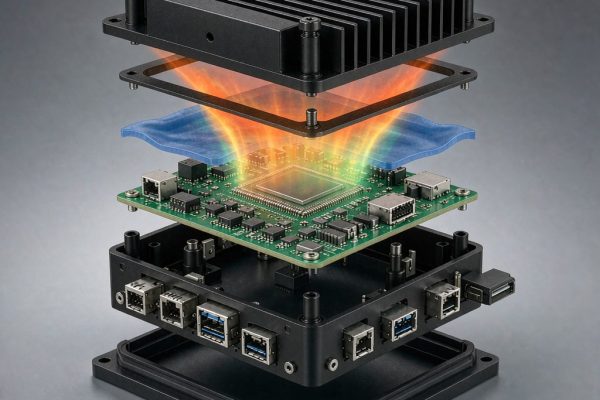
A handheld diagnostic device comes back from a hospital with a crazed housing, cracked at the battery door screw boss, after eight months of daily wiping with 70 percent isopropyl alcohol and quaternary ammonium disinfectant. The material was PC/ABS, chosen for impact strength and surface finish. The failure was not a design error in the wall thickness; it was a chemistry mismatch that no datasheet on the original specification sheet would have predicted.
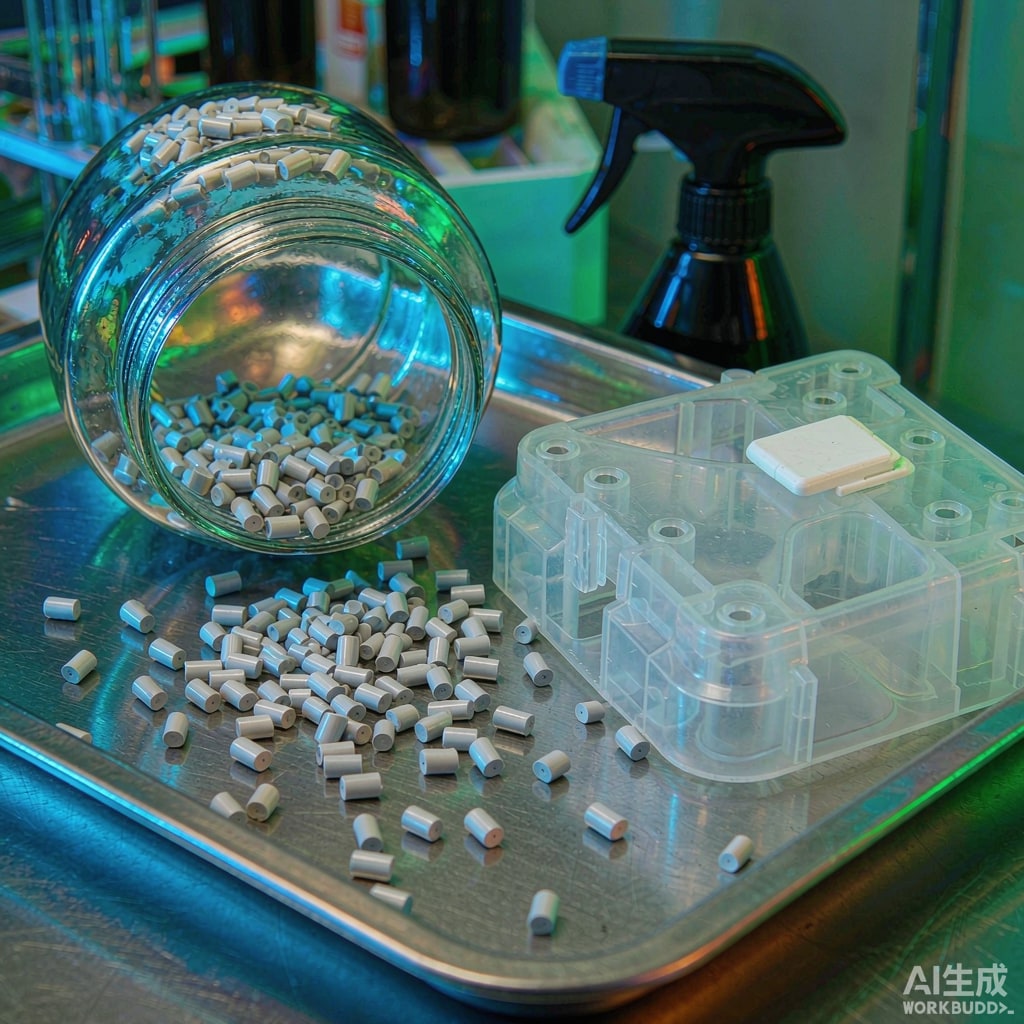
PC/PBT alloy pellets exist for exactly this problem. They keep most of polycarbonate’s toughness and heat resistance while borrowing polybutylene terephthalate’s resistance to oils, alcohols and cleaning agents.
Why an Alloy Rather Than a Single Polymer
Polycarbonate alone offers notched Izod impact of 600 to 900 J/m and a heat deflection temperature near 130 degrees C, but it dissolves in methylene chloride, stress cracks in gasoline and degrades in long contact with many esters. PBT alone resists solvents and chemicals well, crystallises fast for short cycle times, but is brittle at low temperature and has a lower HDT.
What happens at the interface
Blending the two creates an opportunity and a problem. PC and PBT can undergo ester interchange at the interface during melt processing, forming block copolymers that act as a compatibiliser. A small amount of interchange improves toughness and phase adhesion; too much produces random copolymer with degraded properties and unpredictable crystallisation. Commercial grades control this by chemistry: chain stoppers, catalyst deactivation, and tight residence time limits.
That is the reason PC/PBT is not a commodity blend you can make in-house from virgin PC and PBT. Buy a formulated grade from a supplier who will provide the impact and chemical data, and treat any change of source as a full re-qualification.
Impact modification
Most commercial grades add 5 to 15 percent of a core-shell acrylic or MBS impact modifier. This lifts notched Izod from 100 to 150 J/m for unmodified blends to 500 to 800 J/m, and pushes ductile-brittle transition temperature down toward minus 20 to minus 30 degrees C. The modifier sits preferentially in the PC phase, so the dispersion quality depends on screw design and mixing energy, not on the pellet alone.
Property Envelope to Design Against
- Density: 1.20 to 1.25 g/cm cubed
- Tensile modulus: 1900 to 2400 MPa
- Notched Izod at 23 degrees C: 500 to 800 J/m; at minus 20 degrees C: 150 to 300 J/m
- HDT at 0.45 MPa: 100 to 115 degrees C; at 1.82 MPa: 85 to 100 degrees C
- Vicat softening: 115 to 130 degrees C
- Mold shrinkage: 0.6 to 0.9 percent, with slight anisotropy
- Water absorption at saturation: 0.3 to 0.5 percent, well below PC at 0.35 and far below nylon
- UL94: HB in base grades, V-0 achievable at 1.5 to 3.0 mm with phosphorus or sulfonate FR systems
- CTI: 300 to 600 V depending on grade and flame retardant package
Compare with PC/ABS: PC/PBT gives up roughly 10 to 15 percent of impact strength and 10 degrees C of HDT, and gains a step change in chemical resistance. If the housing never sees solvents, PC/ABS remains the better buy. If it sees alcohol, sunscreen, hand sanitiser, machine oil or fuel, the alloy wins.
Environmental Stress Cracking: the Failure Mode to Design Around
ESC is brittle fracture at stress levels far below yield, triggered by a chemical that would be harmless on an unstressed part. It is the number one field failure of electronics housings and it is almost always preventable.
The three ingredients
Stress, chemical and time. Remove any one and the part survives. Stress comes from three sources: molded-in stress from packing pressure and uneven cooling, assembly stress from screws and press fits, and service stress from drops and clamping.
Design rules that actually help
- Keep screw boss wall thickness at 60 to 70 percent of the adjacent nominal wall to avoid sink and high frozen-in stress.
- Radius every internal corner at 0.5 mm minimum, 1.0 mm preferred. Sharp corners concentrate stress by a factor of 2 to 3.
- Avoid press fits tighter than 0.15 percent interference; use a snap or a screw instead.
- Place gates away from high-stress regions and avoid gating directly into a boss.
- A
eal parts at 5 to 10 degrees C below HDT for 2 to 4 hours when the design ca
ot avoid high molded-in stress, particularly for thin walls and long flow paths.
Test it, do not assume it
The standard approach is ISO 22088, bending or tensile specimens under constant strain, immersed in the actual cleaning agent for 24 to 1000 hours, with time to craze recorded. Test the real disinfectant at its real concentration, not a generic alcohol. Quaternary ammonium compounds with surfactants are more aggressive than plain IPA, and surfactant solutions wet and penetrate far better than pure solvents.
Processing Window
Drying is non-negotiable
PBT hydrolyses. Moisture above 0.04 percent produces molecular weight breakdown, visible as splay, silver streaks and a 30 to 50 percent loss of impact strength. Dry at 120 degrees C for 3 to 4 hours in a desiccant dryer, or 110 degrees C for 4 to 6 hours, and verify with a moisture analyser before each shift. A hopper dryer on a machine that sits idle over a weekend is not a drying strategy.
Melt and mold temperature
Melt 240 to 265 degrees C. Below 235 degrees C the PC phase does not fully soften and the blend shows unmelted domains and weak weld lines; above 275 degrees C ester interchange accelerates and impact strength drops sharply. Keep residence time under 6 minutes and purge the barrel after any stoppage longer than 10 minutes.
Mold temperature 60 to 90 degrees C, with 75 to 85 degrees C preferred for good surface and low stress. Below 50 degrees C the surface skins too fast, producing flow marks and high molded-in stress. Above 95 degrees C cycle time grows without further benefit.
Weld lines
PC/PBT weld lines are 40 to 60 percent weaker than the bulk material, worse than PC/ABS. Do not place a weld line in a drop-impact zone or across a screw boss. If the geometry forces it, add a overflow tab at the weld line that is trimmed afterwards, or relocate the gate.
Where PC/PBT Belongs
Good applications: medical device housings and handles, diagnostic instrument enclosures, battery packs for power tools, automotive interior electronic modules, industrial sensor bodies, pump and valve covers on equipment that sees oil. All of these share the pattern of repeated chemical contact plus mechanical load.
Poor applications: outdoor enclosures exposed to UV without a stabilised grade, parts needing glass clarity, optical light guides, and anything requiring continuous service above 110 degrees C.
Purchasing Checklist
Ask for the full property sheet including notched Izod at minus 20 degrees C, HDT at both loads, and the specific chemical resistance data against your actual cleaning agents. Confirm the UL yellow card file number and the flame rating at your production wall thickness, not at 3.0 mm. Ask whether the grade is UV stabilised and whether it is available in a laser-weldable or flame-retardant variant. Then request a 25 kg sample and mold your real part, because pellet datasheets describe specimens, not geometry.