Why Solid Roofs Fail at Resort Pools
Tropical resort pool decks experience monsoon gusts from multiple directions with peak speeds of 25 to 35 metres per second. A conventional solid-roof shade pavilion acts like an airfoil during these gusts, generating lift and drag forces that overwhelm the foundation and break anchorage points. After Typhoon Rai in 2021 and Tropical Storm Megi in 2022, multiple resorts across Southeast Asia reported damaged shade structures, with most failures traced to under-designed drag loads on apparently sturdy roofs.
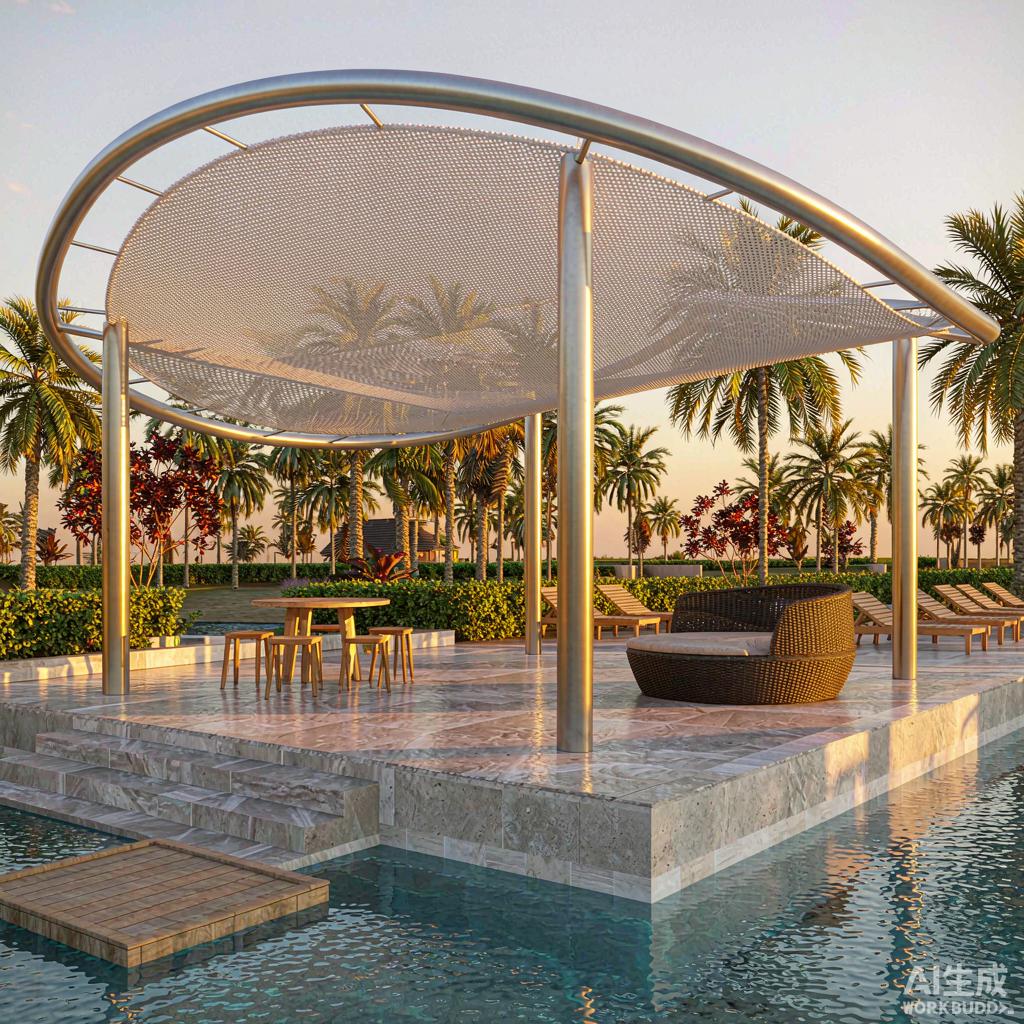
At TechMart SE our outdoor lounge product line includes a wind-permeable shade pavilion range that has been deployed across 18 resorts in Malaysia, Thailand, Vietnam, and Indonesia. The key engineering decision is porosity at the roof level, not just strength at the column level.
Porosity Is the Aerodynamic Lever
A 4 by 4 metre solid aluminium roof at 18 metres per second wind generates 1.8 to 2.4 kN of horizontal drag, equivalent to a 250 kg point load on the foundation. The same roof with 30 to 40 percent open area through woven PTFE fabric or perforated aluminium panels reduces drag to 0.6 to 0.9 kN, a 60 to 70 percent reduction that often determines whether a 200 kg ballast block is sufficient or a 600 kg block is required.
Porosity also reduces uplift. A solid canopy at 18 m/s develops 1.2 to 1.6 kN of upward lift if wind gets under the eave. A 30 percent porous roof breaks up the lift-generating vortex shedding and drops peak uplift to 0.3 to 0.5 kN.
Material Options for Porous Roofs
PTFE-Coated Fiberglass Membrane
PTFE fiberglass membranes in the Tension product line are the high-end option. They carry 25-year design life in tropical sun, block 92 to 97 percent of UV, and have 12 to 18 percent porosity from the weave. Cost is 220 to 320 USD per square metre installed, but the long lifecycle brings a
ualized cost into line with cheaper materials. The architecture is curved hyperbolic-paraboloid, which provides self-cleaning rain shedding.
HDPE Knit Shade Cloth
HDPE knitted fabric with 25 to 40 percent engineered porosity is the workhorse of resort projects. A 90 to 95 percent UV block is standard, with 8 to 12 year colour-fastness warranty. Cost is 25 to 45 USD per square metre installed. The fabric is supplied in rolls up to 4 metres wide and tensioned between cables or frames. Drawback: relatively low wind tolerance and shade cloth-specific cable wear patterns.
Bamboo Lath and Timber Slat
For eco-resort branding, bamboo lath or FSC-certified hardwood slats at 30 to 50 mm spacing deliver 35 to 50 percent porosity with strong regional character. Cost is moderate at 60 to 110 USD per square metre, but maintenance includes a
ual re-oiling and inspection of fastener corrosion. Treat as a 7 to 10 year material with pla
ed refurbishment.
Aluminum Louver System
Extruded aluminum louvers at 30 to 50 mm blade spacing give a modern look with 35 to 55 percent porosity. Electrostatic powder coat over a chromate base provides salt-spray resistance to ASTM B117 1000 hours, suitable for marine-front installations. Cost is 140 to 220 USD per square metre installed, higher than HDPE but with 20-year-plus durability and cleanable surfaces.
Validating With CFD Before Manufacture
Computational fluid dynamics study pays for itself on any shade pavilion project above 50 square metres. We use OpenFOAM with k-omega SST turbulence and a porosity treatment via the Darcy-Forchheimer source term on the roof volume. Simulation outputs include wind pressure coefficient Cp along the roof, peak drag on each column, and lateral moment on the foundation. A typical model at 100 k cell count runs in 3 to 6 hours on a desktop workstation and predicts peak drag within 8 to 12 percent of full-scale measurements.
Anchorage and Foundation Sizing
The CFD-derived drag and uplift numbers feed a conventional foundation design. For temporary or semi-permanent pavilions, surface-mounted ballast blocks of 250 to 600 kg steel-reinforced concrete with rubber damping pads avoid the cost of digging into pool decks. For permanent installations, four 200 to 300 mm diameter auger-cast piles to 2.4 to 3.0 metres depth provide overturning resistance to 1.5 design wind speed safety factor.