Facilities that decide to give smokers a proper space quickly meet a fork in the road: a fully enclosed, filtered walk-in smoking booth, or an open-sided smoking shelter that provides cover but no extraction. Both solve the litter, loitering, and door-lobby problems. They differ sharply in air quality, budget, and regulatory fit, and the right choice should follow from your site rather than from a brochure.
Two Different Products
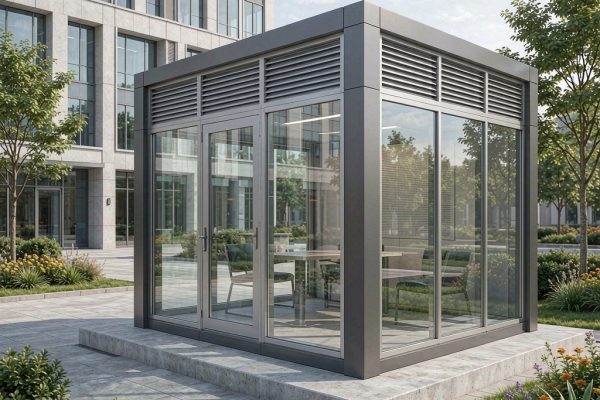
A walk-in smoking booth is a cabin: floor, walls, door, lighting, and an air-handling system that extracts smoke through HEPA and activated-carbon filtration, or vents it through ductwork. Users step inside, and the system keeps the air clean enough that non-smokers walking past smell nothing. Capacities range from two to twenty occupants, and self-contained recirculating models need no duct at all.
An open smoking shelter is architecture: a canopy roof, windbreak walls on two or three sides, benches, and an ashtray station. It defines where smoking happens and keeps it dry and tidy, but it treats smoke as an outdoor dilution problem rather than an engineering problem.
Air Quality and Smoke Control
The booth’s advantage is capture at the source. A well-sized extraction system replaces the booth’s air ten to fifteen times per hour and holds a slight negative pressure, so smoke ca
ot drift out of the door. HEPA filtration handles particulates while activated carbon strips the odor molecules that HEPA alone lets pass. The result is measurable: particulate levels inside a compliant booth can run below those of the surrounding street air.
An open shelter depends on the weather. On a breezy day smoke disperses quickly; on a still, humid afternoon the same shelter becomes a low cloud, and smoke drifts toward entrances or neighboring windows. There is no filter to clog, but there is also no control. You are betting the site’s comfort on wind direction, every day of the year.
Compliance and Placement
Where indoor smoking is ba
ed outright, a walk-in booth becomes a designated smoking room only if local regulations allow enclosed smoking spaces with independent ventilation, and some jurisdictions simply do not. Check three things before specifying a booth: whether an enclosed smoking space is legal at all, what ventilation or pressure differential the code requires, and what signage and distance rules apply.
Open shelters face simpler rules. Most codes treat them as outdoor structures provided they keep the required distance from doors, operable windows, and air intakes, commonly three to nine meters depending on jurisdiction. Roofs and partial walls are usually tolerated, but a shelter enclosed on all four sides can cross the legal line into indoor space and retroactively require smoking-room rules.
Cost and Installation
- Open shelter: the lowest-cost option by far. A steel or aluminum structure with canopy, benches, and anchoring to a slab is a construction job, not a mechanical one, and the operating cost is essentially cleaning.
- Walk-in booth: three to ten times the shelter budget once extraction fans, filter banks, ducting or recirculation, electrical supply, door hardware, and lighting are included. It needs a power feed, and if it ducts outdoors, a route for the duct. Recirculating filtered booths avoid ductwork entirely, which is why they dominate retrofit projects inside existing buildings.
Maintenance Profiles
A shelter wants pressure washing, ashtray emptying, and periodic paint or corrosion touch-ups, which is light work for existing site staff. A booth adds a filter regime: pre-filters monthly, HEPA and carbon banks on a three-to-twelve-month cycle depending on usage, plus fan checks and pressure-gauge readings. Budget the consumables honestly. A booth with neglected filters quickly performs worse than the shelter it replaced, and posting the negative-pressure reading at the door makes neglect visible to every user.
Site Fit Checklist
- Choose an open shelter when: smoking is legal outdoors on your site, the climate is mild for most of the year, budget is limited, no electrical supply is available, and the location can keep legal distance from doors and intakes.
- Choose a walk-in booth when: the site is a high-rise or enclosed campus where people ca
ot easily reach an outdoor area, odor and image control matter as in hospitals, hotels, and premium offices, the climate is harsh or rainy, or local rules push smoking into controlled spaces.
A Middle Path
Many facilities install both tiers: a simple shelter for quick breaks near the factory floor, and one filtered booth at the main building entrance serving visitors and premium tenants. The shelter absorbs peak loads cheaply, while the booth guarantees that at least one location always smells clean. Whichever configuration you choose, measure the result: a smoke-pencil test at the door, a particle counter during peak hours, and a monthly complaint log will tell you within weeks whether the investment is doing its job.