Active ante
a units (AAUs) for 5G base stations pack dozens of RF power amplifiers, phase shifters, and beamforming ASICs behind a dense ante
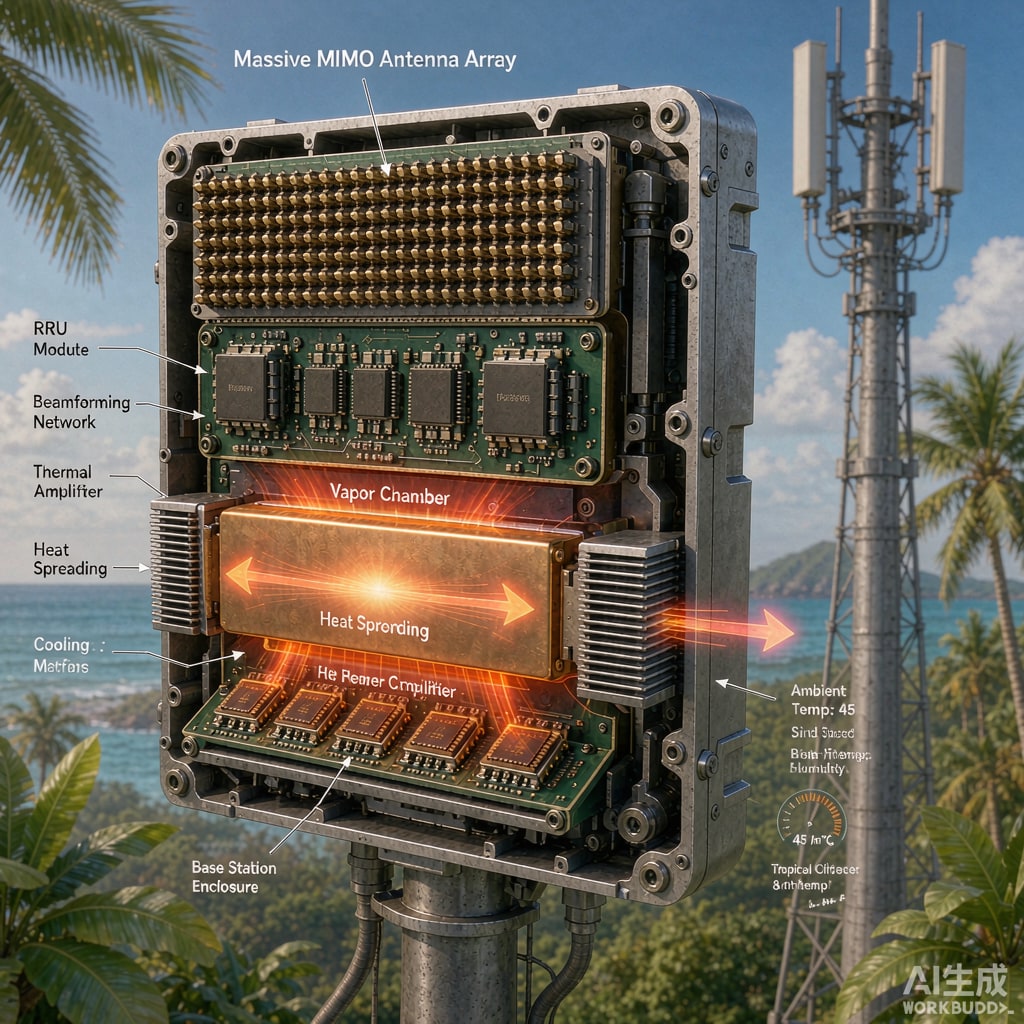
a array. With output power per module reaching 100 W or more and enclosures exposed to direct sunlight in tropical climates, vapor chamber thermal management has become a practical way to spread heat quickly and keep junction temperatures within safe limits.
Why AAUs Need Vapor Chambers
Conventional aluminum or copper heat sinks conduct heat in the solid metal, which limits how fast heat can spread laterally from a small die to a large fin array. A vapor chamber uses phase change: liquid evaporates at hot spots, steam travels to cooler regions, condenses, and returns through a wick structure. The effective thermal conductivity can exceed 5,000 W/(m·K) in the plane, flattening hot spots and allowing a larger fin area to participate in cooling.
In an AAU, dozens of power amplifiers are distributed across the board. A vapor chamber bonded to the RF PCB spreads heat evenly before it reaches the external fins, reducing peak junction temperature by 10–25°C compared with an aluminum baseplate of the same size.
Vapor Chamber Design Considerations
Size and Thickness
AAU vapor chambers are often rectangular plates 150–400 mm long, 80–200 mm wide, and 3–6 mm thick. Thi
er chambers are preferred for weight-sensitive rooftop sites, but they reduce wick volume and capillary limits. Thickness below 3 mm generally requires advanced sintered-powder or mesh wicks rather than simple groove designs.
Thermal Interface to the PCB
The vapor chamber top surface mates with the RF PCB through a thermal interface material. Because the chamber surface is usually flat within 0.05 mm, a thin phase-change pad or graphite sheet can achieve low thermal resistance. Avoid thick gap fillers that add u
ecessary impedance.
Mounting and Mechanical Load
AAUs must survive wind, vibration, and installation handling. Vapor chambers are sealed under vacuum and ca
ot tolerate dents or punctures. Mounting screws should use shoulder washers and controlled torque to avoid crushing the chamber edges. Finite-element analysis is recommended to verify bending under clamp load.
Outdoor Reliability
Tropical 5G sites see ambient temperatures above 40°C and solar loads that can raise enclosure surface temperatures past 70°C. Vapor chambers do not replace external convection; they only improve spreading. Fin design, fan-assisted or passive cooling, and conformal coating of the PCB must still be optimized. Corrosion protection of the copper chamber exterior is also critical in coastal or polluted environments.
Maintenance and Diagnostics
A failed vapor chamber loses its phase-change capability and behaves like a poor solid conductor. Network operators monitor AAU temperature telemetry; a sudden jump in baseplate temperature spread can indicate degradation. When replacing AAUs, technicians should inspect chamber surfaces for dents and verify TIM replacement during reassembly.