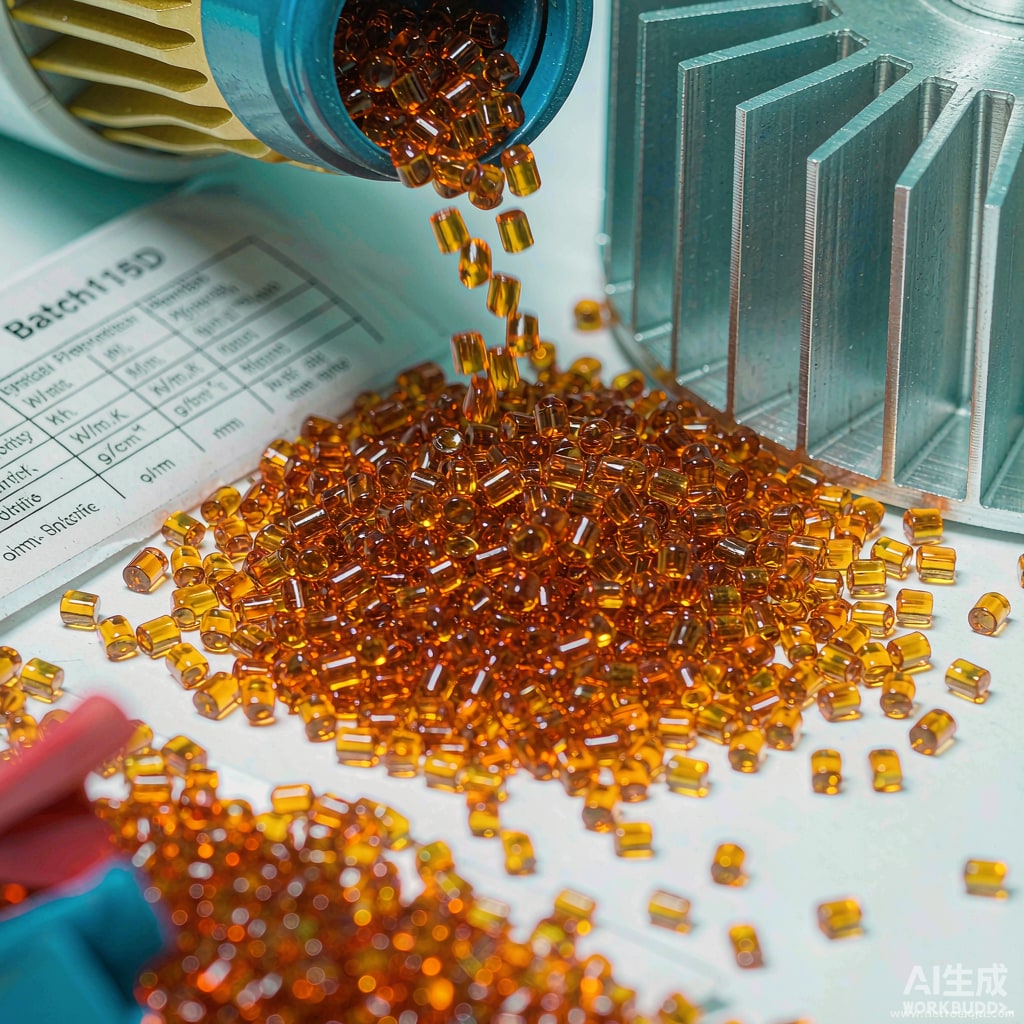
Plastic That Carries Heat
Standard engineering plastics insulate: PA66 runs 0.2–0.3 W/m·K, PC similar, against roughly 150–200 W/m·K for aluminum. Yet a growing share of electronics housings, LED driver enclosures, power supply cases, and heat-dissipating co
ectors are molded from thermally conductive plastic pellets — polymers filled with mineral or graphitic fillers that raise through-plane conductivity into the 1–10 W/m·K range. The value proposition is not beating aluminum; it is replacing aluminum where plastics win on other terms: molded-in features and color, no secondary machining, galvanic insulation (no anodizing, no dissimilar-metal corrosion), lighter weight, and natural electrical insulation that eliminates a class of EMC and safety work.
Filler Technologies Inside the Pellet
Three filler families dominate. Alumina (Al₂O₃) and other oxides are the economy choice: electrically insulating, chemically inert, cheap, typically delivering 1–2 W/m·K at 50–65% loading. Parts remain true electrical insulators — required for Class II power supply housings. Boron nitride (BN) platelets are the premium insulating filler: at 20–40% loading, aligned-platelet grades reach 3–6 W/m·K with lower density and better flow than high alumina loadings, at several times the cost. Graphite and carbon fillers break the 10 W/m·K barrier — expanded-graphite grades exceed 20 W/m·K in-plane — but they make the compound electrically conductive or semi-conductive, which changes the part from an insulator into a component that needs deliberate isolation design. Choosing between them starts with one question: must the housing remain a dielectric? If yes, alumina or BN; if conductivity is acceptable or even useful (ESD control, shielding), graphite grades unlock an order of magnitude more heat transfer.
The Trade-Offs You Accept
High filler loading is not free. Mechanical properties generally fall as filler rises: impact strength drops steeply (a 60%-filled alumina PA is brittle next to neat PA66), so clips and snap features need careful design. Melt viscosity climbs — expect higher injection pressures, slower fill, and sensitivity to thin walls below about 1 mm. Abrasive mineral fillers eat screws and barrels: use bimetallic barrels and wear-resistant screw coatings, and budget for faster tool steel wear on gates and ru
er corners. Anisotropy is the subtle one: platelet fillers (BN, talc, graphite) orient along flow, so thermal conductivity ends up 2–5× higher in-plane than through-plane — and through-plane is usually the direction your heat actually needs to travel across a 2 mm wall. Gate location therefore shapes thermal performance, not just warpage.
Reading the Datasheet Correctly
Two test methods produce the numbers you will see, and they are not interchangeable. ASTM E1461 (laser flash) measures small disc samples and, on filled polymers, tends to report optimistic values — quoted figures of 4–8 W/m·K often derive from it. ASTM D5470 measures an actual molded bar through-plane and yields the lower, more honest number. Insist on knowing the method and the direction (in-plane or through-plane); a housing design built on in-plane laser-flash data can underperform by half. Alongside thermal conductivity, require: UL94 rating at your actual wall thickness, CTI (filled compounds often hold 400–600 V, supporting reduced creepage), continuous use temperature, and — for LED and outdoor products — weatherability data, since some filled compounds color-shift faster than neat resin.
Molding and Design Practice
Dry hygroscopic bases (PA, PPS, PBT) to the base resin’s standard — fillers do not absorb the moisture, but they leave the melt less forgiving of it. Mold hot: filled compounds benefit from tool temperatures 20–40°C above the neat-resin norm to improve surface finish over mineral-rich flow fronts, which otherwise show dull streaks. Design walls at 1.5–3 mm, use generous radii (filled compounds are notch-sensitive), place gates so flow orientation aligns platelets with the dominant heat path where possible, and specify venting generously — high-viscosity fills trap air aggressively. Add-in options matter commercially: most compounds can carry halogen-free FR packages, and conductive graphite grades can double as EMI shields, killing two enclosure functions with one pellet.
Where Thermoplastics Beat Metal — and Where They Do Not
Thermally conductive plastic wins for LED driver and luminaire housings in corrosive or coastal environments, galvanically isolated power supply cases, automotive sensor bodies needing molded-in color and mounting features, and any part where weight or secondary machining costs dominate. It loses where heat flux is concentrated — a 30 W module with a 1 cm² hot spot will always want aluminum or a vapor chamber — and where the housing must also spread heat laterally over large areas, because through-plane conductivity caps what a 2 mm plastic wall can move. A useful hybrid exists: mold the housing in thermally conductive plastic, and press or overmold a thin aluminum plate exactly over the hot spot. You get metal where the heat is and plastic everywhere else — often the cheapest path to a sealed, single-material-feel enclosure that actually stays cool.



