As power densities in modern electronics climb, PCB heat dissipation has moved from a reliability afterthought to a first-order design constraint. A microcontroller ru
ing at full load, a motor driver switching at high current, or an LED driver pushing hundreds of milliamps all generate heat that must leave the board. Thermal interface materials (TIMs) are the hidden bridge between hot components and heat sinks, spreading heat efficiently while compensating for surface imperfections.
Why TIMs Are Necessary
No matter how flat a component package or heat sink appears under a microscope, microscopic valleys and peaks trap air at the contact interface. Air is a poor thermal conductor, typically below 0.03 W/m·K. A TIM displaces that air with a material that conducts heat far better, sometimes improving effective thermal transfer by an order of magnitude.
Without a TIM, even a perfectly bolted heat sink can leave hot spots that exceed the junction temperature rating of semiconductors. Over time, thermal cycling expands and contracts these gaps, making material selection even more important for long-term reliability.
Common Types of Thermal Interface Materials
Thermal Grease and Paste
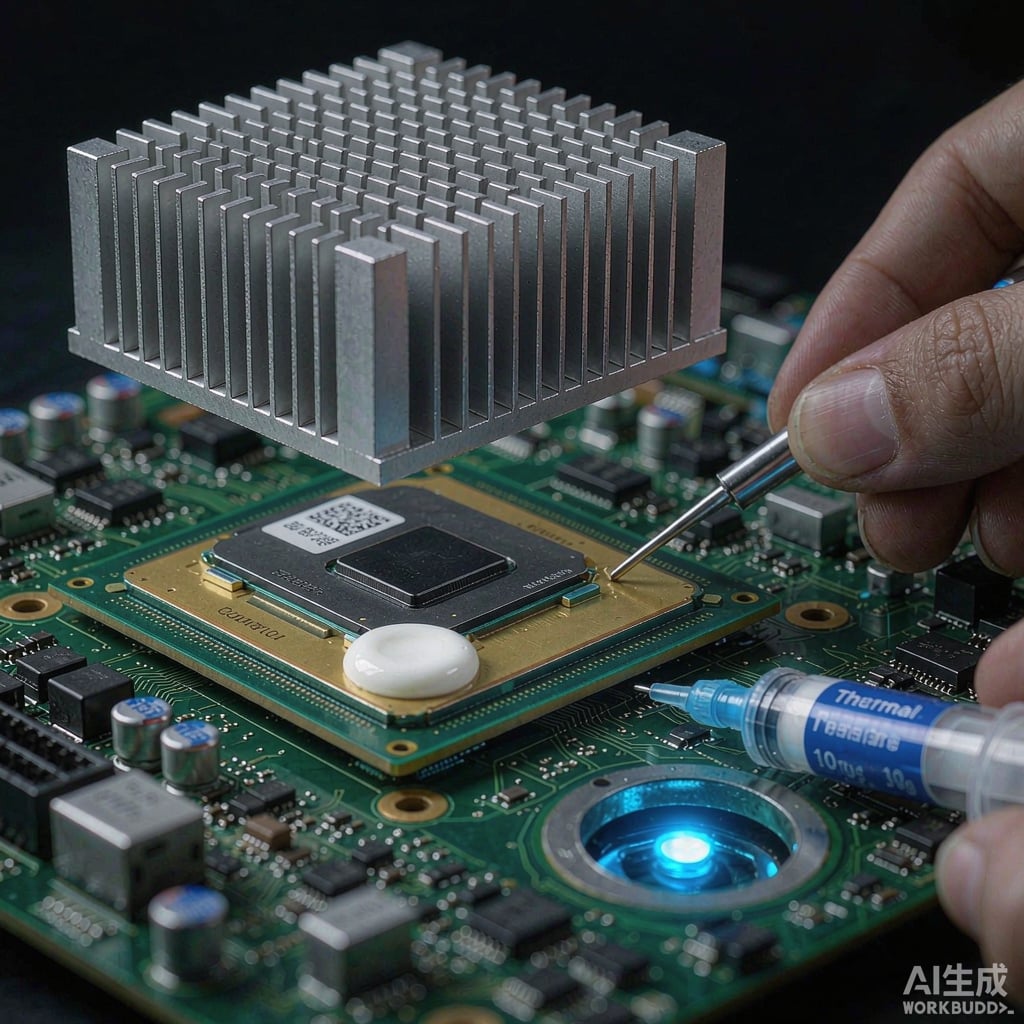
Silicone-based thermal greases filled with alumina, zinc oxide, or boron nitride offer thermal conductivity from 1 W/m·K to over 12 W/m·K. They are inexpensive and easy to apply with a syringe or screen printer. The downside is pump-out under thermal cycling and risk of contamination if over-applied.
Thermal Pads
Solid silicone or acrylic pads come in fixed thicknesses from 0.25 mm to 5 mm. They are clean, reusable during prototyping, and provide electrical isolation. Conductivity ranges from 1 W/m·K to 8 W/m·K. Pads are ideal when multiple components of different heights must share one heat sink.
Phase-Change Materials
Phase-change films soften at operating temperature, flowing into surface voids for very low thermal resistance. They combine the cleanliness of a pad with the gap-filling ability of grease. Typical activation temperatures fall between 45 °C and 60 °C.
Gap Fillers
For large tolerances between a PCB and an enclosure, soft gap fillers with conductivity of 2–6 W/m·K absorb mechanical tolerances while transferring heat. They are common in EV chargers, industrial controllers, and LED modules.
Thermal Adhesives and Tapes
When a permanent mechanical bond is also needed, thermally conductive adhesives and double-sided tapes attach heat sinks while conducting heat. These are common in compact consumer electronics where screws are not practical.
Selection Checklist
When choosing a TIM for PCB heat dissipation, evaluate the following parameters:
- Thermal impedance: The real-world performance metric, combining conductivity, thickness, and contact resistance.
- Dielectric strength: Required when the TIM must isolate electrically live pads from grounded metalwork.
- Compression force: Pads need enough clamping pressure to achieve rated performance without damaging BGAs.
- Outgassing: Critical for aerospace, optics, and sealed enclosures where silicone volatiles can fog lenses.
- Operating temperature range: Must exceed maximum junction or ambient temperatures with margin.
Application Best Practices
Apply just enough material to fill gaps, not to create a thick layer. A pea-sized dot in the center of a CPU-style package or a thin cross pattern on larger chips usually suffices. After assembly, verify performance with an infrared camera or thermocouples placed near the component case.
Conclusion
Thermal interface materials are a small detail with outsized impact on PCB heat dissipation. Matching the material type to the mechanical, electrical, and thermal requirements of the assembly ensures that heat sinks actually sink heat, rather than simply sitting nearby.