Why Membrane Structure Engineering Is Its Own Discipline
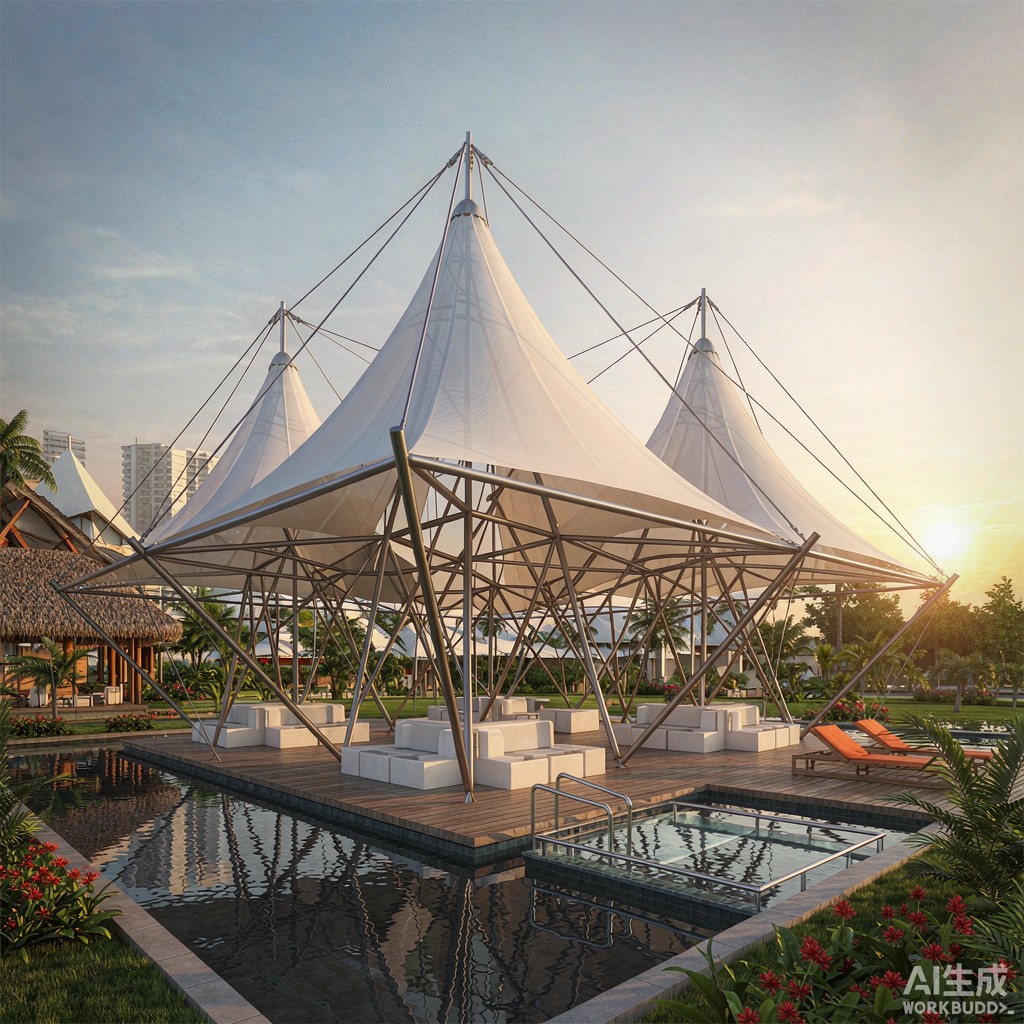
A tensile fabric pavilion looks deceptively simple: a few masts, a few cables, and a piece of fabric stretched between them. The engineering is in the anticlastic curvature, the prestress, the seam pattern, and the corner detail, all of which decide whether the structure survives a tropical typhoon or collapses after a single monsoon. At TechMart SE we supply three fabric families for outdoor lounge pavilions, namely PTFE-coated fiberglass, HDPE knitted shade cloth, and PVC-coated polyester, each with its own structural logic, lifespan, and aesthetic.
PTFE-Coated Fiberglass: The 30-Year Solution
PTFE-coated woven fiberglass is the premium tensile fabric for permanent outdoor pavilions. The substrate is an E-glass yarn at 250 to 500 tex, woven in a 4 to 8 shaft satin pattern, and coated with PTFE to a finished weight of 800 to 1 200 g per square metre. The tensile strength is 4 000 to 6 000 N per 5 cm in the warp and fill directions, the elongation at break is 5 to 12 percent, and the fire rating is DIN 4102-A2 or ASTM E84 Class A. Service life is 25 to 30 years, and the surface is hydrophobic enough to be self-cleaning under rainfall. The capital cost is 80 to 140 USD per square metre, three to five times higher than PVC-coated polyester.
HDPE Knitted Shade Cloth: The Tropical Workhorse
High-density polyethylene shade cloth is the most common membrane in South-East Asia because it is cheap, lightweight, and easy to repair. The base cloth is a 50 to 200 denier HDPE monofilament, knitted in a lock-stitch pattern that allows the fabric to stretch 30 to 60 percent without permanent deformation, ideal for absorbing wind gusts. The shading percentage is 50 to 95 percent depending on the yarn count and knit density, and the fire rating is typically Class B or C under ASTM E84. Service life is 8 to 12 years in full tropical sun, and the capital cost is 6 to 18 USD per square metre, an order of magnitude lower than PTFE.
PVC-Coated Polyester: The Mid-Range Middle Ground
PVC-coated polyester is a woven polyester scrim coated with PVC and a UV-stabilised lacquer top coat. The base fabric is 1 000 to 1 500 denier PET, the coating weight is 600 to 900 g per square metre, and the tensile strength is 2 500 to 4 500 N per 5 cm. The fire rating is ASTM E84 Class B with the optional top coat, the elongation at break is 15 to 25 percent, and the service life is 12 to 18 years. The capital cost is 25 to 50 USD per square metre, sitting between HDPE and PTFE. Lacquered PVDF top-coated versions push the lifespan toward 20 years at a 15 to 20 percent cost premium.
Anticlastic Curvature and the Prestress Number
Every tensile fabric pavilion relies on anticlastic curvature, which is the saddle shape the fabric takes when the warp and fill directions are tensioned to different levels. The minimum prestress for a stable membrane is 2 to 4 percent of the breaking strength, typically 80 to 240 N per 5 cm for PTFE and 50 to 150 N per 5 cm for PVC. Lower prestress produces a flapping membrane that fatigues within 18 to 36 months; higher prestress overstresses the seams. The form-finding is done in a non-linear solver like Forten 4000 or RFEM with the membrane modeled as a cable net with zero bending stiffness.
Wind Load and the Storm Survivability Question
The design wind load for a tropical resort pavilion is set by ASCE 7 or AS/NZS 1170 for a 50-year return period, typically 50 to 70 m/s peak gust. The fabric carries wind as a tensioned membrane, with the maximum tension scaling linearly with the dynamic pressure. A 1.0 by 1.0 m PTFE panel at 1.5 kPa design load develops 1 500 N per metre edge load, which the mast and cable system must react without exceeding 60 percent of the cable breaking load. For HDPE, the fabric stretches under load and the wind load is shed by the change in geometry; the structure is forgiving but the mast loads are still significant.
Seam Patterns and Corner Detailing
The seam is the most fatigue-sensitive part of a tensile fabric. PTFE is welded with a hot-air or hot-wedge process at 380 to 420 degrees Celsius, with a 30 to 50 mm overlap and a seam strength 80 to 100 percent of the parent fabric. PVC is high-frequency welded at 27 MHz, with a 25 to 40 mm overlap. HDPE is sewn with a bonded polyester thread on a double-needle machine, with a 15 to 20 mm overlap and 4 to 6 stitches per centimetre. The corner detail, typically a stainless steel plate with a pin-and-collar, transfers the seam load to the cable or mast without peeling the seam.
Specification Skeleton for a Tensile Fabric Pavilion
A solid specification covers the fabric type and weight, the breaking and tear strength in warp and fill, the fire rating, the UV warranty, the design prestress, the design wind load, the seam pattern, the corner detail, and the inspection interval. At TechMart SE the default specification for a 100 to 300 square metre resort lounge pavilion is PTFE-coated fiberglass at 1 050 g per square metre, 4 800 N per 5 cm warp and fill, ASTM E84 Class A, 25-year warranty, 3 percent prestress, and 60 m/s design wind. HDPE versions are quoted at 70 percent shade, ASTM E84 Class B, 10-year warranty, 4 percent prestress, and 50 m/s design wind. Issuing the full specification to the fabricator in advance eliminates the four most common post-installation disputes, namely sag after the first storm, seam failure at the corner, premature UV degradation, and fire-rating non-compliance with the local building code.