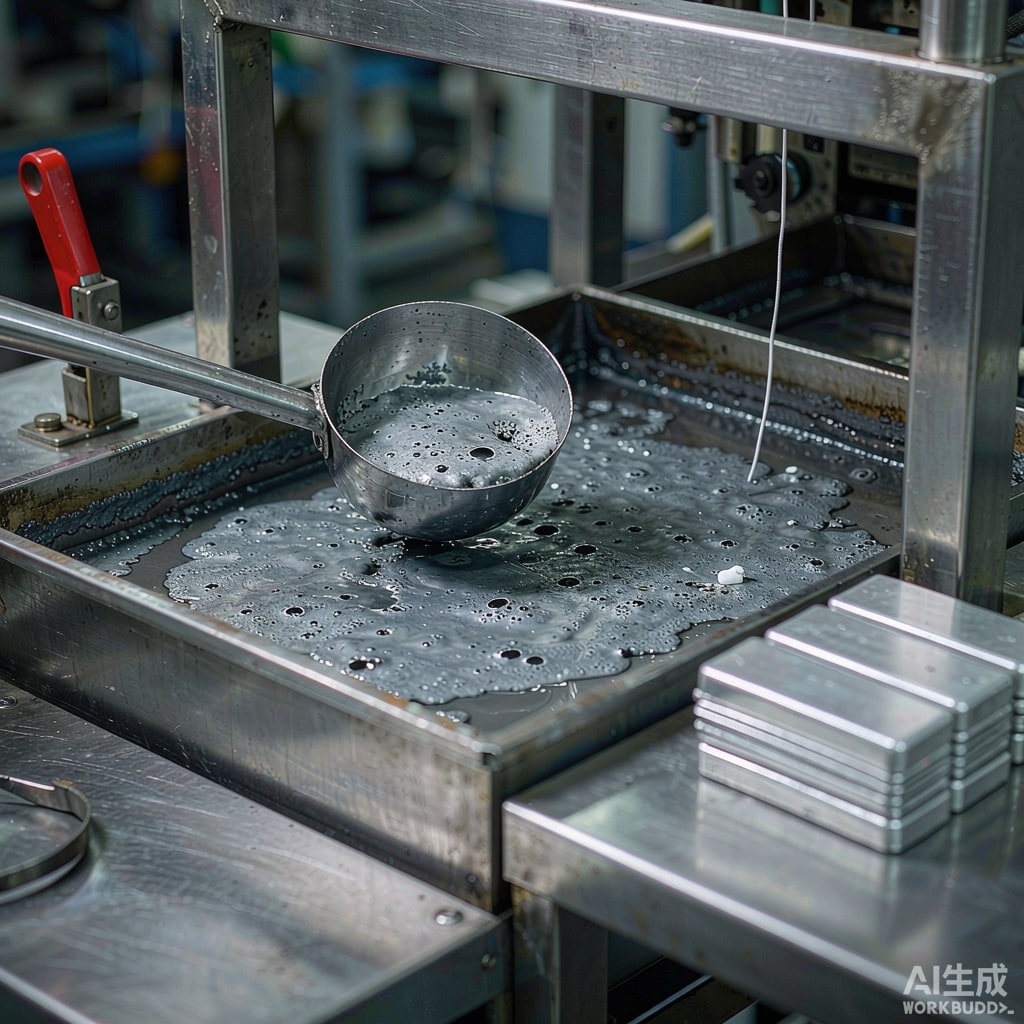
Every wave soldering line generates dross, and every plant manager has a story about the recycler whose numbers never quite added up. Dross is not waste — it is solder, oxides, and process chemistry in a form that someone else can refine. Managed well, a dross programme returns 40–70% of the metal value; managed badly, it becomes an unmeasured cost line that quietly eats a percentage point of gross margin.
What Dross Actually Is
Dross forms when molten solder contacts oxygen. The tin and lead (or tin-silver-copper) oxidise at the surface, and the oxide skin traps metallic solder beneath it. Typical wave solder dross composition is 65–90% free metal, 8–30% oxide, and smaller fractions of flux residues and intermetallic compounds.
Two distinct streams
Pot dross forms on the static solder pot surface and is relatively oxide-rich. Wave dross, generated by the pump and the wave curtain, is finer, higher in free metal, and often wetter with flux. Keep the two streams separate: mixing them lowers the average grade and the price you receive.
Generation rate is a useful benchmark. A well-run wave solder pot at 260 °C with a nitrogen blanket typically produces dross at 0.3–0.8 kg per 8-hour shift. Without nitrogen, in a humid tropical plant with turbulent wave flow, 1.5–3 kg per shift is common. If your number is above that, you have a process problem, not a recycling problem.
Measure Before You Recycle
You ca
ot negotiate recovery yield without a baseline.
Build a three-month baseline
- Weigh dross from each pot separately, per shift, on a scale readable to 10 g.
- Log solder bar consumption over the same period.
- Compute dross ratio: dross mass ÷ (dross mass + solder consumed). A healthy figure is 8–15%; above 20% points to excessive turbulence, high pot temperature, or a dirty pot.
- Record pot temperature, wave height setting, conveyor speed, and nitrogen flow with the dross weight, so you can correlate.
Once you have the ratio, the economics become visible. At 1,200 kg of solder consumption per year and a 12% dross ratio, you are producing 144 kg of dross containing roughly 100 kg of recoverable metal.
Evaluating a Recycler’s Claim
Recyclers quote either a flat price per kilogram of dross, or a “return yield” — the percentage of metal they credit back to you as solder bars or cash. The second is more accurate and far easier to manipulate.
Questions that separate good from bad
- Who takes the sample? Insist on a split sample: the recycler assays one half, you retain the other for independent testing.
- What is the assay method? X-ray fluorescence is fast but only measures surface; a proper assay requires melt and analysis. Ask for the method in writing.
- Is recovery yield guaranteed per lot or averaged per quarter? Averaging hides bad lots.
- What happens to the copper content? This is the critical question, addressed below.
- Is the returned metal traceable? Ask for a certificate of analysis per returned lot with tin, silver, copper, and lead values.
Be realistic about achievable recovery. Simple re-melting with flux and skimming recovers 55–75% of the metal by weight. Full refining recovers more but at a higher charge. A recycler promising 90% recovery of dross weight is either charging a refining fee you have not seen, or grading the input favourably.
The Copper Contamination Trap
This is where reclaimed solder quietly destroys assembly yield. Every time solder contacts a PCB pad, copper dissolves into the melt. Copper accumulates in the pot and, above roughly 0.9% in SAC305, it raises the liquidus temperature and promotes coarse intermetallic growth. Reclaimed solder from a diverse pool can arrive with copper at 0.7–1.2%.
Controls to insist on
Require a copper specification on reclaimed bars — typically 0.4% maximum for SAC305 — and test the first two returned lots with atomic absorption or ICP, not XRF alone. If your returned solder blends multiple customers’ streams, expect variability and budget for blending with virgin bars at a ratio such as 1:3. Pot copper analysis every 500 hours will tell you whether the programme is drifting. Do not put chemically reclaimed solder into a pot ru
ing fine-pitch work without a copper check.
The same logic applies to silver in SAC alloys and to bismuth or antimony cross-contamination when your plant touches multiple alloy systems. A single bismuth-bearing stream blended into an SAC pot can create low-melting phases that crack joints in thermal cycling.
Process Changes That Beat Any Recycling Deal
The cheapest dross is the dross you never generate. Four measures, ranked by return:
1. Nitrogen inerting
Covering the pot and wave with nitrogen reduces oxidation dramatically — dross cuts by 50–80% in most installations. Nitrogen cost in Southeast Asia is typically modest, and the payback is commonly under a year once solder savings and dross handling are counted.
2. Pot temperature discipline
Every 10 °C above 250 °C measurably increases oxidation rate. Run the lowest temperature that still gives acceptable hole fill — often 250–260 °C for SAC305.
3. Turbulence control
Higher wave height and faster pump speeds mean more surface contact with air. Set wave height to the minimum that achieves fill, and keep nozzle geometry clean.
4. Pot maintenance and skim discipline
Skim frequently with a dedicated, non-galvanised tool. Removing oxide early prevents the thick blanket that traps metal. Never stir the pot to “mix” dross back in — that distributes oxides through the bath.
Building the Business Case
Take a plant consuming 1,200 kg/yr of SAC305. Assume a 12% dross ratio, 65% reclaimable metal, a 60% return yield on dross weight, and a solder price that you fill in from your own purchase history. The a
ual value of recovered metal is roughly 0.6 × 144 kg = 86 kg of solder equivalent. Add the nitrogen conversion’s 50% dross reduction, and the numbers justify both the equipment and the administrative effort of a formal recycling contract.
Also account for the compliance side: dross containing lead-bearing solder is regulated waste in most jurisdictions. Even lead-free dross requires manifest documentation in many Southeast Asian countries. A recycler who provides proper manifests protects you as much as one who pays well.
A Practical Dross Programme
Weigh the dross per shift with the pot parameters. Segregate pot and wave streams. Sign a contract with a split-sample assay, a per-lot yield guarantee, and a copper limit. Test the first two lots independently. Install nitrogen and retune pot temperature. Review the dross ratio quarterly against the baseline. That sequence — measure, contract, then reduce — typically halves the real cost of dross within a year and removes a chronic, invisible margin leak from the SMT line.



