Surface-mount pin headers used in DDR5/6 RDIMM memory module sockets, server CPU sockets, and high-cycle industrial co
ectors are routinely spec’d with gold plating on the mating contact area to provide low and stable contact resistance over 100-1,000 mate/unmate cycles. The engineering trade-off between gold thickness (0.025 µm flash gold to 0.76 µm heavy gold) and contact normal force (50-200g per pin) governs both co
ector cost (gold is $78-95/g at 2026 LME) and long-term reliability. Insufficient gold under high normal force wears through to nickel underlayer within 50-100 cycles; excessive gold over low normal force fails by adhesion and creep. This article examines ASTM B488 gold grade selection, the normal force-deflection curve for typical phosphor bronze or beryllium copper pins, JEDEC MO-160 socket requirements, and fretting corrosion mitigation strategies for server-grade memory sockets with 15-20 year operational duty cycles.
Gold Plating Grade & Thickness per ASTM B488
Grade Classification
ASTM B488 classifies electrodeposited gold coatings into three grades based on purity and hardness, with Type I being the most common for electronic contacts:
| Grade | Hardness | Purity (%) | Typical Application | Cost Premium (vs Grade C) |
|---|---|---|---|---|
| Type I, Grade A (soft) | 90-130 KHN | 99.99+ (4N) | Wire bonding, low-cycle contacts | +8-12% |
| Type I, Grade B (medium) | 130-200 KHN | 99.9 (3N) | Edge co
ectors, IC sockets |
+5-8% |
| Type I, Grade C (hard) | 200+ KHN | 99.5+ (cobalt hardened) | High-cycle, fretting-prone contacts | Baseline |
| Type II | — | 99.0+ | Industrial, non-precision | -15-25% |
| Type III | — | 99.9+ (pure soft) | Wire bonding, low-current | +10-15% |
Thickness Selection Rationale
Gold thickness on SMT pin headers for memory sockets typically falls into three tiers:
- Flash gold (0.025-0.10 µm / 1-4 µin): solderability preservation on the SMT tail (not the mating contact area) and minimum-cost decorative finish. Not acceptable for separable contact area in memory sockets.
- Standard gold (0.20-0.40 µm / 8-16 µin): minimum thickness for separable contacts in low-to-medium cycle applications (50-200 cycles). Common in consumer DIMM sockets and peripheral co
ectors.
- Heavy gold (0.51-0.76 µm / 20-30 µin): server-grade and high-cycle industrial sockets rated 500-1,000 cycles per JEDEC MO-160, MIL-PRF-49285, or ESA ESCC 3401 specifications.
For 100-cycle DDR5 UDIMM consumer applications, 0.20 µm gold over 1.3 µm sulfamate nickel is the industry baseline. For 250-cycle server RDIMM and 500-cycle CPU LGA socket pins, 0.51-0.76 µm gold is standard. Above 1.0 µm gold, the cost premium becomes prohibitive ($0.08-0.15 per pin for the gold material alone at 2026 spot price) and reliability gain plateaus because fretting corrosion (not gold wear) becomes the dominant failure mode.
Contact Normal Force Engineering
Pin Material Selection
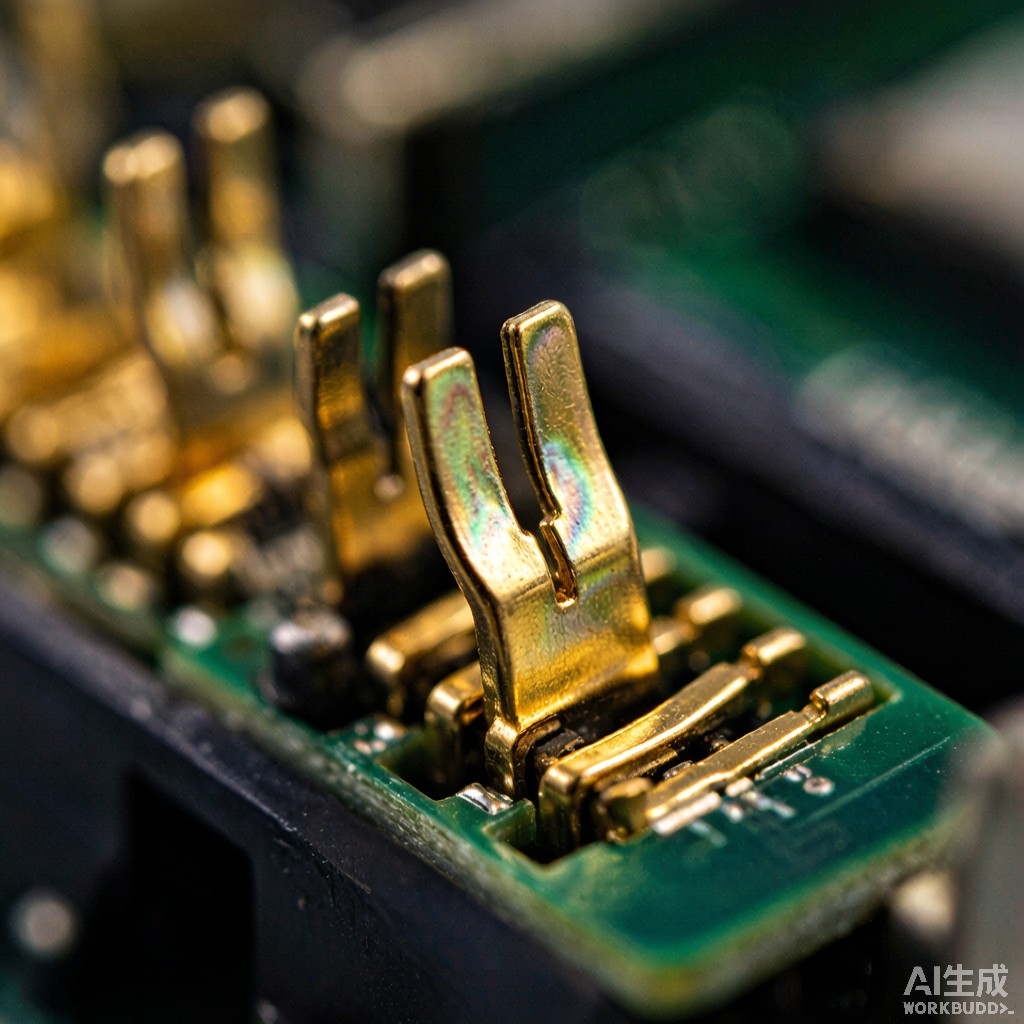
Pin header mating pins are stamped from flat stock and formed into a U-shape or fork geometry. The two dominant alloys are:
- Phosphor bronze C51900 or C52100: 5-9% Sn, 0.03-0.35% P, balance Cu. Yield strength 400-650 MPa, modulus 110 GPa, electrical conductivity 12-20% IACS. Lower cost, lower force per unit deflection, suitable for normal force 50-150g per pin.
- Beryllium copper C17200 (mill-hardened): 1.8-2.0% Be, 0.2-0.6% Co+Ni, balance Cu. Yield strength 800-1,250 MPa (heat-treated), modulus 130 GPa, conductivity 20-25% IACS. Higher force per unit deflection, suitable for high-normal-force sockets 100-250g per pin, longer fatigue life at 500-1,000 cycles.
For DDR5 server RDIMM sockets requiring 100-150g normal force per pin with 250-500 mate cycles, C17200 beryllium copper in TH04 (solution heat-treated + cold-worked + precipitation hardened) temper is the industry standard. C51900 phosphor bronze is acceptable for consumer UDIMM with 50-100g normal force and ≤100 cycles.
Normal Force vs Deflection Curve
A typical 0.40 mm thick × 0.64 mm wide C17200 fork-pin in TH04 temper with a 1.0 mm working gap has the following force-deflection characteristic (per MIL-DTL-32139 test method):
| Deflection (mm) | Force (g) | Stress at Bend (MPa) | Operating Regime |
|---|---|---|---|
| 0.10 | 35-50 | 650-800 | Under-deflected (low contact force) |
| 0.15 | 60-90 | 900-1,100 | Lower bound of spec |
| 0.20 | 100-140 | 1,200-1,500 | Nominal (DDR5 RDIMM target) |
| 0.25 | 150-200 | 1,550-1,900 | Upper bound of spec |
| 0.30 | 220-280 | 1,950-2,300 | Near yield (over-deflected) |
| 0.35+ | 300+ | 2,400+ (plastic) | Permanent set, fatigue failure |
The sweet spot for memory sockets is the 0.20-0.25 mm deflection range, providing 100-200g normal force—high enough to displace surface contamination and maintain stable contact resistance under vibration, but low enough to keep the stress at the bend below 70% of yield (preventing stress relaxation over service life).
JEDEC MO-160 Server RDIMM Socket Requirements
Mechanical & Electrical Spec
JEDEC MO-160 (288-pin DDR5 RDIMM socket) defines the test protocol and acceptance criteria for memory module sockets used in server and workstation applications:
- Normal force: 80-150g per pin at rated deflection
- Insertion force: ≤60g per pin average (5-8N total for 240 active contacts)
- Withdrawal force: ≥30g per pin average (no contact retention less than 20g)
- Durability: 250 mate/unmate cycles minimum at rated normal force, with contact resistance increase ≤10 mΩ and dielectric withstand retention
- Contact resistance: ≤30 mΩ initial (gold-gold), ≤50 mΩ after 250 cycles
- Vibration: 10-500 Hz at 10g RMS, no discontinuities >1 µs
- Thermal aging: 1,000 hours at 105°C, post-aging contact resistance ≤+15 mΩ
Material Selection per Application
OEM server platforms (Dell PowerEdge, HPE ProLiant, Lenovo ThinkSystem) typically require 0.51-0.76 µm hard gold (Type I, Grade C) over 1.3-2.5 µm sulfamate nickel on C17200 fork pins, validated to 250-500 cycles per MO-160 plus OEM-specific derating tests. Consumer desktop UDIMM (JEDEC MO-328) accepts 0.20 µm gold on C51900 phosphor bronze with 50-100 cycles, and laptop SODIMM (JEDEC MO-337) often uses 0.10-0.20 µm gold on thi
er (0.30 mm) C51900 pins for compact 30g normal force per pin.
Fretting Corrosion & Wear Mechanisms
Microslip Amplitude
Fretting wear is the dominant failure mode in low-amplitude (<50 µm) cyclic relative motion between mated contacts, typically driven by thermal expansion mismatch, vibration, or insertion/withdrawal micro-slip. In a server RDIMM socket, the differential CTE between FR-4 PCB (15-17 ppm/°C in X/Y) and the copper alloy pin (17-23 ppm/°C) creates 5-20 µm of relative displacement per 30°C thermal swing, well within the fretting zone. Fretting corrosion in gold-plated contacts typically progresses as follows:
- 0-50 cycles: Burnishing of asperities (microscopic high points flatten), contact area increases, contact resistance decreases slightly (10-15%).
- 50-200 cycles: Gold wear-through at high-spots exposing nickel underlayer. Contact resistance stable at 20-35 mΩ (gold-nickel-gold tri-junction).
- 200-500 cycles: Nickel oxidation in wear tracks, accumulation of NiO insulating debris. Contact resistance rises to 50-100 mΩ with intermittent opens during vibration.
- 500+ cycles: Wear-through of nickel exposing copper substrate. Rapid oxidation (Cu₂O/CuO) causes contact resistance to exceed 500 mΩ with frequent opens.
Fretting Mitigation Strategies
To extend gold-on-gold mating life beyond 500 cycles, OEM server sockets employ one or more mitigation techniques:
- Hard gold with 0.05-0.10 wt% cobalt or nickel hardening agent: increases gold hardness from 90-130 KHN to 200-250 KHN, reducing wear rate by 2-3×.
- PdNi (60/40 or 80/20) underlayer: 0.5-1.0 µm palladium-nickel diffusion barrier between gold and nickel, preventing Ni diffusion to surface and reducing NiO fretting product formation.
- Lubricant application: 0.5-1.0 µm polyphenyl ether (PPE) or perfluoropolyether (PFPE) contact lubricant reduces friction coefficient from 0.4-0.6 (unlubricated gold) to 0.1-0.15, and prevents adhesive wear.
- Inserted memory module locking mechanism: latches and retention clips reduce vibration-induced microslip by 50-80%, validated via 10-500 Hz sweep per IEC 60068-2-6.
Cost Engineering & Specification Trade-Off
Cost Breakdown per Pin
At 2026 gold spot price of $87/g and assuming 0.64 mm × 0.40 mm pin × 3 mm plated length, the gold material cost per pin is:
- 0.10 µm gold: $0.0015/pin ($0.36/288-pin socket)
- 0.20 µm gold: $0.0030/pin ($0.86/socket)
- 0.51 µm gold: $0.0077/pin ($2.22/socket)
- 0.76 µm gold: $0.0115/pin ($3.31/socket)
- 1.27 µm gold: $0.0192/pin ($5.53/socket)
The cost delta between consumer-grade 0.20 µm and server-grade 0.76 µm gold is approximately $2.45 per 288-pin RDIMM socket. Across a server with 24-32 DIMM slots, the total gold premium is $59-78, justified by 5-10× longer operational life and reduced field-failure rate (typically targeted below 50 ppm at 5 years).
Specification Recommendation
For DDR5 server RDIMM sockets (250-500 cycle target): specify 0.51 µm hard gold (ASTM B488 Type I, Grade C) over 1.3 µm sulfamate nickel over 1.27 µm matte tin (SMT tail) on C17200 beryllium copper TH04 pin, with PFPE contact lubricant on mating surfaces and JEDEC MO-160 compliance. For consumer DDR5 UDIMM (50-100 cycle target): specify 0.20 µm hard gold over 1.3 µm sulfamate nickel on C51900 phosphor bronze, JEDEC MO-328 compliance. For CPU LGA socket pins (500-1,000 cycle target): specify 0.76 µm hard gold over 2.5 µm sulfamate nickel on C17200, with PdNi underlayer optional, MIL-PRF-49285 or Intel/AMD-specific spec compliance.
Conclusion
SMT pin header gold plating thickness and contact normal force are co-dependent engineering variables that must be jointly specified for memory module socket reliability. The 0.51-0.76 µm hard gold over sulfamate nickel on C17200 beryllium copper in TH04 temper with 100-200g normal force per pin represents the sweet spot for 250-500 cycle server RDIMM applications, validated per JEDEC MO-160 with $59-78 gold premium per server compared to consumer-grade specifications. Fretting corrosion—not gold wear—is the dominant failure mode beyond 200 cycles, and mitigation requires hard gold, optional PdNi underlayer, PFPE contact lubricant, and module retention mechanism. Cost engineering and reliability engineering converge on the same specification: hard gold, beryllium copper, and modest normal force for high-cycle separable contacts in server and industrial electronics.