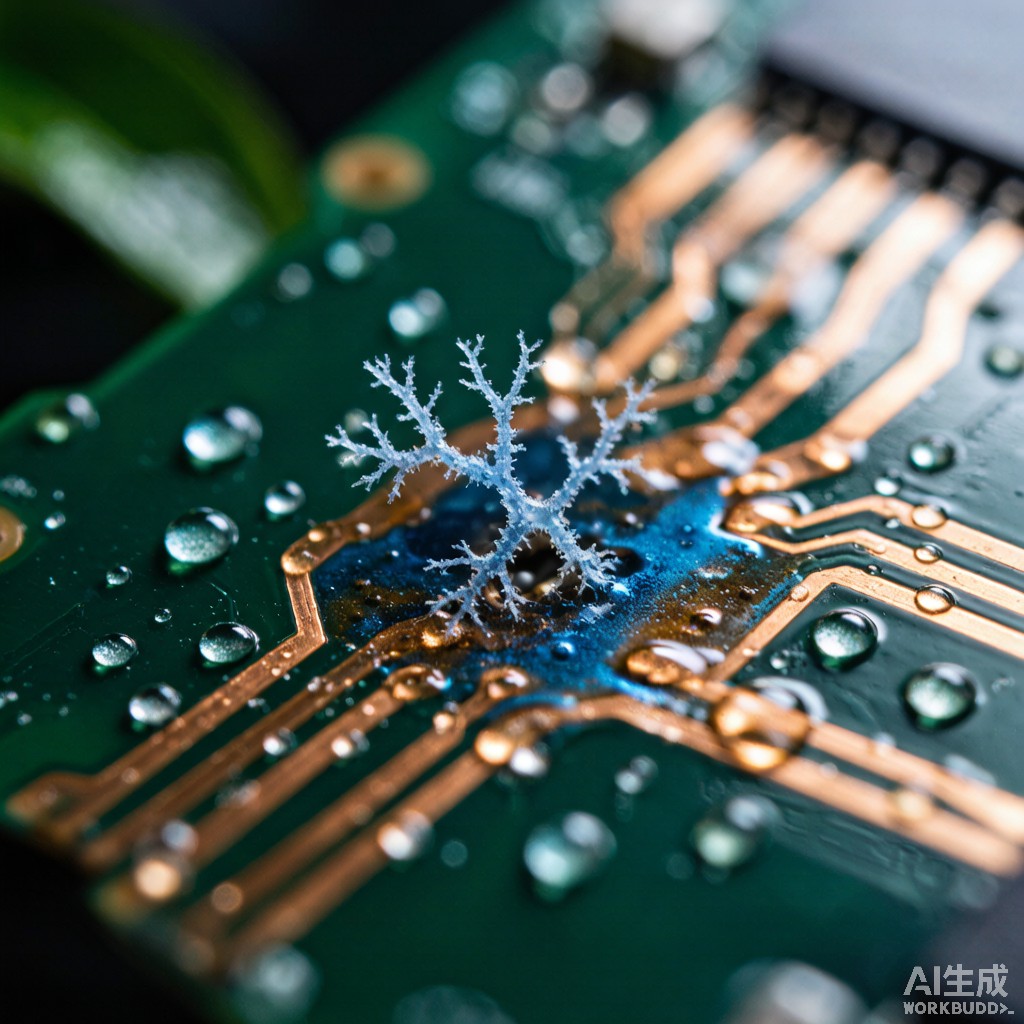
Electrochemical migration (ECM) is a humidity-driven failure mechanism in which dissolved metal ions migrate across a printed circuit board or component surface under DC bias, forming dendritic bridges that eventually short adjacent conductors. In tropical and subtropical markets—Southeast Asia, coastal China, India, and Latin America—electronics routinely experience 75-95% relative humidity, 30-40°C ambient temperatures, and airborne salts or industrial pollutants that accelerate ECM on SMT copper strip conductors, lead frames, and solder joints. Bare copper, tin-lead, and even ENIG-finished pads can fail within 500-2,000 hours of biased-humidity stress if layout, materials, and protective measures are not optimized. This article explains the ECM mechanism, industry-standard test methods, copper strip finish and spacing rules, conformal coating strategies, and design-for-reliability practices for SMT products deployed in tropical humidity bias environments.
Electrochemical Migration Mechanism on SMT Copper
From Ion Dissolution to Dendritic Bridge
ECM proceeds in four stages. First, a thin water film forms on the substrate surface when relative humidity exceeds the deliquescence point of adsorbed ionic contamination (typically 60-80% RH for chlorides and sulfates). Second, anodic copper dissolves into Cu⁺ or Cu²⁺ ions under applied DC voltage, with dissolution rate increasing exponentially above 0.1 V/µm electric field. Third, metal ions migrate toward the cathode by electrophoresis and are reduced back to metallic dendrites. Finally, the dendrite grows toward the anode until it bridges the gap, causing a temporary or permanent short. Copper dendrites are particularly fine and fast-growing—typical growth rates are 1-10 µm/hour under 85°C/85% RH with 5-50 V bias—because copper has high ionic mobility in aqueous films and low reduction overpotential.
Effect of Contamination and Material Finish
The presence of halide ions, flux residues, or acidic pollutants lowers surface insulation resistance (SIR) by one to three orders of magnitude and can reduce time-to-failure by 50-90%. Common SMT copper strip finishes show different ECM susceptibility:
| Finish | Relative ECM Risk | Typical Failure Mode | Mitigation Notes |
|---|---|---|---|
| Bare copper / OSP | High | Anodic dissolution from copper traces | OSP degrades after reflow; best under coating |
| ImSn (immersion tin) | Moderate-High | Tin whisker + tin oxide bridging | Thickness >1.0 µm improves robustness |
| ENIG (Ni-Au) | Low-Moderate | Black pad / nickel corrosion at pores | Pore-free gold >0.08 µm recommended |
| ENEPIG (Ni-Pd-Au) | Low | Palladium corrosion rare | Best for high-reliability applications |
| Sn-Ag-Cu HASL | Moderate | Tin oxidation and ionic residue | Requires thorough cleaning |
Industry Testing and Acceptance Criteria
IPC-TM-650 2.6.14 and IEC 61189-5
The dominant accelerated test is IPC-TM-650 Method 2.6.14, which subjects comb-pattern test coupons to 85°C/85% RH and a defined DC bias for 500-1,000 hours. Pass criteria vary by product class: automotive typically requires SIR >10⁸ Ω under bias and no dendrites visible at 50x optical inspection; consumer electronics may accept >10⁷ Ω. IEC 61189-5 provides similar guidance for surface insulation resistance and electrochemical migration susceptibility of solder mask, conformal coatings, and base materials. For tropical applications, many OEMs add a 40°C/93% RH, 96-hour unbiased preconditioning step followed by biased humidity testing to simulate shipping and seasonal monsoon exposure.
Design Rules to Suppress ECM
Layout and electrical design have the strongest influence on ECM lifetime. The electric field between conductors should be minimized by increasing spacing and reducing operating voltage where possible. Practical rules for tropical SMT designs include:
- Maintain conductor spacing ≥0.5 mm for voltages below 24 V and ≥1.0 mm for 48-120 V in uncoated outdoor or marine environments.
- Avoid sharp corners and trace stubs that create field concentration; rounded pad corners reduce peak field by 20-40%.
- Route high-impedance nodes away from low-impedance power rails and ground pours.
- Apply guard rings or leakage paths that safely divert any dendritic current before it reaches signal traces.
- Minimize DC bias across adjacent conductors during sleep or standby modes; use AC-coupled signals where feasible.
Material and Process Mitigation
Conformal Coating Selection
Conformal coatings are the most effective ECM mitigation for SMT assemblies. Acrylic coatings provide good moisture resistance and are easy to repair but offer limited chemical protection. Urethane and silicone coatings deliver superior humidity barrier and temperature cycling performance. Parylene C vapor-deposited coatings provide pinhole-free, ultra-thin (5-25 µm) protection with excellent dielectric strength and are preferred for high-density SMT modules. For tropical outdoor products, a two-layer system—urethane base plus parylene topcoat—can extend ECM life by 5-10x compared to uncoated boards.
Flux Residue Cleaning
No-clean flux residues are not truly inert under humidity bias. Weak organic acids and halide activators can hydrolyze and become ionic conductors. Aqueous or semi-aqueous cleaning with ionic contamination testing (ROSE method per IPC-TM-650 2.3.25) should achieve ≤1.56 µg NaCl eq/cm² for high-reliability products. Target levels below 0.5 µg NaCl eq/cm² for automotive or marine applications.
Summary
Electrochemical migration is a dominant reliability concern for SMT copper strip conductors in tropical, high-humidity environments. Effective control combines material finish selection (ENEPIG or pore-free ENIG), conservative spacing and bias design, rigorous cleaning, and appropriate conformal coating. By following IPC-TM-650 2.6.14 test methods and design-for-reliability rules, manufacturers can confidently deploy copper-based SMT components in Southeast Asian and other humid markets without premature field failures.