Introduction: When Building Physics Defies Design Intent
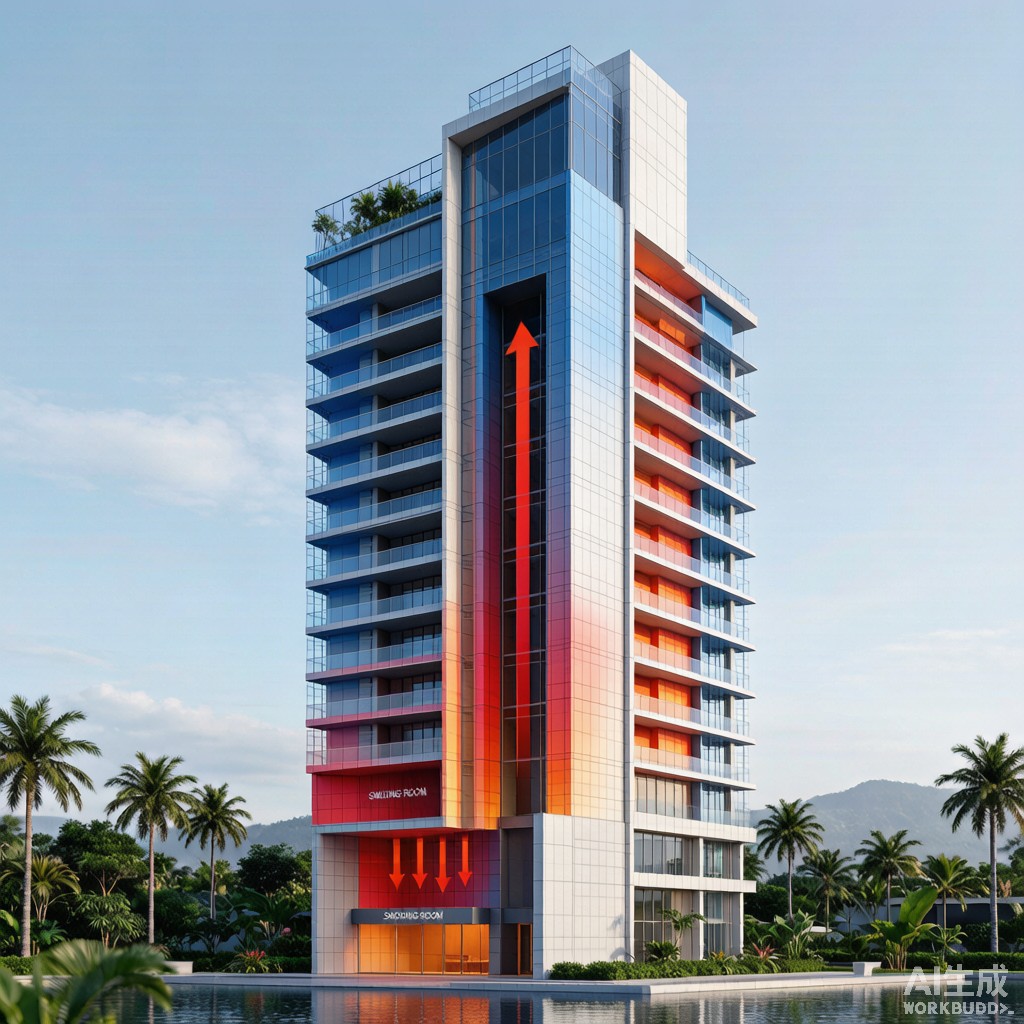
A smoking room designed to maintain negative pressure for odor containment can perform flawlessly on the 3rd floor of a commercial building — and fail completely when the same design is replicated on the 30th floor. The culprit is the stack effect: the pressure differential driven by temperature differences between building interior air and outside air, which creates powerful vertical pressure gradients in tall buildings. In Southeast Asian skyscrapers, where air-conditioned interiors at 24°C contrast sharply with outdoor air at 35°C, the stack effect is a year-round phenomenon that must be engineered into smoking room ventilation design from the outset.
This article examines the physics of stack effect, its impact on smoking room pressure containment in high-rise buildings, and the engineering solutions that maintain reliable negative pressure regardless of floor level or seasonal conditions.
Stack Effect Physics in Tall Buildings
Mechanism and Pressure Calculation
The stack effect arises from the density difference between warm indoor air and cooler outdoor air (or vice versa). In air-conditioned buildings in tropical climates, the indoor air (24°C) is cooler than outdoor air (35°C), creating a reverse stack effect where cool indoor air sinks and warm outdoor air pushes inward at lower levels while exfiltrating at upper levels. The pressure difference at any height h is:
ΔP_stack = ρ_avg × g × H × (T_out – T_in) / T_out
Where ρ_avg is average air density (approximately 1.2 kg/m³), g is gravitational acceleration (9.81 m/s²), H is the height difference from the neutral pressure level (NPL), T_out and T_in are absolute temperatures in Kelvin.
For a 40-story building (150 m height) with T_out = 308 K (35°C) and T_in = 297 K (24°C), the total stack pressure from bottom to top is approximately 60 Pa — a substantial force that can overwhelm the modest -5 to -12.5 Pa negative pressure typically specified for smoking rooms.
Neutral Pressure Level (NPL) and Floor-Dependent Pressure
The neutral pressure level (NPL) is the height at which indoor and outdoor pressures are equal. Below the NPL, outdoor air pushes inward (positive infiltration pressure). Above the NPL, indoor air pushes outward (positive exfiltration pressure). For a building with evenly distributed leakage, the NPL is at mid-height — roughly the 20th floor of a 40-story building.
The pressure at any floor relative to the NPL determines how hard the smoking room ventilation system must work to maintain containment:
| Floor (of 40) | Height Above NPL | Stack Pressure (Pa) | Direction | Required Compensation |
|---|---|---|---|---|
| Floor 5 | -55 m below NPL | +22 Pa inward | Infiltration | Easy — infiltration assists containment |
| Floor 15 | -18 m below NPL | +7 Pa inward | Infiltration | Moderate — natural assistance |
| Floor 20 (NPL) | 0 m | 0 Pa | Neutral | Design baseline applies |
| Floor 25 | +18 m above NPL | -7 Pa outward | Exfiltration | Moderate — ventilation must overcome |
| Floor 35 | +55 m above NPL | -22 Pa outward | Exfiltration | Severe — containment at risk |
| Floor 40 (top) | +75 m above NPL | -30 Pa outward | Exfiltration | Critical — specialized design required |
On lower floors, the stack effect actually assists smoking room containment by pushing air inward through any gaps. The design challenge concentrates on upper floors, where the outward stack pressure of 15-30 Pa can exceed the smoking room’s negative pressure design of -5 to -12.5 Pa, causing smoke-laden air to exfiltrate into adjacent occupied spaces.
Containment Failure Modes in High-Rise Smoking Rooms
Door Opening Transient Pressure Reversal
When a user opens the smoking room door, the room’s negative pressure momentarily equalizes with the corridor pressure. On lower floors, the stack effect pushes corridor air into the room (assisting containment). On upper floors, the stack effect pushes room air out into the corridor — the opposite of the intended containment direction. The transient reversal lasts 3-8 seconds (the time for the door to close and the exhaust system to re-establish negative pressure), but during this window, 0.5-2.0 m³ of smoke-laden air can escape into the corridor.
Damper Response Lag in VAV Systems
Variable Air Volume (VAV) smoking room ventilation systems modulate supply and exhaust airflows to maintain target pressure. However, VAV damper actuators have response times of 15-60 seconds — far slower than the 3-8 second door-opening transient. On upper floors where the stack pressure works against the system, the damper ca
ot respond fast enough to prevent transient containment loss during door operation.
Building Façade Leakage and Wind Interaction
In tropical Southeast Asia, the stack effect does not act alone. Monsoon-season wind pressures of 20-50 Pa on windward facades can shift the NPL upward by 5-15 floors, changing the pressure regime on mid-building floors from infiltration to exfiltration without warning. A smoking room that performs adequately in calm conditions may fail during a monsoon wind event because the floor it occupies suddenly transitions from below-NPL to above-NPL behavior.
Engineering Solutions for High-Rise Stack Effect Compensation
Floor-Specific Ventilation Design
The most effective approach is to abandon the one-size-fits-all ventilation design and specify floor-specific airflows based on stack pressure calculations:
| Floor Zone | Stack Pressure Range | Exhaust Airflow Multiplier | Supply Airflow Strategy | Makeup Air Source |
|---|---|---|---|---|
| Lower (1-15) | +5 to +25 Pa inward | 1.0x (baseline) | Full supply, standard VAV | Corridor (infiltration-assisted) |
| Mid (15-25) | -5 to +5 Pa | 1.3x | Reduced supply, fast-acting VAV | Dedicated outside air duct |
| Upper (25-35) | -5 to -20 Pa outward | 1.6x | Minimal supply, pressure-independent | Dedicated outside air duct, sealed |
| Top (35-40) | -20 to -35 Pa outward | 2.0x | No supply (exhaust-only) | Sealed transfer grille with backdraft damper |
For upper floors, the design shifts from balanced supply-exhaust to exhaust-dominant operation, where makeup air is carefully controlled through sealed pathways rather than open corridors. The exhaust airflow multiplier of 2.0x on top floors ensures that even under worst-case stack and wind conditions, the room maintains at least -5 Pa relative to the corridor.
Pressure-Independent Damper Technology
Standard VAV dampers respond to thermostat or pressure sensor signals with pneumatic or electric actuators that are too slow for stack effect compensation. Pressure-independent constant airflow regulators (CAVRs) maintain a fixed airflow regardless of upstream pressure fluctuations, effectively decoupling the smoking room ventilation from building-wide stack pressure variations.
CAVRs are mechanical devices (typically based on a silicone-impregnated fabric diaphragm or aerodynamic cone) that automatically restrict or open flow area in response to pressure changes, maintaining constant airflow within ±5% across a 50-500 Pa differential pressure range. Installing CAVRs on both supply and exhaust airflows ensures that the smoking room pressure differential remains stable regardless of stack effect magnitude.
Anteroom (Vestibule) Design for Upper Floors
For smoking rooms on floors 30 and above, an anteroom (vestibule) between the corridor and the smoking room provides a pressure buffer zone that eliminates door-opening transient containment loss. The anteroom is maintained at an intermediate pressure between the corridor and the smoking room. When the corridor door opens, air flows from corridor to anteroom (not from smoking room to corridor). When the smoking room door opens, air flows from anteroom to smoking room (not from smoking room to corridor). The two doors are interlocked so they ca
ot be opened simultaneously.
Anterooms add 4-6 m² of floor area but eliminate the primary containment failure mode on upper floors. For high-end commercial buildings where smoking room odor complaints are unacceptable, the anteroom approach is the most reliable engineering solution.
Commissioning and Ongoing Performance Verification
Multi-Season Pressure Testing
Smoking room pressure containment in high-rise buildings must be commissioning-tested under at least two conditions: calm weather (to establish baseline performance) and windy conditions (to verify wind-stack interaction). A differential pressure monitor with data logging should be permanently installed in each smoking room, recording the corridor-to-room pressure differential at 1-minute intervals. The commissioning acceptance criterion should be that negative pressure is maintained for at least 95% of occupied hours, with no single exceedance lasting more than 60 seconds (typical door operation duration).
A
ual Recalibration
Building stack effect characteristics change over time as façade seals age, window gaskets leak more, and HVAC system performance drifts. A
ual recalibration of smoking room ventilation systems should include re-measurement of the pressure differential under controlled door-closed conditions and adjustment of CAVR setpoints if drift exceeds 10% of the design differential. This is particularly important for upper-floor installations where the margin between design pressure and stack effect reversal is narrowest.
Conclusion
Stack effect is an unavoidable consequence of building height and indoor-outdoor temperature differences. In Southeast Asian high-rise commercial buildings, the reverse stack effect from air-conditioned interiors creates pressure differentials of 20-60 Pa from bottom to top — forces that can overwhelm standard smoking room containment designs. By understanding the neutral pressure level concept, designing floor-specific ventilation rates, employing pressure-independent airflow regulators, and incorporating anterooms on upper floors, engineers can ensure that smoking room containment performs reliably at every floor level. Ongoing performance monitoring and seasonal recalibration ensure that the system continues to meet containment criteria throughout the building’s operational life.