Introduction: The Engineering Challenge of Indoor Smoking Containment
Designing a compliant smoking room within a commercial or institutional building requires rigorous engineering of airflow containment, filtration efficiency, and pressure differential control. Unlike outdoor smoking booths where natural ventilation assists smoke dispersion, indoor smoking rooms must actively prevent secondhand smoke leakage into adjacent occupied spaces — a requirement codified in ASHRAE 62.1, local building codes, and increasingly stringent Southeast Asian workplace health regulations.
This article provides a comprehensive engineering framework for smoking room negative pressure design, HEPA filtration selection, and air change rate calculations, with specific considerations for tropical climate deployment where HVAC energy costs and humidity management present additional challenges.
Negative Pressure Containment Fundamentals
Pressure Differential Requirements
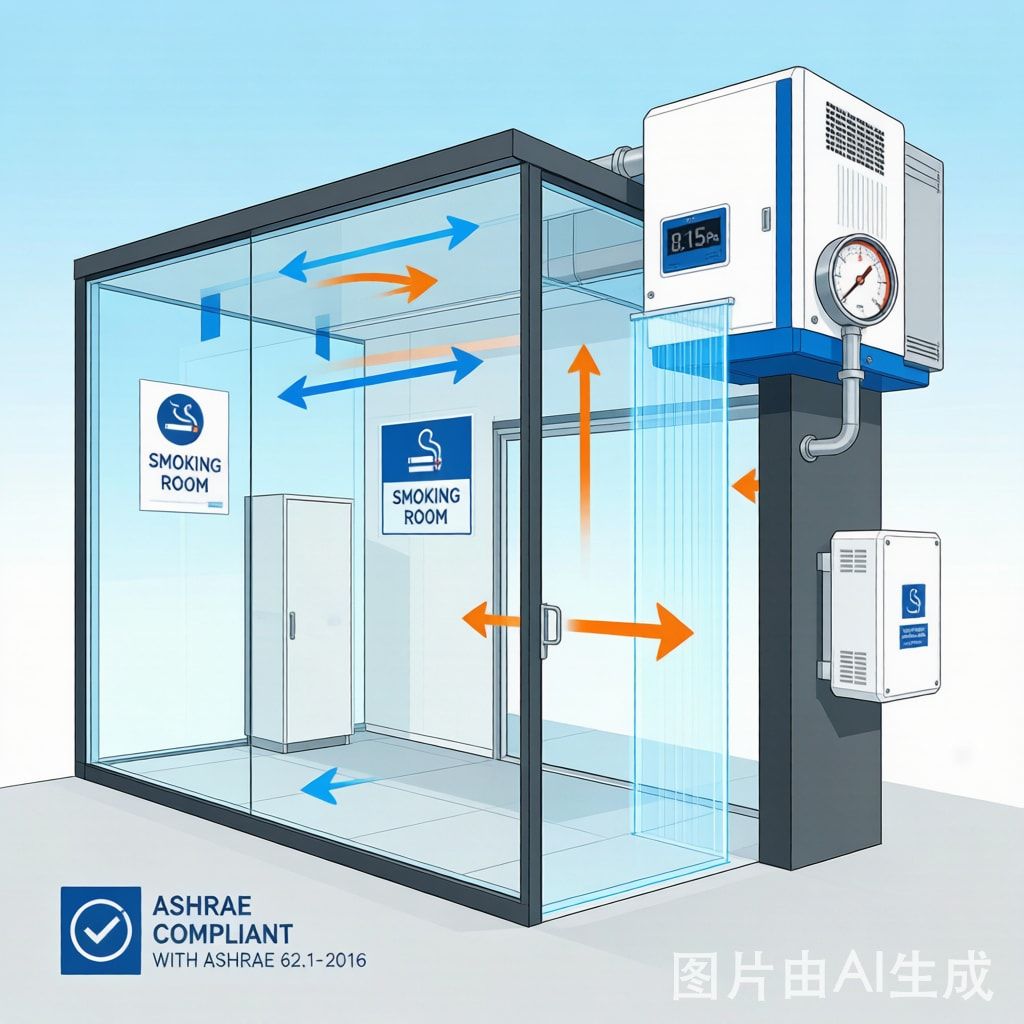
The fundamental principle of smoking room containment is maintaining a consistent negative pressure differential between the smoking room and adjacent spaces, ensuring that air flows inward through any leakage paths (door gaps, wall penetrations, ceiling joints) rather than outward carrying tobacco smoke particles.
International standards and best practices specify:
| Standard / Reference | Minimum ΔP | Recommended ΔP | Monitoring |
|---|---|---|---|
| ASHRAE 62.1-2022 | —5 Pa | —5 to —12.5 Pa | Continuous gauge |
| WHO Indoor Air Quality Guidelines | —5 Pa | —10 Pa | Periodic verification |
| UK Building Regulations Part F | —5 Pa | —10 Pa | Continuous |
| Singapore BCA Code | —5 Pa | —10 Pa | Digital monitor |
| Malaysia UBBL | —3 Pa | —8 Pa | Periodic |
A differential of —5 Pa is the absolute minimum for containment; —10 to —12.5 Pa provides a robust margin that accommodates door-opening events, wind pressure fluctuations on exterior walls, and HVAC system pressure variations. Pressures below —15 Pa create excessive door-opening force (exceeding 30 N per ADA/EN 1725 accessibility requirements) and cause uncomfortable drafts.
Airflow Calculation for Negative Pressure Maintenance
The exhaust airflow rate required to maintain a target pressure differential depends on the total leakage area of the smoking room envelope:
Q = C × A × √(2 × |ΔP| / ρ)
Where:
– Q = required exhaust excess (m³/s)
– C = leakage flow coefficient (typically 0.6 for standard construction)
– A = total leakage area (m²) — sum of door gaps, wall cracks, ceiling penetrations
– ΔP = target pressure differential (Pa)
– ρ = air density (1.2 kg/m³ at standard conditions)
Practical example: A 4 m × 3 m smoking room with one 0.9 m × 2.1 m door (3 mm gap on three sides = 0.017 m² leakage area), wall joints (0.004 m²), and ceiling penetrations (0.003 m²) — total leakage area ≈ 0.024 m². For ΔP = —10 Pa:
Q = 0.6 × 0.024 × √(2 × 10 / 1.2) = 0.6 × 0.024 × 4.08 = 0.059 m³/s ≈ 213 m³/h
This 213 m³/h must be the excess exhaust over supply — the total exhaust will be this plus the ventilation air change volume.
Ventilation Air Change Rate Standards
ASHRAE 62.1 Smoking Room Requirements
ASHRAE 62.1-2022 Table 6.2.2.1 specifies for “Smoking Lounges” in commercial buildings:
– Minimum outdoor air rate: 25 CFM per person (≈42.5 m³/h per person)
– Minimum air change rate: 10 ACH (air changes per hour) recommended for effective smoke dilution
– Exhaust air: 100% outdoor air (no recirculation permitted)
For a typical 12 m² smoking room designed for 4 occupants:
– Per-person ventilation: 4 × 42.5 = 170 m³/h
– Minimum ACH volume: 12 m² × 2.5 m ceiling × 10 = 300 m³/h
– Containment exhaust excess: 213 m³/h
– Total required exhaust: 300 + 213 = 513 m³/h
– Supply air: 513 — 213 = 300 m³/h (ensuring net negative pressure)
Enhanced Air Change Rates for Smoke Particle Removal
While 10 ACH meets ASHRAE minimums, practical experience shows that 15–20 ACH provides significantly better occupant comfort and faster smoke clearance between occupancy periods. The particle concentration decay follows:
C(t) = C₀ × e^(—n × t / V)
At 10 ACH, particle concentration drops to 10% of initial value in approximately 14 minutes. At 20 ACH, this recovery time reduces to 7 minutes — a meaningful difference for user comfort in multi-occupancy smoking rooms.
HEPA Filtration System Design
Filtration Requirements for Tobacco Smoke
Tobacco smoke particles span two critical size ranges:
– Respirable fraction (0.1–1.0 μm): The most harmful particle size, penetrates deep into lungs. HEPA H13 captures ≥99.95% at 0.3 μm MPPS (most penetrating particle size), and even higher efficiency at 0.1 μm due to diffusion capture mechanism dominance.
– Visible fraction (1.0–10 μm): Causes visible haze and surface staining. Easily captured by HEPA at >99.99% efficiency.
| Filter Class | Efficiency at MPPS | Applicable for Smoking Room | Cost Range |
|---|---|---|---|
| HEPA H13 (EN 1822) | ≥99.95% | ✓ Standard specification | $80–150/panel |
| HEPA H14 (EN 1822) | ≥99.995% | ✓ Enhanced specification | $120–250/panel |
| ePM₁ 50% (ISO 16890) | 50% at 0.1–1.0μm | ✗ Insufficient | $20–40/panel |
| Activated Carbon Layer | VOC/gas phase | ✓ Essential addition | $30–80/panel |
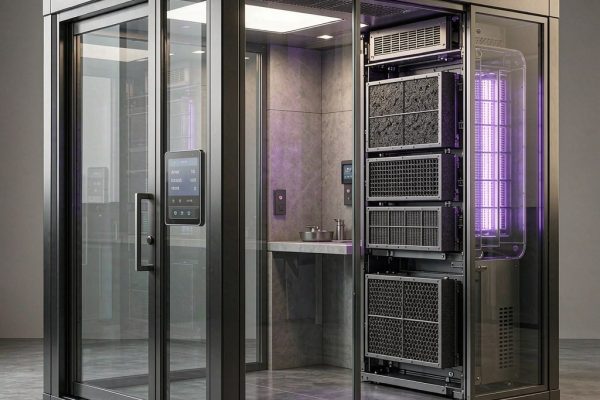
A minimum HEPA H13 filtration stage is required; H14 is recommended for high-occupancy rooms. Activated carbon pre-filtration (or a separate carbon stage) is essential for gaseous phase contaminants — nicotine, formaldehyde, acetaldehyde, and over 200 other VOCs in tobacco smoke that particulate filtration ca
ot address.
Filter Loading and Service Life in Tropical Conditions
Tobacco smoke loading rates vary with occupancy:
– Per-cigarette particle emission: approximately 7–14 mg of particulate matter
– Per-occupant daily load (average 5 cigarettes): 35–70 mg particulate
– 4-occupant room, 8-hour day: 140–280 mg/day
HEPA H13 filter panel (610 × 610 × 292 mm, typical capacity 400–600 g particulate) service life estimate:
– At 280 mg/day loading: 1,400–2,100 days (3.8–5.8 years) — theoretical
– Practical replacement interval: 12–18 months (accounting for humidity degradation, microbial growth in tropical conditions, and safety margin)
In Southeast Asian tropical conditions (RH 80–95%), filter media moisture absorption accelerates structural degradation and microbial colonization. Pre-filtration with a moisture-resistant synthetic media (ePM₁ ≥65%, ISO 16890) extends HEPA service life by 30–50%.
Air Curtain and Door Containment Enhancement
Air Curtain Design at Entrance
An air curtain at the smoking room entrance provides an additional containment barrier during door-closing intervals and reduces the instantaneous smoke burst that occurs when the door opens. Design parameters:
– Air curtain velocity at nozzle: 8–12 m/s
– Nozzle width: 100–150 mm across full door width
– Installation height: 50–100 mm above door header
– Angle: 15–20° inward from vertical (directing air into the room)
– Flow rate: 1,200–2,400 m³/h for standard 0.9 m door width
The air curtain reduces transient smoke leakage during door-open events by 60–80%, but does not substitute for the continuous negative pressure differential requirement.
Self-Closing Door Mechanism
A self-closing door mechanism (spring hinge or hydraulic closer) with closing time of 3–5 seconds is mandatory. The door must achieve full closure and seal (achieving the designed leakage area) within this window to restore negative pressure containment.
Energy Optimization for Tropical Climate Deployment
Heat Recovery Considerations
Since smoking rooms require 100% exhaust with no recirculation, the exhausted conditioned air represents a significant energy loss in air-conditioned buildings. Heat recovery options:
– Enthalpy wheel: Recovers 65–75% of cooling energy from exhaust air. However, tobacco smoke contamination of the wheel surface is a concern — requires segregated wheel sections or bypass during high-occupancy periods.
– Run-around coil: Indirect heat recovery with no cross-contamination risk. Recovery efficiency 40–55%, suitable for tropical applications where the primary energy cost is dehumidification rather than sensible cooling.
In Southeast Asian climates, the enthalpy recovery focus should be on latent heat (humidity) rather than sensible temperature, as 60–70% of air conditioning energy in tropical buildings is consumed by moisture removal.
Conclusion
Effective smoking room containment requires a systematic approach combining negative pressure differential control (minimum —5 Pa, recommended —10 Pa), adequate ventilation air change rates (10–20 ACH per ASHRAE 62.1), HEPA H13+ particulate filtration with activated carbon VOC removal, and entrance air curtain enhancement. Southeast Asian deployment demands additional attention to humidity effects on filter service life, energy recovery optimization for air-conditioned buildings, and local building code compliance. Proper engineering of these elements ensures occupant comfort, regulatory compliance, and protection of adjacent indoor air quality.