## Introduction
A smoking room that does not exhaust smoke effectively becomes unpleasant for occupants and a health hazard for adjacent spaces. The exhaust fan is the heart of the ventilation system, but selecting the right size requires more than guessing a cubic-feet-per-minute value. Engineers must balance air changes per hour, capture velocity at the smoking source, duct pressure losses, and acceptable noise levels.
This article provides a practical method for sizing exhaust fans for indoor smoking rooms and smoking lounges, with examples and installation tips.
## Start With Room Volume and Occupancy
### Calculate Air Volume
The first step is to determine the room volume in cubic meters or cubic feet. For a smoking room measuring 3 m × 4 m × 2.7 m, the volume is 32.4 m³. In imperial units, a 10 ft × 12 ft × 9 ft room has a volume of 1,080 ft³.
### Determine Occupant Load
Local codes and ASHRAE guidelines typically recommend 60 cfm of outdoor air per person for smoking lounges, or about 30 L/s per person. For a four-person smoking room, that equals 240 cfm or 113 L/s. This value often governs the minimum outdoor air supply, while the exhaust fan must remove at least the same amount to maintain negative pressure.
## Air Changes Per Hour for Smoking Rooms
### Recommended ACH Range
For smoking rooms and smoking booths, the exhaust rate should provide 15–30 air changes per hour. A higher ACH is needed when:
– The room is small and has multiple simultaneous smokers.
– The design relies on general dilution rather than a local capture hood.
– Local codes or building standards specify a minimum ACH.
### Example Calculation
For the 32.4 m³ smoking room with a target of 20 ACH:
Exhaust airflow = 32.4 m³ × 20 / 60 = 10.8 m³/min = 648 m³/h
In imperial units, 1,080 ft³ × 20 / 60 = 360 cfm.
The fan must deliver this airflow against the static pressure of the duct system, filters, and louvers.
## Capture Velocity vs Dilution Ventilation
### Why Capture Velocity Matters
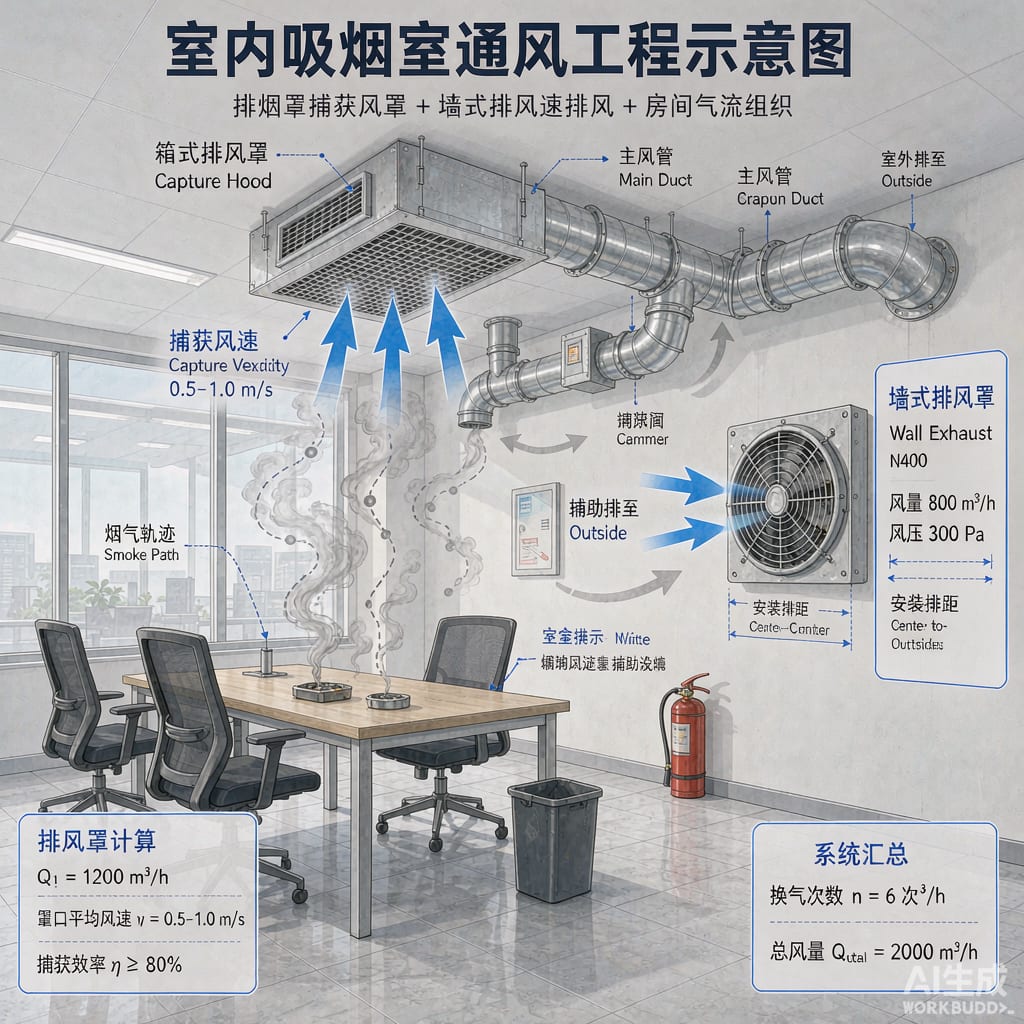
Air changes dilute smoke throughout the room, but dilution is inefficient. The most effective strategy is to capture smoke at the source before it mixes with room air. A capture hood or overhead canopy above a smoking table should provide a capture velocity of 0.25–0.5 m/s at the point where smoke rises.
### Hood Airflow Formula
The airflow required by a capture hood depends on the opening area and the target velocity:
Q = A × V
where Q is airflow, A is hood face area, and V is capture velocity. For a hood 0.6 m × 0.6 m with a target velocity of 0.35 m/s:
Q = 0.36 m² × 0.35 m/s = 0.126 m³/s = 456 m³/h
A room with four such smoking stations would need 1,824 m³/h just for the hoods, plus additional airflow for general ventilation.
## Duct Layout and Static Pressure
### Minimize Pressure Loss
Every elbow, transition, filter, and louver adds resistance. A poorly designed duct can double the required fan power. Best practices include:
– Use smooth, gradual bends instead of sharp elbows.
– Keep duct runs as short and straight as possible.
– Size ducts for air velocities of 5–8 m/s to balance noise and pressure drop.
– Include access doors for filter and duct cleaning.
### Negative Pressure Control
The smoking room should operate at a slight negative pressure relative to adjacent spaces, typically 2.5–12 Pa. This prevents smoke migration through doors and wall penetrations. The exhaust fan should be sized slightly larger than the supply fan, or the room should have no dedicated supply and rely on transfer air from surrounding areas.
## Noise Control
Exhaust fans can generate noise that disturbs nearby offices or hotel guests. Noise control measures include:
– Selecting a fan with a low sone rating.
– Installing flexible duct co
ections to isolate vibration.
– Lining the first few meters of duct with acoustic insulation.
– Using variable speed drives to reduce airflow and noise during low-occupancy periods.
## Filter and Maintenance Considerations
Exhaust air from smoking rooms contains tar, nicotine, and odor compounds. A simple axial fan blowing directly outside may satisfy airflow but will create complaints from neighbors and dirty the duct quickly. A better design includes:
– A pre-filter to capture large particles.
– An activated carbon stage for odor and gas removal.
– A final filter before the fan to protect the impeller.
Filters add static pressure, so the fan selection must account for the pressure drop across dirty filters, not just clean ones.
## Conclusion
Sizing an exhaust fan for a smoking room requires balancing air changes per hour, capture velocity, duct pressure losses, and noise. A well-designed system captures smoke at the source with local hoods, maintains negative pressure to protect adjacent spaces, and includes filtration to reduce odor and maintenance. For most indoor smoking rooms, an exhaust rate of 15–30 ACH with capture velocities of 0.25–0.5 m/s provides a good starting point for compliant, comfortable operation.