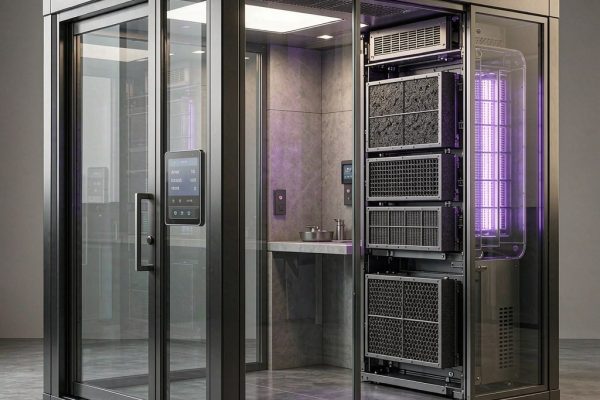
A well-built smoking room holds smoke inside through negative pressure alone, right up until someone opens the door. Every door swing trades a slug of smoky room air for clean corridor air, and in busy venues the door is open a surprising fraction of the time. The standard architectural answer is an airlock: a small double-door vestibule that isolates the smoking room from the clean space outside it. Done well, an airlock reduces smoke migration to near zero without heroic exhaust rates. This guide covers why single-door rooms leak, how to size and ventilate a vestibule, and the hardware and verification details that separate a working airlock from an expensive hallway.
Why Single-Door Smoking Rooms Leak Smoke
Negative pressure only moves air when there is an opening. With the door closed, the room exhausts more air than it receives and draws replacement air invisibly through gaps. When the door opens, two effects take over. First, turbulent exchange: the swinging door and the passing body stir the two air masses, and each opening can exchange several room-volumes of air with the corridor depending on door width, swing speed, and dwell time. Second, direction reversal: if the corridor is momentarily at higher pressure, or the building’s stack effect or HVAC cycling shifts pressures, air flows outward at floor level and inward at head height, carrying the smoke layer with it. In tall buildings and wind-exposed lobbies, these pressure reversals happen daily.
The Airlock Principle: Two Doors, One Pressure Buffer
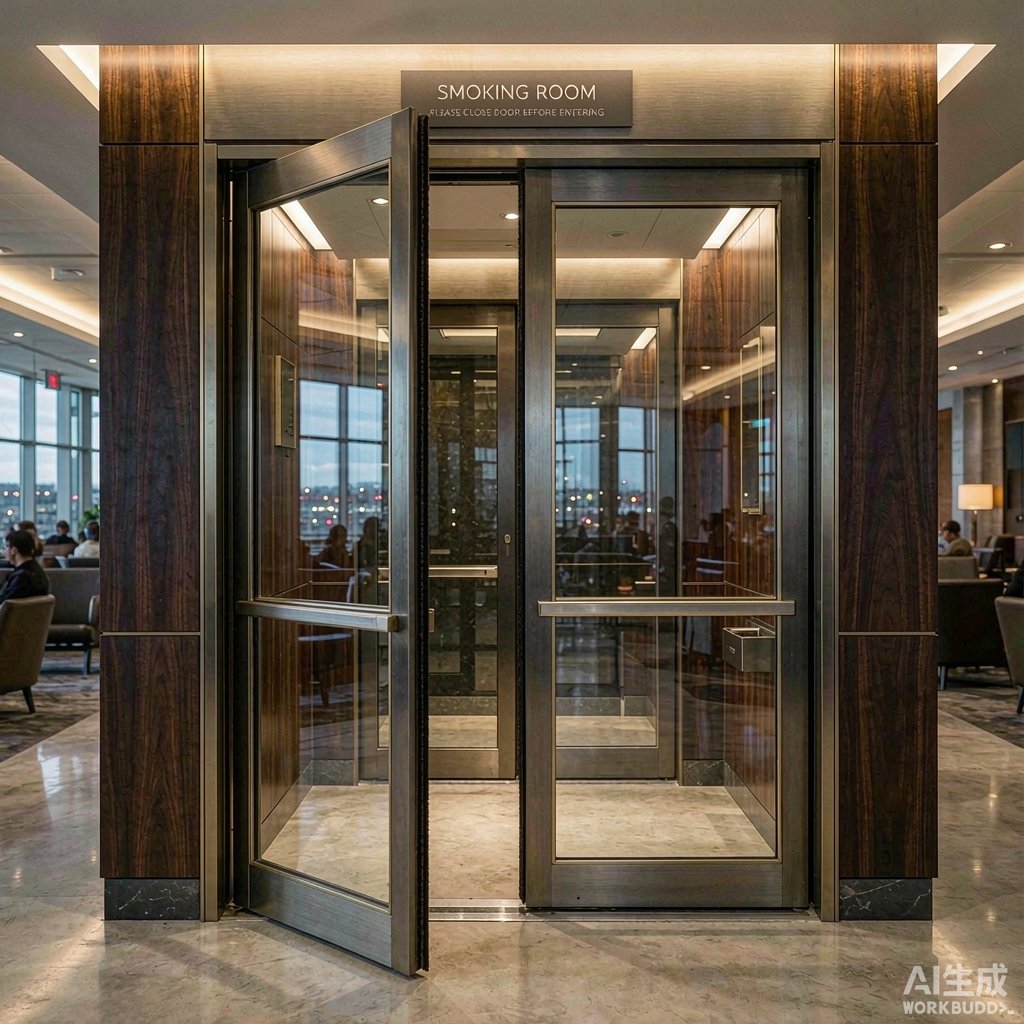
A vestibule inserts a small buffer volume between the smoking room and the clean zone. Smoke that escapes through the first door is trapped in a few cubic meters of buffer air instead of several hundred cubic meters of lobby. The vestibule is held at an intermediate pressure, below the corridor and above the smoking room, so air always drifts from clean toward smoky and never the reverse. Both doors are self-closing, and ideally interlocked so only one can be open at a time. The result is that even during peak traffic the clean zone sees only the dilute residue of the buffer, which the exhaust system strips continuously.
Sizing the Vestibule
Practical vestibules run from roughly 3 to 8 square meters of floor area with a clear depth of at least 1.5 to 2 meters, large enough to comply with accessibility requirements and to let one person close the first door before opening the second. Volume cuts both ways: a bigger buffer dilutes smoke that leaks in but takes longer to purge between users, and it costs saleable floor area. Airports and hotels often choose 5 to 10 cubic meters as a balanced middle ground, sized around their expected peak traffic rather than the minimum code envelope.
Ventilating a Smoking Room with an Airlock
The airlock changes the ventilation arithmetic in a helpful way. The main room still runs exhaust-driven and negative, with supply air held to roughly 80 to 90 percent of exhaust so the deficit is drawn through the vestibule and any controlled leakage path, keeping airflow directional at all times. Air changes of ten per hour or more, sized around the exhaust fan using capture-velocity and air-change methods, remain the baseline. The vestibule itself may share the main room’s exhaust, or better, take a small dedicated exhaust tap so the buffer is continuously flushed even when both doors are closed. What the vestibule buys you is tolerance: pressure setpoints of a few pascals, which are fragile with a single door, become robust because the door-opening event is contained.
Doors, Hardware, and Controls
Hardware determines whether the airlock actually functions in daily use:
- Self-closing doors with adjustable closers, verified to latch fully every time; a door that lags open undoes the entire concept.
- Interlocks or hold-open timers: the gold standard is an electrical or mechanical interlock so both doors never open simultaneously; timed automatic sliding doors are the comfortable premium option in airports.
- Vision panels so users can see the far door is clear, which shortens dwell time and prevents door-against-person collisions.
- Sealed frames and drop seals on the vestibule’s outer door to keep corridor air entering only where the designer intended.
- Fire-rated door assemblies where the smoking room shares a rated corridor, per local code.
Materials and Build Quality
The vestibule endures the worst of both worlds: moisture, ash residue, and constant door traffic. Tempered or laminated glass sidelights and doors keep sightlines open and simplify supervision; powder-coated steel or stainless framing resists corrosion and cleans easily; joints and wall penetrations must be sealed with compliant sealant so the pressure boundaries stay airtight. Flooring should be non-absorbent and easy to mop, and fixtures need ashtrays positioned so users are not tempted to prop a door with a foot or a chair.
Commissioning and Ongoing Verification
An airlock is a pressure machine, and pressure machines need commissioning. Balance the exhaust and supply to hit the design differential between corridor, vestibule, and smoking room, and record the manometer readings as the acceptance baseline. Walk the doors with a smoke pencil or puffer: with both doors closed, smoke should drift steadily inward through every gap; with one door open, the visible drift should still point toward the smoking room. Then re-check quarterly, because ducts foul, closers drift, and building HVAC schedules change. A differential pressure sensor wired to the building management system with a low-pressure alarm turns silent failure into a maintenance ticket, which is the difference between a smoking room that stays compliant for years and one that quietly becomes the corridor’s problem.
Conclusion
A double-door airlock converts the smoking room’s hardest problem, the open door, into a small, continuously flushed buffer that the exhaust system can dominate. The recipe is compact: a vestibule sized for accessibility and traffic, exhaust-driven negative pressure with directional airflow, self-closing or interlocked doors, durable sealed construction, and a commissioning and re-check routine that verifies pressure and drift. TechMartSe manufactures smoking booths and smoking rooms with optional airlock vestibules for offices, hotels, airports, and industrial campuses across Southeast Asia, engineered for negative pressure, easy maintenance, and code-compliant placement.