Introduction: Airborne Pathogen Risk in Smoking Booths
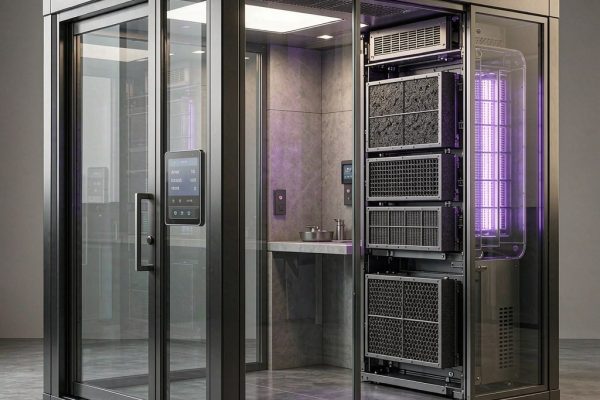
Modern smoking booths, designed to contain tobacco smoke and vape aerosol, also create enclosed micro-environments where airborne pathogens can concentrate. The combination of limited ventilation, continuous occupancy, and respiratory activity (talking, coughing) elevates infection transmission risk. Upper-room ultraviolet germicidal irradiation (UVGI) systems offer a proven engineering solution for inactivating airborne pathogens without exposing occupants to harmful UV doses. This article examines the design, safety, and performance of UV-C upper-room systems for smoking booth pathogen control.
UV-C Wavelength Selection: 254nm vs 222nm
Low-Pressure Mercury Lamp (254nm)
Traditional UV-C upper-room fixtures use low-pressure mercury vapor lamps emitting primarily at 253.7nm. This wavelength is near the peak germicidal effectiveness for DNA/RNA absorption (260-265nm), providing high pathogen inactivation efficiency.
- Germicidal effectiveness: 85-95% of peak (260nm)
- Lamp efficiency: 30-38% electrical-to-UV conversion
- Lamp lifetime: 8,000-12,000 hours (UV output degrades 15-25% per year)
- Safety concern: 254nm can cause photokeratitis and erythema at acute doses above 6mJ/cm²
- Cost: $80-250 per fixture (15-30W lamp)
KrCl Excimer Lamp (222nm)
Emerging far-UV-C technology uses krypton chloride excimer lamps emitting at 222nm. This wavelength is strongly absorbed by the outer layers of skin and eye tissue (stratum corneum and tear film), preventing penetration to living cells. Far-UV-C offers the potential for whole-room irradiation without the upper-room geometry constraint.
- Germicidal effectiveness: 70-80% of peak (slightly lower than 254nm but adequate)
- Lamp efficiency: 5-12% electrical-to-UV conversion
- Lamp lifetime: 3,000-5,000 hours (rapidly improving with technology)
- Safety profile: Threshold Limit Value (TLV) for skin is 161mJ/cm² (27x higher than 254nm)
- Cost: $300-800 per fixture (early-market pricing)
Upper-Room UVGI Design Principles
Irradiation Zone Geometry
Upper-room UVGI fixtures are mounted at a height of 2.1-2.4m (7-8 feet), directing the UV beam horizontally or slightly upward into the upper air volume above the occupied breathing zone. A louver or parabolic reflector shapes the beam to maintain a sharp vertical cutoff, ensuring that UV irradiance at the 1.8m (6 foot) occupant breathing height remains below the ACGIH TLV of 6mJ/cm² for 254nm over an 8-hour exposure.
The irradiation zone typically extends 3-6m horizontally and 0.3-0.6m vertically, creating a high-intensity UV treatment volume above the occupants. Natural convection and air mixing continuously transport airborne pathogens from the breathing zone upward through the irradiation zone, where they receive a lethal UV dose.
Air Mixing and Dose Delivery
The effectiveness of upper-room UVGI depends on air exchange between the breathing zone and the irradiation zone. In smoking booths with mechanical ventilation (35-60 ACH), the air mixing efficiency is high, ensuring that the entire room air volume passes through the UV treatment zone every 1-2 minutes. The equivalent clean air delivery rate (eCADR) can be calculated as:
eCADR = Q_room × (1 – e-kUV·V_UV/Q)
Where Q_room is the ventilation rate, kUV is the UV inactivation rate constant, and V_UV is the irradiation zone volume. For a smoking booth with 45 ACH and a 254nm fixture delivering 50 µW/cm² average irradiance, the eCADR typically achieves 2,500-4,000 equivalent ACH for pathogen control, far exceeding what mechanical ventilation alone can provide.
Pathogen Inactivation Performance
UV Dose-Response Relationships
The UV dose required for pathogen inactivation follows first-order kinetics: N/N0 = e-kD, where N/N0 is the surviving fraction, k is the pathogen-specific rate constant (cm²/mJ), and D is the UV dose (mJ/cm²). Representative k values and doses for 99% (2-log) and 99.9% (3-log) reduction:
| Pathogen | k (cm²/mJ) | 99% Kill Dose | 99.9% Kill Dose |
|---|---|---|---|
| SARS-CoV-2 | 0.41 | 11 mJ/cm² | 17 mJ/cm² |
| Influenza A | 0.52 | 9 mJ/cm² | 13 mJ/cm² |
| Mycobacterium tuberculosis | 0.38 | 12 mJ/cm² | 18 mJ/cm² |
| Adenovirus | 0.12 | 38 mJ/cm² | 57 mJ/cm² |
| Bacterial spores (B. subtilis) | 0.04 | 115 mJ/cm² | 173 mJ/cm² |
In the upper-room irradiation zone, air residence time of 3-5 seconds at 50-100 µW/cm² irradiance delivers a UV dose of 15-50 mJ/cm², sufficient for 2-3 log inactivation of most respiratory pathogens. Multiple passes through the irradiation zone accumulate the total dose, achieving 3-4 log overall reduction for room-scale pathogen concentrations.
ASHRAE 185.1 Compliance and Safety
ASHRAE Standard 185.1 provides the testing and rating methodology for UV-C systems in air-handling units and upper-room applications. Key compliance requirements include:
Fixture Performance Testing
- UV irradiance mapping at specified distances and angles
- Lamp output degradation over 8,000-hour rated life
- Beam cutoff angle verification (must achieve <0.2 µW/cm² at 1.8m height)
- Ballast electromagnetic compatibility per FCC Part 18
Occupant Safety
- Daily 8-hour TLV for 254nm: 6.0 mJ/cm² (ACGIH 2024)
- Daily 8-hour TLV for 222nm: 161 mJ/cm² (ACGIH 2024)
- Eye exposure monitoring: UV radiometer survey at occupant positions
- Warning labels and interlocked access panels for maintenance
- Lamp warm-up time: 3-5 minutes to reach full output (requires pre-occupancy activation)
Integration with Smoking Booth Ventilation
In smoking booths, the UV-C upper-room system works synergistically with the existing HEPA and activated carbon filtration system. The ventilation system handles particulate removal (PM2.5, smoke tar, vape droplets) and gas-phase adsorption (nicotine, formaldehyde, VOCs), while the UVGI system provides pathogen inactivation that no particle filter can achieve. This layered approach addresses all three primary indoor air quality concerns in smoking booths: particulate contamination, gaseous pollutants, and biological agents.
The recommended design sequence is: smoking booth ventilation rate 35-60 ACH → HEPA H13/H14 filtration (99.95% MPPS) → activated carbon adsorption (KI-impregnated for nicotine) → upper-room UV-C at 254nm (50-100 µW/cm²) or 222nm (100-200 µW/cm²). This integrated system achieves WHO PM2.5 targets (<15 µg/m³), formaldehyde levels below 0.05 mg/m³, and pathogen concentrations 2-4 log below ambient outdoor levels.
Maintenance and Lamp Replacement
UV-C lamp output degrades over time due to electrode sputtering, mercury depletion, and quartz tube solarization. Recommended maintenance intervals:
- Lamp output measurement: Quarterly using a NIST-traceable UV radiometer
- Lamp replacement trigger: When output falls below 70% of new-lamp value (typically 9,000-12,000 hours for 254nm, 3,000-5,000 hours for 222nm)
- Quartz tube cleaning: Monthly with isopropyl alcohol to remove dust and tar residue (smoking booth environments require more frequent cleaning than general spaces)
- Reflector inspection: Semia
ually for tarnish, UV degradation, or misalignment
Conclusion
Upper-room UV-C germicidal irradiation provides a scientifically validated, ASHRAE 185.1-compliant method for airborne pathogen control in smoking booths. The 254nm mercury lamp technology offers proven performance and reasonable cost, while 222nm far-UV-C excimer lamps represent the future direction for occupant-safe whole-room irradiation. When integrated with existing HEPA and activated carbon filtration, the UVGI system completes a comprehensive three-layer air quality strategy that addresses particulate, gaseous, and biological contaminants simultaneously. Proper fixture installation, irradiance verification, and scheduled lamp maintenance are essential to maintaining the 2-4 log pathogen reduction performance that protects smoking booth occupants throughout the system’s operational life.