Particle Size Reality in Cigarette Smoke
One of the most common mistakes in smoking booth air filtration specification is to assume that cigarette smoke behaves like outdoor PM2.5 pollution. In fact, mainstream cigarette smoke has a count median diameter of 0.3 to 0.4 micrometres and a mass median diameter near 0.5 micrometres because of the high density of liquid tar droplets. Side-stream smoke condenses even further to 0.05 to 0.2 micrometres ultrafines. Designing the booth for PM2.5 misses the actual challenge.
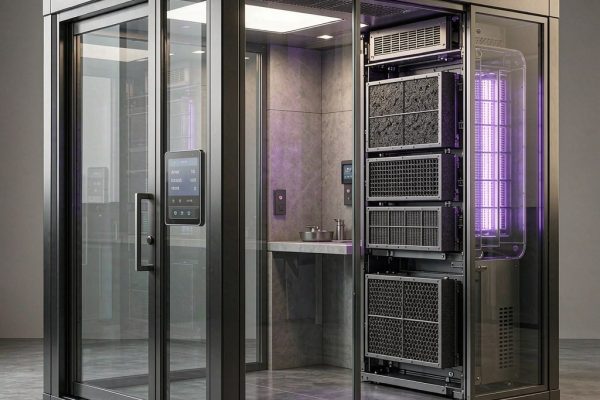
At TechMart SE our smoking booth product line has been adopted in airports, hospitals, and high-traffic commercial buildings in Malaysia, Indonesia, Vietnam, and the Philippines. The filtration cascade is tuned to the actual particle physics, not to generic outdoor air targets.
Cut-Size and HEPA Grade Selection
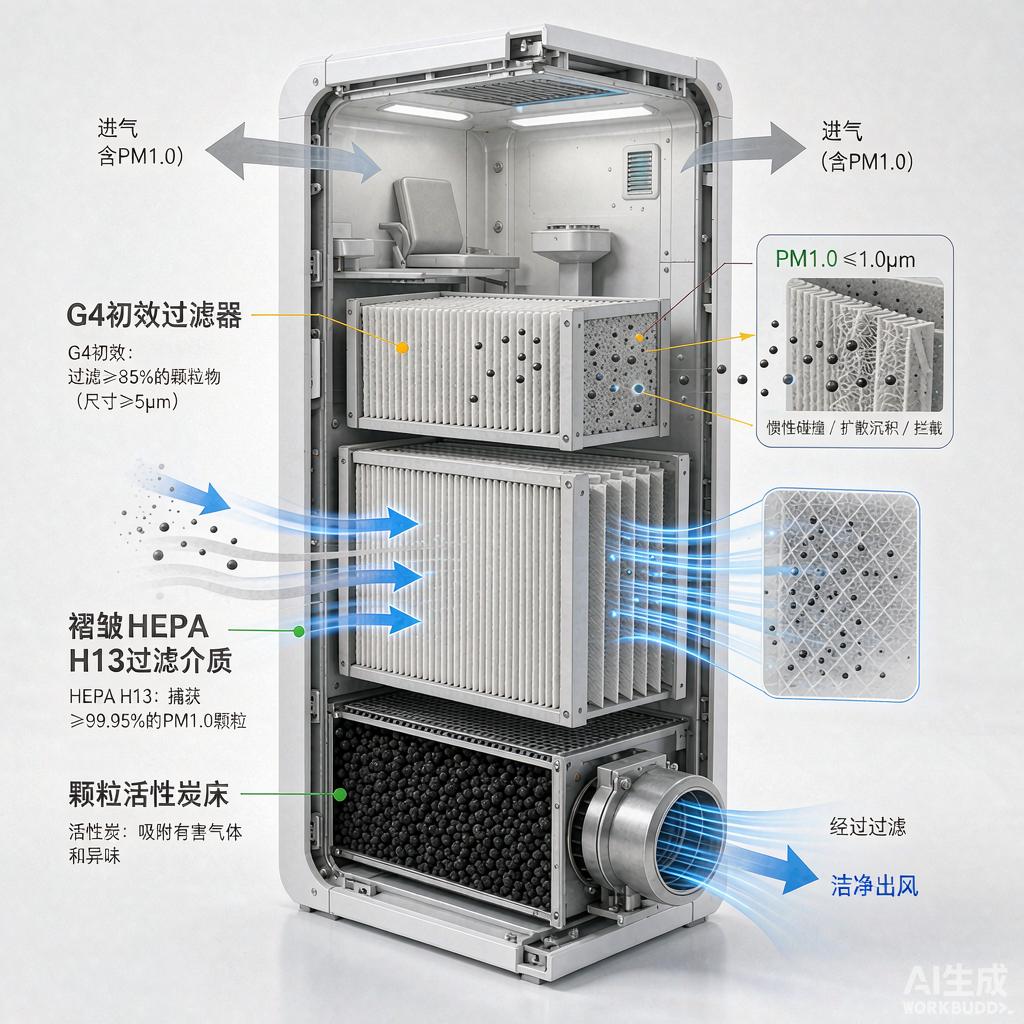
HEPA filter efficiency is rated at the most-penetrating-particle-size, MPPS, which is typically 0.1 to 0.3 micrometres. For cigarette smoke the relevant penetration window is right at this point, so do not over-spec by choosing ULPA U15 or higher unless the design must also capture viruses. A practical cascade for indoor smoking booths is:
- Pre-filter G4 grade (MERV 8, 1.0 micrometre cut-size at 90 percent) protects downstream media from lint and large debris, extending HEPA life by a factor of 3.
- HEPA H13 grade (MPPS 99.95 percent) captures the smoke droplet fraction with extreme reliability even at 5 to 10 grams per cigarette of particulate load.
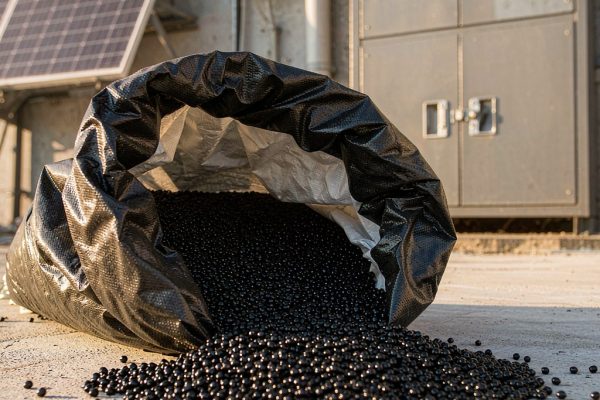
- Activated carbon 25 to 50 mm bed downstream of HEPA captures VOC and nicotine vapor that HEPA ca
ot touch.
Why H13 Is Usually the Sweet Spot
Specifying H14 or ULPA increases pressure drop by 30 to 60 percent at the same face velocity and shortens filter life in a smoke-loaded environment because the additional densification rarely pays back. On the other hand, choosing H10 or H11 to save money produces visible plume leakage in side-by-side public-area testing. H13 hits the 99.95 percent MPPS point that regulatory references such as EN 1822 and ASHRAE 145.1 use to define true HEPA media.
Air Changes per Hour for Source Control
Source control needs 35 to 60 air changes per hour (ACH) for a 4-square-metre booth when occupied by 3 to 5 smokers. At 35 ACH the steady-state PM2.5 settles at 60 to 90 micrograms per cubic metre, above the WHO 15 micrograms per cubic metre 24-hour guideline but acceptable for short-term occupational exposure. At 50 to 60 ACH the PM2.5 falls to 20 to 35 micrograms per cubic metre, suitable for a smoking booth immediately adjacent to non-smoking public areas.
Face Velocity and Filter Loading
Face velocity across the filter is normally held between 0.9 and 1.5 metres per second for pleated H13 media. Lower face velocity improves collection efficiency for 0.1 to 0.3 micrometre particles but increases pressure drop. Higher face velocity beyond 1.5 m/s shortens filter life by 30 to 50 percent in tobacco service. Our factory default is 1.2 m/s, with a 60 to 90 Pa clean pressure drop and a 250 to 350 Pa change-out trigger.
VOC and Nicotine Vapor Capture
Most of the toxic compounds in cigarette smoke are gases and vapours rather than particles. HEPA ca
ot capture them. Activated carbon with a surface area of 1000 to 1200 square metres per gram removes 70 to 90 percent of nicotine, acetaldehyde, and benzene at 0.1 to 0.3 seconds residence time. Impregnated carbon with potassium iodide or amino-functional treatment boosts capture of HCN and acrolein to 95 percent.
Maintenance Schedule for Tropical Service
Indoor booths with air conditioning run 12 to 16 hours per day. Expect pre-filter change every 4 to 6 weeks, HEPA change every 9 to 12 months, and carbon change every 6 to 8 months. Add differential pressure gauges upstream and downstream of each stage so facility teams can replace filters based on actual loading rather than calendar.