Introduction: Indoor Air Quality Is the Smoking Booth’s Primary Mission
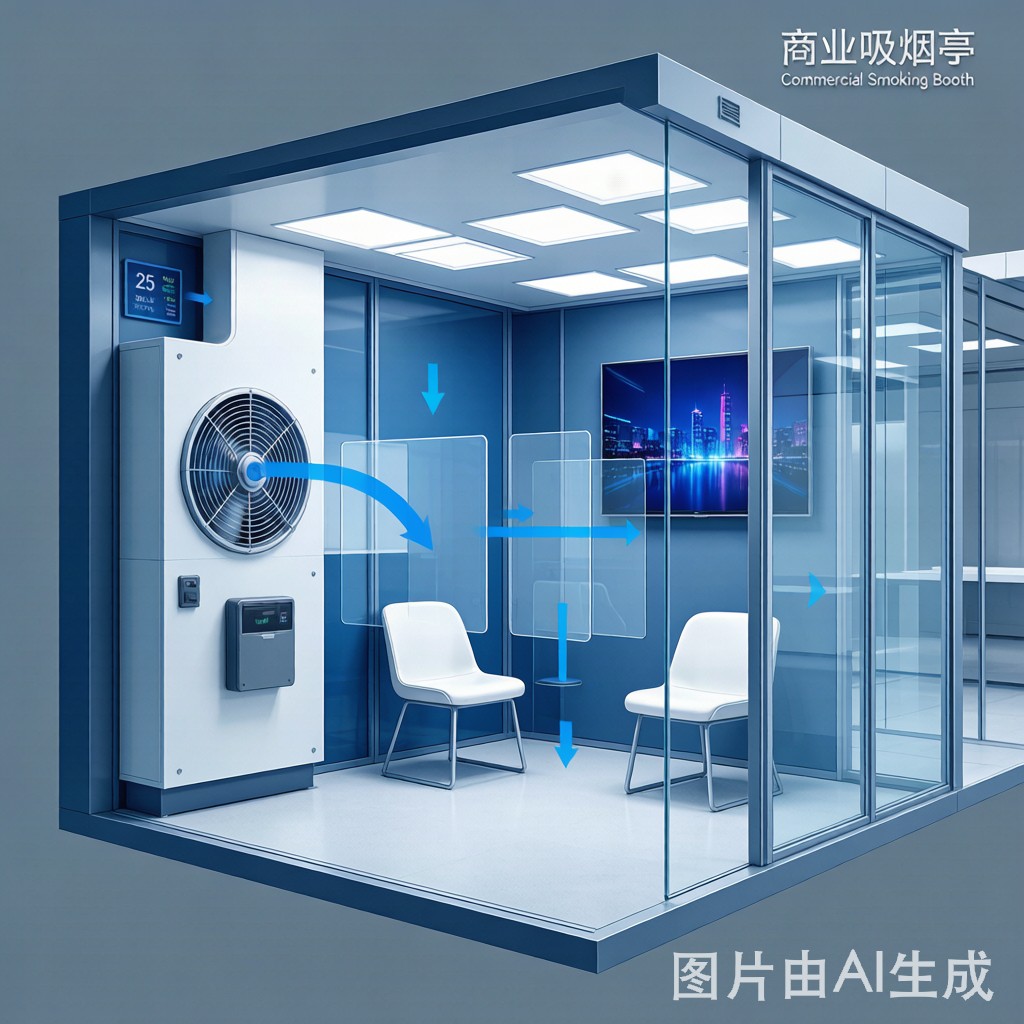
The fundamental purpose of a commercial smoking booth deployed inside an airport terminal, hospital lobby, or office building is not to provide a comfortable smoking lounge — it is to protect the building’s non-smoking occupants from environmental tobacco smoke (ETS) exposure. The booth must capture, filter, and contain particulate matter (PM2.5, PM10), volatile organic compounds (VOCs), carbon monoxide (CO), and odor compounds at sufficient rates to maintain the surrounding indoor space’s air quality within regulatory and comfort thresholds.
This mission-critical function depends on three engineering subsystems working in concert: (1) a multi-stage filtration train that removes particulates, gases, and odors at specified efficiency levels; (2) a real-time air quality monitoring system that continuously verifies filtration performance and triggers alerts when filter change is needed; and (3) a maintenance scheduling protocol that ensures filter elements are replaced before breakthrough occurs. This article provides an engineering framework for all three subsystems, with specific attention to the demanding conditions of high-traffic public facilities (airports, hospitals, shopping malls).
Multi-Stage Filtration Architecture
Stage 1: Pre-Filter (G4/MERV 8 — Coarse Particulate Removal)
The first filtration stage captures large airborne particles (>10 μm) — tobacco ash, paper fibers, lint, hair, and coarse dust — that would rapidly clog the downstream HEPA filter if not removed. G4-rated panel filters (per EN 779) or MERV 8 pleated filters (per ASHRAE 52.2) capture 90–95% of particles ≥10 μm with a typical pressure drop of 25–50 Pa at rated airflow.
Engineering considerations:
- Filter face velocity: 2.0–2.5 m/s (maximum to prevent particle re-entrainment from the filter surface)
- Filter media: Synthetic (polyester) non-woven — preferred over glass fiber for smoking booth applications because synthetic media is hydrophobic and resists moisture absorption from humid tobacco smoke
- Replacement interval: 1–3 months (high-traffic), based on pressure drop reaching 2× initial (typically 50 Pa → 100 Pa)
- Differential pressure gauge or manometer across pre-filter for visual maintenance indication
Stage 2: HEPA H13 Filter (Sub-Micron Particulate Removal)
The HEPA (High Efficiency Particulate Air) filter is the critical barrier for respirable particles — PM2.5 (particles ≤2.5 μm aerodynamic diameter) and PM1.0, which penetrate deep into the lungs’ alveolar regions. An H13 HEPA filter (per EN 1822) captures ≥99.95% of particles at the Most Penetrating Particle Size (MPPS, typically 0.1–0.3 μm) with a pressure drop of 120–250 Pa at rated airflow.
The MPPS is the particle size at which the combined capture mechanisms — inertial impaction (dominates ≥1 μm), interception (dominates 0.3–1 μm), and Brownian diffusion (dominates ≤0.1 μm) — have their minimum efficiency. Tobacco smoke particles have a complex bimodal distribution: the particulate phase has a mass median aerodynamic diameter of 0.3–0.5 μm with a count median diameter of 0.1–0.2 μm. H13 filters capture >99.95% of these particles by count.
Filter selection criteria for smoking booth applications:
- Frame material: Aluminum or stainless steel (not wood/particle board — moisture absorption in humid smoke environment causes warping and bypass leakage)
- Seal type: Continuous polyurethane gasket (not knife-edge seal — requires precision frame alignment that degrades with vibration and thermal cycling)
- Filter media: Microglass fiber paper with water-repellent treatment (hydrophobic binder resists moisture degradation)
- Temperature rating: ≥70°C continuous (tobacco smoke entering the filter near the smoking zone can be 40–60°C)
Stage 3: Activated Carbon / VOC Adsorption Filter
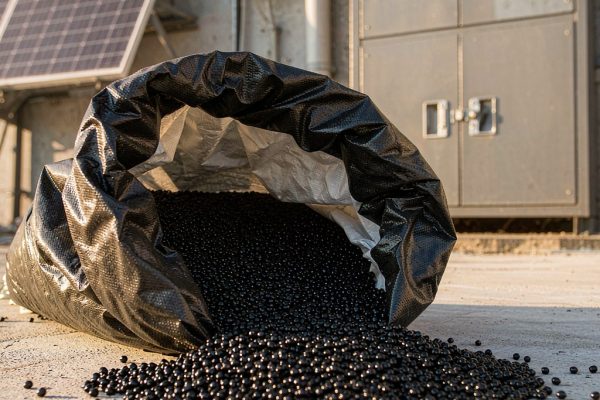
While HEPA filters capture particulates, they are transparent to gases and vapors — carbon monoxide, formaldehyde, acetaldehyde, benzene, toluene, and the hundreds of volatile organic compounds that constitute tobacco smoke’s odor signature pass through HEPA media unimpeded. An activated carbon filter adsorbs these compounds through physical adsorption in the carbon’s microporous structure (pore diameter 1–20 nm, surface area 800–1,200 m²/g per ASTM D4607 iodine number method).
| Carbon Filter Parameter | Recommended Specification | Notes |
|---|---|---|
| Carbon type | Coconut-shell based granular activated carbon (GAC) | Highest microporosity for VOC adsorption |
| Carbon bed depth | 25–50 mm | Deeper bed = longer residence time = higher removal efficiency |
| Face velocity | 0.2–0.5 m/s | Lower than pre-filter — required for adequate gas residence time (0.1–0.2 s) |
| Carbon mass per unit airflow | 5–10 kg per 100 m³/h | Determines service life before saturation |
| Expected service life | 3–6 months (high-traffic) | Based on odor breakthrough, not pressure drop (carbon filter ΔP remains low until carbon bed is physically clogged) |
| Impregnation option | KI (potassium iodide) or KMnO₄ impregnated carbon | Chemisorption of H₂S, formaldehyde — 2–3× capacity for these compounds vs plain GAC |
Carbon filter maintenance challenge: Unlike particulate filters where pressure drop rise signals loading, carbon filters provide no visual or mechanical indication of saturation — the carbon pores simply fill up and breakthrough occurs (detected as returning odor). This makes the PM2.5/VOC monitoring system (discussed below) essential for determining the actual carbon replacement interval rather than relying on a calendar-based schedule that may waste filter life or allow breakthrough.
Complete Filtration Train Performance
| Particle Size / Compound | Pre-Filter G4 | + HEPA H13 | + Activated Carbon | Overall System |
|---|---|---|---|---|
| PM10 (>10 μm) | 90–95% | 99.995% | — | >99.99% |
| PM2.5 (0.3–2.5 μm) | 5–15% | 99.95% | — | >99.95% |
| PM1.0 (0.1–1.0 μm) | 1–5% | 99.95% (MPPS) | — | >99.95% |
| Formaldehyde (HCHO) | 0% | 0% | 60–85% | 60–85% |
| Benzene, Toluene (BTEX) | 0% | 0% | 70–90% | 70–90% |
| Carbon Monoxide (CO) | 0% | 0% | <10% (not adsorbed) | Dilution-dependent |
| Odor compounds (total) | 5–10% | 5–10% | 75–95% | 80–95% |
CADR (Clean Air Delivery Rate) Calculation and Sizing
The Clean Air Delivery Rate (CADR) quantifies the effective clean air volume delivered by the filtration system, accounting for both airflow rate and filtration efficiency:
CADR = Q × η
Where Q is airflow rate (m³/h) and η is the single-pass removal efficiency (fraction). For a smoking booth with Q = 600 m³/h and overall PM2.5 η = 0.9995:
- CADR(PM2.5) = 600 × 0.9995 ≈ 600 m³/h
- For a booth interior volume of V = 15 m³, air changes per hour (ACH) = Q / V = 600 / 15 = 40 ACH
At 40 ACH, the booth air is completely filtered every 90 seconds. Combined with the >99.95% single-pass PM2.5 removal, the steady-state PM2.5 concentration inside the booth — even with 2–4 active smokers — can be maintained below 25 μg/m³ (WHO 24-hour guideline) provided adequate make-up air is supplied.
Sizing rule for high-traffic facilities: Each active smoker generates approximately 10–15 mg of PM2.5 per cigarette. With 4 smokers at 2 cigarettes/hour each, the emission rate is 80–120 mg PM2.5/hour. At CADR = 600 m³/h and a booth volume of 15 m³, the steady-state concentration is:
Steady-state C = Emission Rate / CADR = 100 mg/h / 600 m³/h ≈ 0.17 mg/m³ = 170 μg/m³
While this exceeds the 25 μg/m³ WHO guideline, the filtered exhaust (≥99.95% PM2.5 removal) discharges at near-zero concentration to the building exterior — the booth functions as a containment system, not a dilution system. The building’s non-smoking air remains protected.
Real-Time Air Quality Monitoring System
Sensor Selection and Placement
| Parameter | Sensor Type | Range | Accuracy | Placement |
|---|---|---|---|---|
| PM2.5 / PM10 | Laser scattering (plantower PMS5003 or Sensirion SPS30) | 0–1,000 μg/m³ | ±10 μg/m³ (0–100), ±10% (>100) | Booth interior, breathing zone (1.5 m height); exhaust duct (post-filter verification) |
| TVOC (Total VOC) | Metal-oxide semiconductor (MOS) — Sensirion SGP40 or Bosch BME688 | 0–60,000 ppb | ±15% of reading (calibrated to ethanol equivalent) | Exhaust duct after carbon filter (detects carbon saturation breakthrough) |
| CO₂ | NDIR (Non-Dispersive Infrared) — Sensirion SCD40 | 0–40,000 ppm | ±50 ppm + 3% of reading | Booth interior (occupancy indicator and ventilation adequacy) |
| Temperature / Humidity | Digital (Sensirion SHT40) | -40 to +125°C / 0–100% RH | ±0.2°C / ±1.8% RH | Booth interior center |
Monitoring Logic and Alert Thresholds
- PM2.5 alert (interior): >150 μg/m³ sustained for 5 minutes → indicates filtration airflow inadequate, filter bypass, or door left open. Trigger visual indicator (red LED on booth display panel) and SMS/email alert to facilities management.
- PM2.5 post-filter (exhaust duct): >10 μg/m³ → HEPA filter compromised (tear, improper seating, or end-of-life). Immediate maintenance call.
- TVOC upward trend (exhaust duct): 20% increase from baseline over 1 week → carbon filter approaching saturation. Schedule replacement within 2 weeks.
- CO₂ >1,500 ppm: Insufficient ventilation. Increase make-up air or reduce occupancy.
Filter Maintenance Scheduling Protocol
Preventive Maintenance Intervals
| Filter Stage | High-Traffic (Airport/Hospital) >200 users/day |
Medium-Traffic (Office) 50–200 users/day |
Low-Traffic (Hotel) <50 users/day |
|---|---|---|---|
| Pre-filter G4 | Monthly replacement | Every 2 months | Every 3 months |
| HEPA H13 | Every 6 months | Every 12 months | Every 18 months |
| Activated Carbon | Every 3–4 months | Every 6 months | Every 12 months |
| PM2.5 sensor calibration | Every 6 months | Every 12 months | Every 12 months |
Condition-based maintenance triggers: Replace HEPA when differential pressure reaches 2.5× initial (e.g., 120 Pa → 300 Pa) OR when exhaust PM2.5 sensor detects >10 μg/m³. Replace carbon when TVOC sensor trend rises 20% from post-replacement baseline. The monitoring system should log filter replacement dates, pressure drop values, and sensor readings for compliance auditing — particularly important for hospital deployments where air quality records may be subject to regulatory inspection.
High-Traffic Facility Design Considerations
Airport Deployments
Airport smoking booths face the highest usage intensity — 500–1,000+ users per day in major international terminals — and operate 18–24 hours/day. Specific requirements:
- Redundant filtration: Two parallel filtration trains, each sized for 100% of design airflow — one unit can be taken offline for filter replacement without interrupting booth operation.
- Filter access: Hinged, tool-less filter access panels on the booth exterior (not interior) so maintenance staff can replace filters without entering the smoking booth.
- Duty cycle rating: Fan motors rated for continuous operation (S1 duty, 40,000+ hours bearing life) with EC motor technology for energy efficiency at variable speed.
- Self-diagnostic system: Automated filter life tracking with countdown display on booth exterior — “Filter change due in 150 hours” — visible to maintenance staff without accessing the monitoring system.
Hospital Deployments
Hospital smoking booths (typically for staff, not patients) require additional infection control considerations:
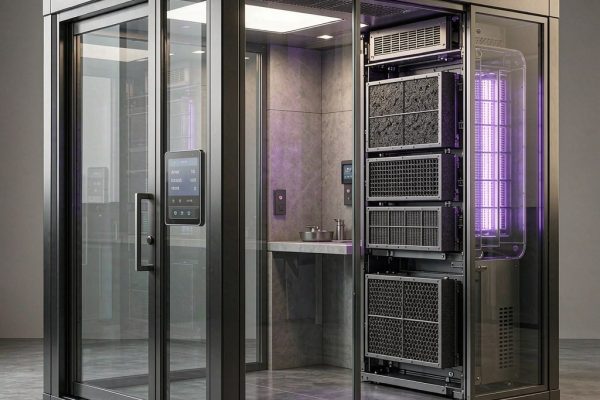
- UV-C germicidal irradiation: Optional UV-C lamp (254 nm, 10,000 μW·s/cm² dose) in the HEPA filter plenum for inactivation of airborne pathogens captured on the filter media. Note: UV-C lamp must be shielded to prevent polymer filter frame degradation.
- Antimicrobial filter treatment: HEPA media with silver-ion antimicrobial treatment (prevents bacterial colonization on the filter surface in humid environments).
- Negative pressure verification: Differential pressure sensor between booth and surrounding hospital corridor — alarm if ΔP drops below -2.5 Pa (smoke ingress risk into hospital air space).
Conclusion
A properly engineered multi-stage air filtration system — G4 pre-filter → HEPA H13 → activated carbon with KI/KMnO₄ impregnation — combined with real-time PM2.5/TVOC/CO₂ monitoring and condition-based maintenance scheduling, transforms the commercial smoking booth from a simple shelter into a validated indoor air quality protection device. The system achieves >99.95% PM2.5 removal efficiency, 75–95% odor compound adsorption, and continuous real-time verification of filtration integrity — essential for high-traffic public facilities (airports, hospitals) where a single filtration failure event can trigger occupant complaints, regulatory citations, and reputational damage. The incremental cost of monitoring sensors and automated alerts ($200–400 per booth in components) is recovered many times over through: (1) avoidance of premature filter replacement (saving $100–300/year in u
ecessary filter consumption); (2) prevention of filter breakthrough incidents that require emergency maintenance callouts ($150–300 per incident); and (3) documented air quality compliance records that support facility management liability defense.