Smoking booth construction typically involves composite wood panels for interior finishes, cabinetry, seating, and work surfaces. These panels — particularly medium-density fiberboard (MDF), particleboard, and standard hardwood plywood — are bonded with urea-formaldehyde (UF), phenol-formaldehyde (PF), or melamine-formaldehyde (MF) resins that continue to release free formaldehyde and volatile organic compounds (VOCs) into the enclosed booth air for months to years after manufacture. In a small-volume smoking booth of 6-15 m³ internal volume with limited air exchange during standby, formaldehyde concentrations can exceed WHO indoor air quality guidelines (0.1 mg/m³, 30-minute average) and cause occupant complaints, regulatory non-compliance, and long-term health concerns. This article examines the engineering principles, material selection, testing methodology, and mitigation strategy for formaldehyde and VOC off-gassing in smoking booth composite panel applications.
Formaldehyde Emission Sources
Resin Chemistry and Off-Gassing Mechanism
Formaldehyde emission from composite wood panels is governed by the resin chemistry, panel density, and ambient conditions inside the booth:
| Panel Type | Typical Resin | Formaldehyde Emission (mg/m³ chamber, 24h) | Formaldehyde Class (European E-standard) |
|---|---|---|---|
| Particleboard (PB), standard UF | Urea-formaldehyde | 0.3-0.8 | E2 / E1 borderline |
| Medium-Density Fiberboard (MDF), UF | Urea-formaldehyde | 0.4-1.2 | E2 (non-compliant for indoor) |
| MDF, low-emission UF | Modified urea-formaldehyde | 0.1-0.3 | E1 (compliant) |
| MDF, no-added-formaldehyde (NAF) | MDI polyurethane or soy-based | <0.05 | Super E0 / NAF |
| Hardwood plywood, interior | UF or MF | 0.2-0.5 | E1 |
| Hardwood plywood, exterior | Phenol-formaldehyde (PF) | 0.02-0.08 | E0 (lowest) |
| Phenolic composite panel | PF + cellulose fiber | 0.01-0.05 | E0 / NAF equivalent |
| Compact laminate (HPL) | PF + kraft paper | 0.01-0.03 | E0 |
For smoking booth interior surfaces, the specification must clearly require E1 or lower emission class panels, with NAF (no-added-formaldehyde) or phenolic-bonded materials preferred for high-traffic installations in healthcare, education, and hospitality settings.
Other VOC Emissions Beyond Formaldehyde
Volatile Organic Compound Profile
Composite panels also emit a complex mixture of VOCs that contribute to indoor air quality problems and odor complaints:
- Aromatic VOCs: Toluene, ethylbenzene, xylene from solvent-based adhesives and edge banding; typical emission 50-200 µg/m³ per compound after 24h.
- Aliphatic aldehydes: Acetaldehyde, propanal, hexanal from wood extractives and panel aging; 20-80 µg/m³ range.
- Terpenes: α-pinene, β-pinene, limonene from softwood components; 100-500 µg/m³ in pine-containing panels.
- Acetic acid: From wood hydrolysis, especially in high-humidity environments; 50-200 µg/m³.
- Phenol and cresols: From phenolic resin breakdown in hot/humid conditions; 5-30 µg/m³.
Total VOC (TVOC) emissions in newly installed smoking booths can reach 1,000-3,000 µg/m³ during the first 1-4 weeks, declining to 200-500 µg/m³ equilibrium after 3-6 months of ventilation. Smoking booth occupants entering during this initial off-gassing peak frequently report eye, nose, and throat irritation that is misattributed to secondhand smoke.
Chamber Testing Methodology
ASTM E1333 and Equivalent Standards
Formaldehyde emission from composite panels is quantified using large-chamber test methods that simulate real-world conditions:
- ASTM E1333 (Large Chamber Test): 22-25 m³ stainless steel chamber, 25°C, 50% RH, 0.5 air change per hour, panel loading 0.43 m²/m³; sample collected at 2-4 hours via impinger with DNPH, analyzed by HPLC. Result reported in mg/m³ or ppm.
- EN 717-1 (European Chamber): 1 m³ chamber, 23°C, 45% RH, 1.0 ACH; emission reported in mg/m³ after equilibrium (typically 7-28 days).
- JIS A 5905 (Japanese): Desiccator method, 24h at 20°C; rapid screening test widely used in Asia.
- ASTM D6007 (Small Chamber): 0.225 m³ chamber for quality control testing; 1-hour analysis time.
For smoking booth material specification, the supplier should provide ASTM E1333 or EN 717-1 third-party test reports with the panel lot number traceable to the actual product supplied. Generic CARB Phase 2 or E1 claims without supporting test certificates are not sufficient for premium installations.
Target Emission Levels for Smoking Booths
Indoor Air Quality Standards
Smoking booth interiors should meet the most stringent of the following guidelines to ensure occupant comfort and regulatory compliance:
| Standard / Guideline | Formaldehyde Limit | TVOC Guideline | Notes |
|---|---|---|---|
| WHO Indoor Air Quality Guidelines (2010) | 0.1 mg/m³ (30-min average) | No specific TVOC limit | Reference standard for international installations |
| ASHRAE 62.1-2022 | 33 µg/m³ (0.033 mg/m³) | 500 µg/m³ (within 24h of installation) | Most stringent; LEED certified buildings |
| EU Indoor Air Quality (1989) | 0.124 mg/m³ | — | European commercial buildings |
| China GB/T 18883-2002 | 0.10 mg/m³ (1-hour) | 600 µg/m³ | Mainland China standard |
| Singapore BCA Green Mark | 0.05 mg/m³ | 300 µg/m³ | Tropical climate zone requirement |
| Hong Kong BEAM Plus | 0.05 mg/m³ | 200 µg/m³ | Premium indoor air quality |
For premium Southeast Asian installations, Singapore BCA Green Mark or Hong Kong BEAM Plus level specifications (0.05 mg/m³ formaldehyde, 200-300 µg/m³ TVOC) are recommended targets that require NAF or phenolic-bonded panels throughout the booth interior.
Material Selection Strategy
Low-Emission Panel Options for Smoking Booths
The composite panel specification for smoking booth construction should follow a tiered approach based on application criticality:
- Premium tier (medical, educational, government): NAF MDF or phenolic compact laminate; 0.01-0.05 mg/m³ formaldehyde; cost premium 30-50% over standard E1.
- Standard commercial tier (airport, mall, hotel): E1-class MDF with edge sealing; 0.05-0.124 mg/m³ formaldehyde; cost premium 5-15%.
- Budget tier (outdoor transient structures): E2-class plywood is acceptable for ventilated outdoor smoking structures with ≥2 ACH continuous ventilation.
Edge sealing of cut panels is critical — the cut edges of MDF or particleboard emit 5-10x more formaldehyde than the original surface because the sealing overlay is removed. All field-cut edges must be sealed with low-VOC edge banding tape, aluminum profile wrapping, or two coats of low-VOC polyurethane sealer before installation.
Mitigation and Post-Installation Treatment
Ventilation and Air Cleaning
Even with low-emission panel selection, post-installation mitigation can further reduce occupant exposure to residual off-gassing:
- Bake-out procedure: Heat booth to 35-40°C with full fresh-air ventilation (5-10 ACH) for 5-7 days before occupancy; accelerates off-gassing by 3-5x.
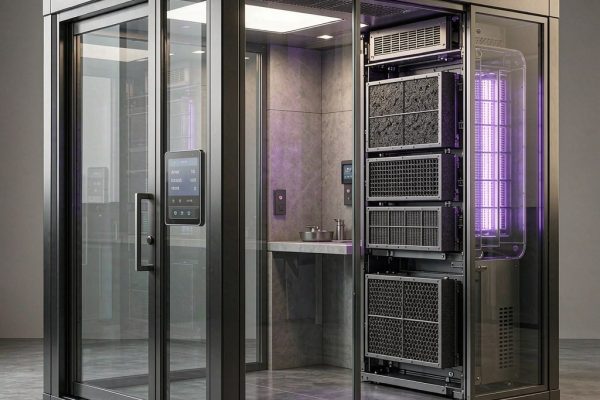
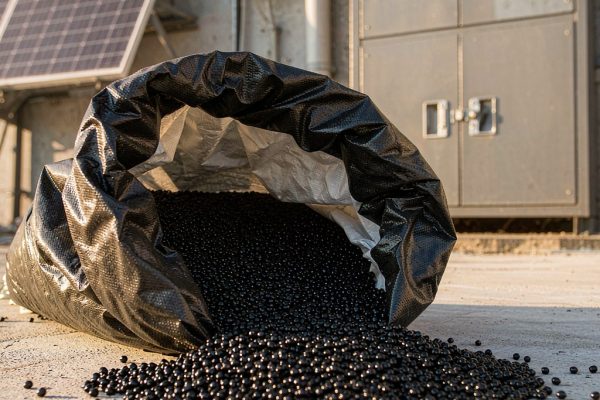
- Activated carbon pre-filter: 5-10 kg of impregnated activated carbon in supply air stream; removes 60-80% of formaldehyde and TVOC over first 3-6 months.
- Photocatalytic oxidation (PCO): TiO₂ + UV-A oxidation stage in supply air; effective for formaldehyde HCHO → CO₂ + H₂O; 70-90% removal efficiency.
- Ventilation rate: Maintain minimum 1.0-1.5 ACH during occupied periods; ASHRAE 62.1 baseline 0.6 ACH is insufficient for new installation off-gassing.
The combination of NAF or phenolic panel specification, complete edge sealing, pre-occupancy bake-out, and photocatalytic supply air treatment can achieve <0.03 mg/m³ formaldehyde steady-state in smoking booth interiors — well below all major international IAQ guidelines. The 30-50% material cost premium for premium panels is typically recovered within 3-5 years through reduced complaints, lower HVAC filtration cost, and improved occupant satisfaction in commercial smoking booth installations.