Why Fire Safety Defines Smoking Booth Acceptance
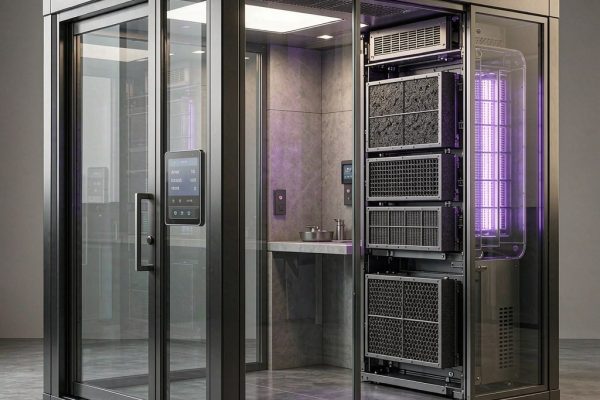
Building managers, fire marshals, and insurance carriers treat smoking booths differently from ordinary furniture. The combination of an active ignition source (lit cigarette), enclosed space, potentially intoxicated occupants, and electrical ventilation equipment creates risk that building codes address through specific certification pathways. A smoking booth that meets fire safety standards can be installed in airports, hospitals, factories, and high-rise offices; one that does not is frequently rejected at the design review stage or removed after a routine inspection. This article covers the four pillars of smoking booth fire safety: self-extinguishing panel certification, cigarette disposal chamber design, fire damper integration, and smoke detection architecture.
Self-Extinguishing Panel Certification
UL 2818 GREENGUARD and ASTM E84 Class A
Wall and ceiling panels inside a smoking booth must resist ignition from a dropped cigarette and limit flame spread if a fire does start. Two certifications are typically required:
- UL 2818 GREENGUARD Gold: Low chemical emissions for indoor air quality; required in hospitals, schools, and many corporate campuses.
- ASTM E84 Class A: Surface flame spread index 0-25, smoke developed index 0-450. Required by most U.S. fire codes for interior finishes in enclosed occupancies.
- EN 13501-1 B-s2,d0: European equivalent with limited smoke production and no burning droplets.
Common panel choices include 12-18 mm calcium silicate board (non-combustible A1 rating), 8-12 mm high-pressure laminate with fire-retardant core, and 6-10 mm solid phenolic resin panels. Solid phenolic is preferred for outdoor smoking booths because of its moisture resistance and impact strength; calcium silicate is preferred for indoor installations where non-combustibility is the deciding factor.
Dropped-Cigarette Ignition Test
The most common functional test simulates a lit cigarette resting on the panel for 30 seconds. The panel must not ignite, char beyond a 25 mm radius, or sustain smoldering after the cigarette is removed. Calcium silicate panels typically score best in this test; phenolic panels pass with proper surface treatment; powder-coated steel panels are non-combustible by definition and require no further testing. Avoid standard MDF, plywood, or ABS linings in any smoking booth application.
Cigarette Disposal Chamber Design
Fire-Resistant Receptacle Geometry
The disposal chamber is the highest-risk component of any smoking booth. A typical design uses a 1.5-3 mm thick stainless steel (304 or 316 grade) cylindrical or rectangular chamber with these features:
- Self-closing spring-loaded door with positive latch at 60-80°C to prevent flashback during a fire.
- Sand or water reservoir at the chamber bottom to extinguish butts; minimum 50 mm depth of either medium.
- Restricted opening diameter: 25-40 mm prevents insertion of larger materials and limits oxygen supply.
- Thermal fuse link that releases and closes the chamber door at 68°C (UL requirement for waste receptacles).
For tropical climates (Singapore, Bangkok, Jakarta), specify 316-grade stainless to resist chloride pitting. Coastal sites within 1 km of shoreline should electropolish the chamber interior for additional corrosion resistance. Empty the chamber weekly in normal use or daily in high-traffic booths to prevent overflow and combustion of accumulated butts.
External Ashtray vs Internal Chamber Trade-offs
External ashtrays are easier to empty and monitor but create a visible fire load outside the booth. Internal chambers keep all ignition sources inside the controlled enclosure but require staff training and access protocols. Most commercial installations combine both: an external porcelain or stainless ashtray at the entry threshold for convenience, plus an internal chamber rated for accidental overload as a backup safety device.
Fire Damper Integration in Ventilation Ducts
Motorized vs Thermally-Actuated Dampers
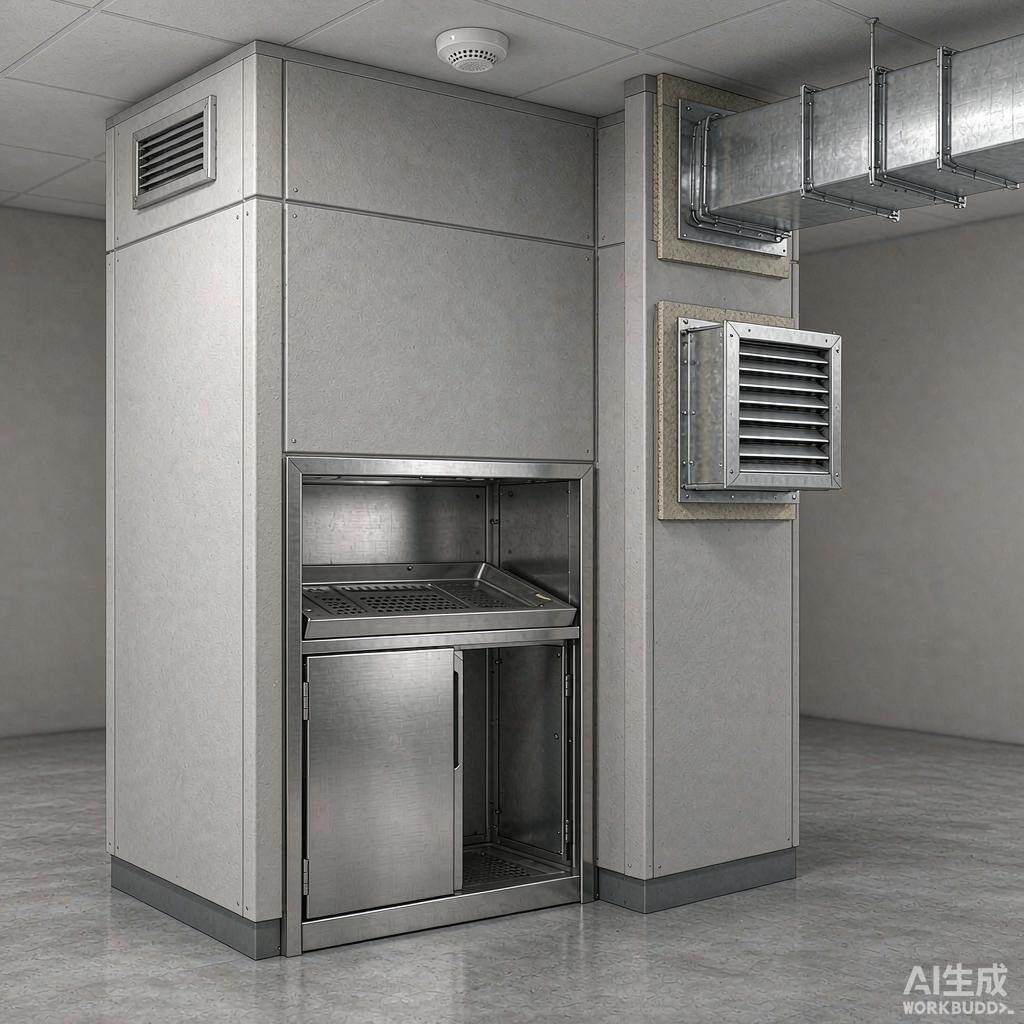
The exhaust duct leaving the smoking booth must include a fire damper to prevent fire and smoke propagation to other parts of the building. Two actuation principles are common:
- Thermally-actuated (fusible link): Damper closes automatically at 68-74°C. Low cost, no electrical co
ection required, and pass-by default. Best for installations serving 1-3 booths on a single duct run.
- Motorized (smoke-detector interlocked): Damper receives a 24V DC close signal from the smoke detection system. Required when the duct runs through fire-rated walls or when the booth is in a smoke-control zone per NFPA 92.
For multi-booth installations, UL 555-rated fire dampers are mandatory when ducts penetrate fire-rated construction; UL 555S rated smoke dampers are required in fully addressable smoke-control systems. Both types should be specified with external reset and a position indicator switch that reports back to the building management system.
Smoke Detection Architecture
Aspirating Smoke Detection (ASD) vs Spot Detectors
Conventional ionization or photoelectric spot detectors inside a smoking booth generate nuisance alarms from the normal cigarette smoke. Aspirating smoke detection (ASD) is preferred because it continuously samples air through a pipe network and uses laser-based forward-scatter optics with sophisticated algorithms to distinguish cigarette smoke from incipient fire signatures. Key design points:
- Sample pipe diameter: ¾ inch (20 mm) OD for runs under 50 m; 1 inch (25 mm) for longer runs to reduce transport time.
- Sampling holes: 4-8 mm diameter, spaced per the manufacturer’s pipe-mapping tool. Place holes in the booth ceiling and on each wall 50-100 mm below the ceiling to capture the buoyant smoke layer.
- Alarm thresholds: Set Alert at 0.02 % obs/m and Fire 1 at 0.05 % obs/m for normal smoking booth environments; do not use the manufacturer’s default thresholds for clean rooms.
- Filter maintenance: Replace the ASD particulate filter every 6-12 months in clean indoor environments, every 3-6 months in dusty outdoor or factory environments.
For smaller or budget installations, a photoelectric spot detector inside the booth ceiling co
ected to a 90-second delay relay is acceptable; the delay filters out the cigarette smoke puff signature while still detecting sustained smoldering or a real fire within two minutes.
Compliance Documentation and Inspection
Documentation Package
Most jurisdictions require a fire safety package before issuing an occupancy permit or approving a smoking booth installation. The package typically includes:
- Panel certifications: UL 2818, ASTM E84, EN 13501-1 test reports from an accredited lab.
- Cigarette disposal chamber: UL listing or equivalent, plus thermal fuse link test certificate.
- Fire damper: UL 555 or UL 555S listing, installation manual, and firestop specifications at each wall penetration.
- Ventilation calculation: Airflow rate (CFM or m³/h), duct velocity (5-10 m/s), static pressure drop, and fan curve point of operation.
- Smoke detection: ASD or spot detector data sheet, pipe mapping diagram (for ASD), and fire alarm system interface diagram.
- Electrical: Single-line diagram showing interlocks between smoke detector, fire damper actuator, and exhaust fan.
A
ual inspection should include a 30-second drop-cigarette test on each panel, fire damper functional test, ASD or spot detector calibration check, and chamber emptying and cleaning. Document each inspection with photos and log entries; insurance carriers increasingly require this evidence for continued coverage.
Cost and Lead Time Considerations
A code-compliant smoking booth with UL 2818 panels, fire-rated disposal chamber, UL 555 damper, and ASD detection carries a 20-40% cost premium over a non-certified booth, but the incremental cost is small relative to avoided liability and accelerated permit approval. Lead times range from 4-6 weeks for stocked configurations to 12-16 weeks for fully customized layouts with specific color matching and corporate branding. Specify the certification package at the procurement stage; retrofitting certification into an existing booth is rarely practical.