Why Ventilation Defines Smoking Booth Performance
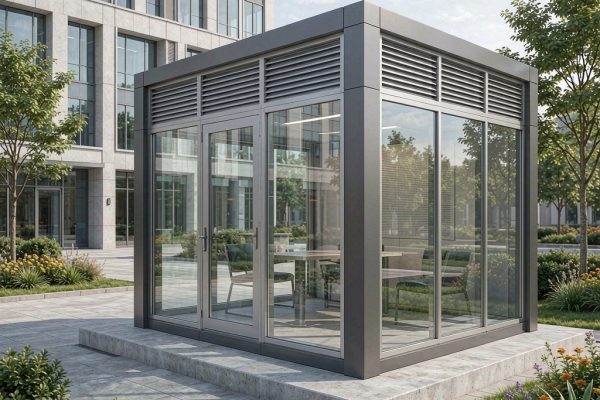
Outdoor smoking booths, also called smoking shelters or designated smoking rooms, are intended to contain secondhand smoke and protect non-smokers in adjacent areas. The effectiveness of these structures depends less on their walls and roof than on the mechanical ventilation system that captures, dilutes, and exhausts tobacco smoke. Without adequate exhaust airflow, smoke lingers inside the booth, creating unpleasant conditions for users and allowing pollutants to escape through doorways into nearby spaces. Proper exhaust fan sizing and ductwork design are therefore central to smoking booth performance, user comfort, and regulatory compliance.
Engineers and facilities managers responsible for smoking booth projects need to balance multiple objectives: achieving the recommended air changes per hour (ACH), maintaining negative pressure relative to adjacent buildings, minimizing fan noise, and routing exhaust away from air intakes, windows, and pedestrian pathways. This guide presents practical methods for sizing smoking booth exhaust fans and designing the associated ductwork.
Air Changes Per Hour for Smoking Booths
Regulatory guidance for smoking booth ventilation varies by jurisdiction, but most standards recommend higher ventilation rates than ordinary occupied spaces. A common design target is 30 to 60 air changes per hour, with some specifications requiring up to 60 ACH for fully enclosed booths. The required airflow in cubic feet per minute (CFM) or cubic meters per hour (m³/h) is calculated by multiplying the booth volume by the desired ACH and dividing by 60.
For example, a smoking booth measuring 2.5 m × 2.0 m × 2.4 m has a volume of 12 m³. At 40 ACH, the required exhaust airflow is 12 × 40 = 480 m³/h, or approximately 282 CFM. At 60 ACH, the requirement rises to 720 m³/h (424 CFM). Designers should select the ACH target based on anticipated occupancy, smoking frequency, local regulations, and whether the booth is fully enclosed or partially open. Partially open shelters rely more on natural wind-driven dilution and may use lower mechanical exhaust rates.
Exhaust Fan Sizing and Selection
Once the required airflow is determined, the exhaust fan must be sized to deliver that airflow against the total system resistance. System resistance includes ductwork friction, bends, transitions, louvers, filters, and weather caps. A common mistake is to select a fan based only on its free-air rating, which ignores these losses. Instead, use the fan curve provided by the manufacturer to verify that the fan can deliver the design airflow at the calculated static pressure.
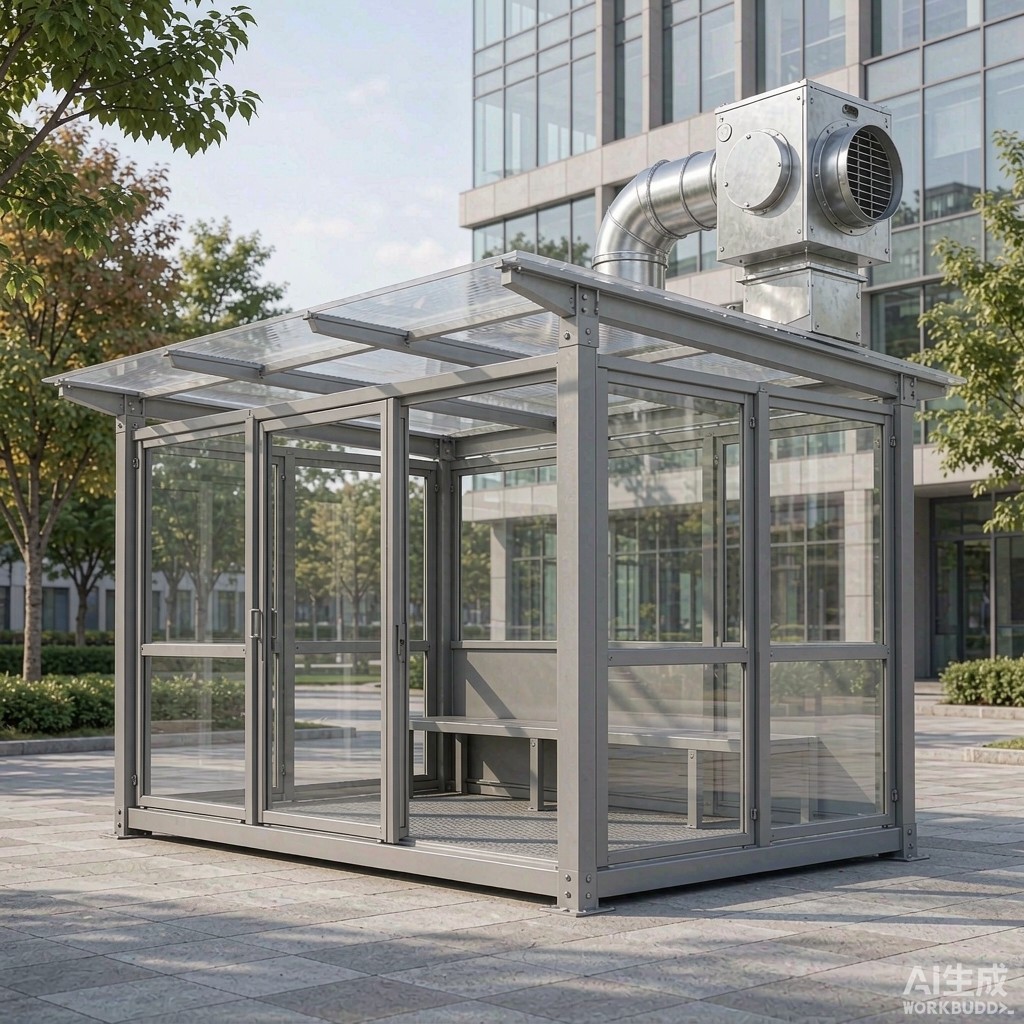
For smoking booths, centrifugal inline duct fans are often preferred over axial fans because they can generate higher static pressures and are easier to acoustically isolate. Fan motors should be rated for continuous operation and, for outdoor installations, protected against rain and dust with appropriate enclosure ratings such as IP55 or higher. Variable-speed drives can be useful for balancing airflow after construction or for reducing noise during low-occupancy periods.
Ductwork Layout and Capture Efficiency
The geometry of the ductwork strongly influences how effectively smoke is captured. Exhaust inlets should be located low in the booth, since tobacco smoke is initially buoyant but cools and descends as it ages. Many designs use low sidewall grilles or an under-bench extraction plenum to capture smoke at the source. If the booth has seating, exhaust points near each seating position improve capture and reduce recirculation zones.
Duct runs should be as short and straight as possible. Every 90-degree elbow adds equivalent length to the duct and increases pressure drop. Where bends are unavoidable, use smooth-radius elbows or vaned fittings. Round ductwork generally has lower friction loss than rectangular ductwork of equivalent cross-sectional area. Keep duct velocities in the range of 5–10 m/s to minimize noise and avoid excessive fan loading. Externally insulate ductwork routed through unconditioned spaces to prevent condensation and maintain airflow efficiency.
Negative Pressure and Makeup Air
To prevent smoke migration into adjacent buildings, smoking booths should operate at a slight negative pressure relative to surrounding spaces. In practice, this means the exhaust airflow should exceed any supply or infiltration airflow. For enclosed booths, provide filtered makeup air through a dedicated intake grille or door undercut, positioned to promote cross-flow without short-circuiting directly to the exhaust inlet. The intake path should be sized so that the booth maintains approximately 5–15 pascals of negative pressure.
Smoke containment can be further improved by using an airlock or double-door entry, though this is often impractical for small outdoor shelters. At minimum, doors should be self-closing and gasketed to limit uncontrolled leakage. Airflow indicators, such as differential pressure gauges or visual flow monitors, help facilities staff verify that the system is operating correctly.
Filtration, Noise, and Exhaust Discharge
Before discharge to atmosphere, exhaust air may be filtered to reduce odors and particulate emissions. Common options include pre-filters, activated carbon adsorbers, and HEPA media for high-sensitivity installations. Filters add pressure drop and must be included in fan sizing calculations. Maintenance access for filter replacement should be pla
ed during design.
Fan noise is a frequent complaint near outdoor smoking booths, especially in office campuses and hospitality settings. Select quiet fans, install vibration isolators, and use acoustic duct liner or silencers where necessary. Discharge stacks should terminate well above occupied areas and away from building air intakes, typically at least 3 m above roof level and 10 m from any air intake or operable window. Downward-facing discharge caps prevent rain ingress and direct exhaust away from pedestrians.
Conclusion
Proper exhaust fan sizing and ductwork design are critical to smoking booth effectiveness. By targeting 30–60 air changes per hour, selecting fans based on system resistance, locating inlets for good smoke capture, and maintaining negative pressure, designers can create smoking shelters that protect non-smokers and provide acceptable conditions for users. Attention to noise, filtration, and exhaust discharge location ensures that the installation is both compliant and neighbor-friendly.