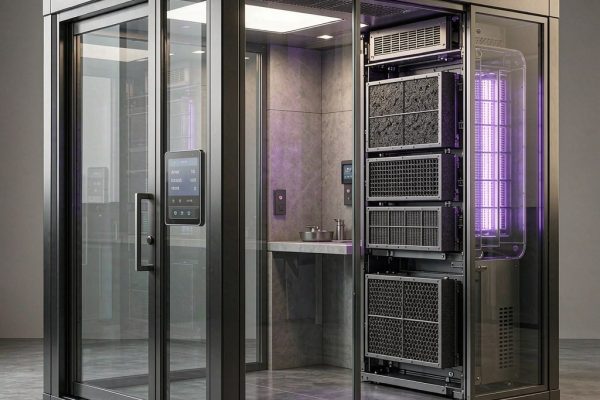
Modern commercial smoking booths must address the full spectrum of tobacco combustion byproducts, not just visible particulate matter. The gaseous and semi-volatile compounds generated by cigarette combustion include nicotine (odor threshold 4 ppb), acetaldehyde (odor threshold 25 ppb), acrolein (odor threshold 20 ppb), pyridine (odor threshold 200 ppb), benzene, toluene, and hydrogen sulfide. These compounds have odor thresholds 100-1,000 times lower than the WHO indoor air quality guidelines, requiring dedicated deodorization technology in addition to standard HEPA particulate filtration. Three primary deodorization technologies compete for smoking booth deployment: activated carbon adsorption, photocatalytic TiO2 oxidation, and ozone-catalyst systems. Each offers distinct advantages, limitations, and cost profiles. This article provides an engineering comparison to guide smoking booth deodorization system selection for commercial installations.
Deodorization Technology Fundamentals
Activated Carbon Adsorption
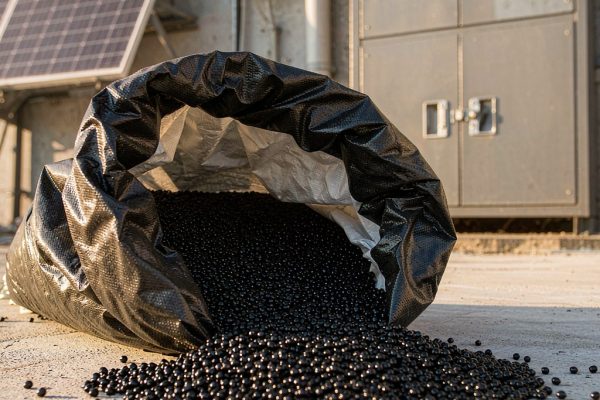
Activated carbon removes gaseous contaminants through physical adsorption onto the highly porous carbon structure. The internal surface area of premium-grade activated carbon reaches 1,000-1,500 m²/g, with pore size distribution tailored to target molecule size:
-
<l
- Micropores (< 2 nm): Capture small molecules including hydrogen sulfide, formaldehyde, lower VOCs.</l
- <l
- Mesopores (2-50 nm): Capture nicotine, pyridine, acetaldehyde.</l
- <l
- Macropores (> 50 nm): Provide access cha
els for diffusion to micropores.</l
Virgin coconut shell activated carbon with apparent density 0.45-0.55 g/cm³ and iodine number 1,000-1,200 mg/g provides the best balance of adsorption capacity and kinetics for tobacco smoke deodorization. Impregnated carbons with potassium iodide (KI), potassium permanganate (KMnO4), or amine functional groups add chemisorption capability for difficult-to-adsorb compounds like hydrogen sulfide.
Photocatalytic Oxidation (PCO)
Photocatalytic oxidation uses ultraviolet light (typically 365 nm UV-A) to activate titanium dioxide (TiO2) catalyst, generating hydroxyl radicals (·OH) and superoxide radicals (O2-) that oxidize organic compounds into CO2 and H2O. The heterogeneous catalysis occurs at the catalyst surface, requiring:
-
<l
- TiO2 catalyst form: Anatase phase TiO2 nanoparticles (5-50 nm) coated on aluminum honeycomb, fiberglass mesh, or ceramic foam substrate.</l
- <l
- UV source: 4-16 W UV-A lamps emitting 365 nm with intensity 5-15 mW/cm² at catalyst surface.</l
- <l
- Residence time: 0.2-1.0 seconds contact time with the catalyst surface.</l
- <l
- Humidity requirement: 30-70% RH optimal. Dry air (<20% RH) reduces ·OH generation; high humidity (>80% RH) competes for active sites.</l
PCO is effective against most tobacco smoke VOCs but is less efficient on high-concentration bursts (smoking event spikes). The system requires warm-up time (30-60 seconds for UV lamp stabilization) and produces intermediate oxidation byproducts including aldehydes that can have stronger odors than the original compounds.
Ozone-Catalyst Oxidation
Ozone-catalyst systems inject low-concentration ozone (0.1-1.0 ppm) into the airstream, with the ozone decomposing catalytically on MnO2 or Pd/Al2O3 surfaces to generate atomic oxygen and additional reactive species. The catalytic decomposition of ozone on MnO2 follows Mars-van Krevelen mechanism with surface lattice oxygen participating in the oxidation cycle. Key characteristics:
-
<l
- Ozone generation: Corona discharge at 5-15 kV, 20-50 kHz producing 0.5-2.0 g O3/hour per cell.</l
- <l
- Catalyst: Alpha, beta, gamma, or delta phase MnO2 with surface area 50-200 m²/g. Delta-MnO2 (birnessite) shows highest activity for tobacco smoke compounds.</l
- <l
- Contact time: 0.5-1.5 seconds through catalyst bed.</l
- <l
- Byproduct management: Residual ozone must be reduced below 0.05 ppm (WHO 8-hour guideline) by activated carbon polishing filter at system outlet.</l
Ozone-catalyst systems deliver superior destruction of high-concentration bursts and have wider effective humidity range (20-95% RH) than PCO. The trade-off is ozone exposure risk, requiring robust residual ozone monitoring and redundant safety controls.
Removal Efficiency Comparison
Single-Pass Removal Efficiency
| Compound | Odor Threshold (ppb) | Activated Carbon | Photocatalytic (PCO) | Ozone-Catalyst |
|---|---|---|---|---|
| Nicotine | 4 | 85-95% | 70-85% | 95-99% |
| Acetaldehyde | 25 | 40-60% | 85-95% | 90-98% |
| Acrolein | 20 | 60-75% | 80-90% | 85-95% |
| Pyridine | 200 | 90-98% | 75-85% | 95-99% |
| Hydrogen sulfide | 0.5 | 95-99% (KI impregnated) | 60-75% | 99%+ |
| Benzene | 2700 | 70-85% | 85-95% | 90-95% |
| Formaldehyde | 80 | 50-70% | 85-95% | 80-90% |
System Sizing and Design
Airflow Requirements
For a 2-person smoking booth (1.5 m × 1.5 m × 2.4 m = 5.4 m³ internal volume), ASHRAE 62.1 specifies minimum 30 CFM (54 m³/h) per smoker. For typical occupancy of 1.5 persons and 80% duty cycle:
Q = 1.5 × 54 m³/h × 0.8 = 65 m³/h (38 CFM)
This corresponds to approximately 12 air changes per hour (ACH), sufficient to maintain CO2 below 1,000 ppm and PM2.5 below 35 µg/m³ during typical use.
Carbon Bed Sizing
Activated carbon bed sizing follows the empirical rule of 2-4 kg carbon per 100 m³/h airflow for tobacco smoke applications, with bed depth 25-50 mm and contact time 0.1-0.3 seconds:
For 65 m³/h airflow: carbon mass = 65 × 3.0 = 195 g… wait, 2-4 kg / 100 m³/h × 65 m³/h = 1.3-2.6 kg
For 65 m³/h airflow: carbon mass = 65 × (3.0/100) = 1.95 kg (using 3 kg per 100 m³/h). Bed cross-section 0.04 m² at 0.2 m/s face velocity = 0.20 × 0.20 m. Bed depth 30 mm.
PCO and Ozone-Catalyst Sizing
PCO and ozone-catalyst systems are typically sized by residence time and UV/catalyst density:
-
<l
- PCO: Catalyst area = airflow × residence time / velocity. For 65 m³/h and 0.5 sec residence: 0.0090 m³ catalyst volume at 30% packing density = 0.030 m³ apparent volume. UV power 4-8 W for this airflow.</l
- <l
- Ozone-catalyst: Catalyst bed volume 0.02-0.05 m³ for 65 m³/h airflow. Ozone generation 0.5-1.0 g/hour.</l
Energy Consumption
| System | Fan (W) | UV/Ozone (W) | Total (W) | Daily kWh (16h use) | A
ual Cost (USD) |
|---|---|---|---|---|---|
| Carbon only | 60-90 | 0 | 60-90 | 0.96-1.44 | $35-53 |
| PCO + pre-filter | 60-90 | 8-16 | 68-106 | 1.09-1.70 | $40-63 |
| Ozone-catalyst + polishing | 60-90 | 15-30 | 75-120 | 1.20-1.92 | $44-71 |
| Hybrid PCO + carbon | 60-90 | 8-16 | 68-106 | 1.09-1.70 | $40-63 |
Energy cost assumes $0.10/kWh commercial rate in Southeast Asia.
Maintenance Scheduling
Activated Carbon
Carbon service life depends on cumulative VOC loading. For a smoking booth with 1.5 average occupancy and 8 hours daily use:
-
<l
- Carbon loading rate: 50-100 g VOC per kg carbon to breakthrough (10% of inlet concentration at outlet).</l
- <l
- Tobacco VOC emission: 8-15 mg per cigarette × 5 cigarettes/person/day × 1.5 persons = 60-110 mg/day.</l
- <l
- Carbon life: 1.95 kg × 75 g/kg = 146 g adsorption capacity / 85 mg/day = 1,720 days = 4.7 years.</l
A
ual carbon replacement cost: $40-80 (carbon material $20-30/kg plus labor). Pressure drop monitoring (replace when ΔP doubles from clean value) provides end-of-life indication.
Photocatalytic (PCO)
PCO catalyst has 5-10 year service life but requires periodic cleaning to remove deposits that block active sites:
-
<l
- Lamp replacement: Every 12-18 months (UV output degrades to 70% of initial). Cost $20-40 per lamp.</l
- <l
- Catalyst cleaning: Quarterly wash with mild detergent, distilled water rinse. Avoid abrasive cleaners that damage TiO2 coating.</l
- <l
- Pre-filter replacement: G4 pre-filter every 6 months, $5-10 per filter.</l
Ozone-Catalyst
Ozone-catalyst systems require the most maintenance but offer the highest removal efficiency:
-
<l
- MnO2 catalyst replacement: Every 3-5 years depending on usage. Cost $80-150 per cartridge.</l
- <l
- Ozone generator cell: Every 5-7 years. Cost $50-100.</l
- <l
- Residual ozone monitor calibration: A
ually per OSHA requirements. Cost $100-200 service.</l
- <l
- Polishing carbon filter: Every 12-18 months. Cost $20-30.</l
System Selection Decision Matrix
Application-Specific Recommendations
-
<l
- Small office, low-traffic (1-5 users/day): Activated carbon only. Lowest cost, simple maintenance, adequate for low cumulative load.</l
- <l
- Hotel/airport, high-traffic (50+ users/day): Hybrid PCO + activated carbon. PCO handles high-concentration bursts, carbon provides polishing and lifetime.</l
- <l
- Hospital/healthcare, zero-odor requirement: Ozone-catalyst + redundant polishing carbon. Highest removal efficiency, requires robust safety monitoring.</l
- <l
- Outdoor/transport hub, all-weather: Activated carbon with KI impregnation. PCO and ozone-catalyst performance degrades in high humidity / temperature extremes.</l
- <l
- Food court / restaurant adjacent: Hybrid ozone-catalyst + carbon. Ensures zero odor transfer to dining areas.</l
Conclusion
Activated carbon adsorption remains the most cost-effective baseline for smoking booth deodorization, while photocatalytic TiO2 oxidation offers enhanced performance for moderately high-traffic installations, and ozone-catalyst systems deliver the highest removal efficiency for healthcare-grade applications. Hybrid systems combining PCO or ozone-catalyst with activated carbon polishing provide optimal balance of efficiency, lifetime, and cost for high-traffic commercial installations. For Southeast Asian deployment where ambient humidity and temperature stress equipment, robust enclosure design (IP54 minimum) and tropicalized component selection ensure reliable long-term operation. The integration of deodorization with PM2.5/CO2/TVOC monitoring creates a complete indoor air quality management system that meets and exceeds ASHRAE 62.1 and WHO IAQ guidelines.