Introduction
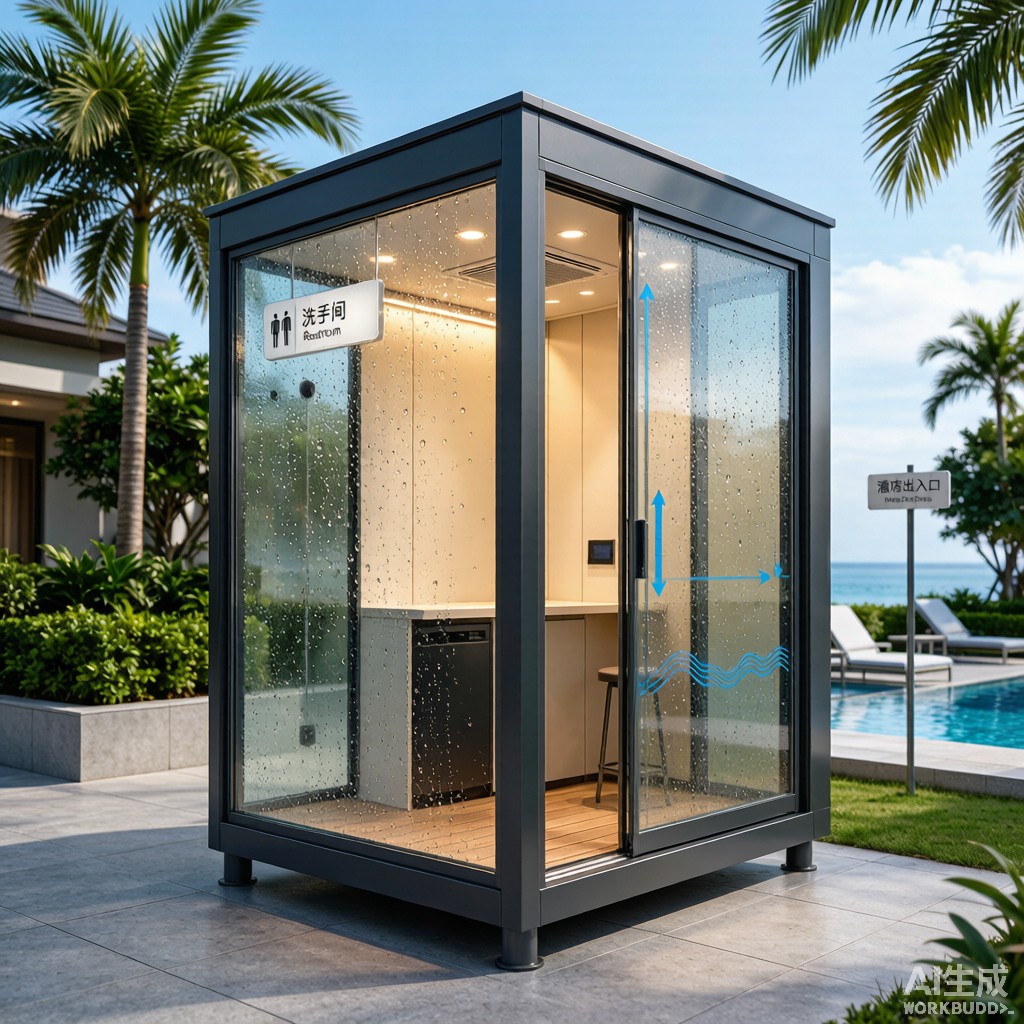
In tropical Southeast Asian climates where ambient humidity regularly exceeds 80% RH and temperatures reach 32–35°C, smoking booth interior condensation is a pervasive engineering challenge. Condensation on glass panels obstructs visibility and creates security concerns; condensation on interior surfaces promotes mold growth, accelerates corrosion of metal components, and degrades electrical systems. This article examines the root causes of smoking booth condensation and presents engineering solutions for tropical climate deployment.
Condensation Physics in Smoking Booths
Condensation occurs when warm, moisture-laden air contacts a surface whose temperature is below the dew point. In a smoking booth, several conditions create condensation risk:
Dew Point Calculation
The dew point temperature (Td) can be calculated from ambient temperature (T) and relative humidity (RH) using the Magnus formula:
Td = (243.12 × ln(RH/100) + (17.62 × T) / (243.12 + T)) / (17.62 – (17.62 × T) / (243.12 + T) – ln(RH/100))
| Ambient Temp (°C) | RH (%) | Dew Point (°C) | Condensation Risk |
|---|---|---|---|
| 32 | 85 | 28.7 | Critical – any surface below 29°C will condense |
| 32 | 75 | 26.8 | High – AC-cooled surfaces will condense |
| 30 | 80 | 26.2 | High – interior glass at 26°C or below condenses |
| 28 | 90 | 26.1 | Critical – nearly all interior surfaces at risk |
In a typical scenario, a smoking booth with air conditioning set to 24°C in a 32°C/85% RH environment will have interior glass surfaces at approximately 25–26°C—well below the 28.7°C dew point—guaranteeing condensation on all glass and metal surfaces.
Condensation Sources in Smoking Booths
1. Air Conditioning Temperature Differential
The primary condensation driver is the temperature differential between AC-cooled interior air and warm humid exterior air. Glass surfaces, being thermally conductive, sit at a temperature between interior and exterior—often below the exterior dew point.
2. Occupant Moisture Load
Each occupant generates approximately 50–100g of moisture per hour through respiration and perspiration. For a 4-person booth, this adds 200–400g/h of moisture that must be removed by the dehumidification system.
3. Ventilation Air Infiltration
Smoking booth ventilation systems exchange 10–20 air changes per hour (ACH) to remove smoke. Each air change brings in warm humid outdoor air, introducing a continuous moisture load that must be managed.
4. Night-Time Temperature Drop
Tropical nights can cause interior surfaces to cool below the daytime dew point, leading to condensation that accumulates overnight even when the booth is unoccupied.
Engineering Solutions for Condensation Prevention
Solution 1: Insulated Double-Glazing with Thermal Break
The most effective single measure is replacing single-pane glass with insulated double-glazing units (DGU) featuring thermal break aluminum frames. A DGU with 6mm glass + 12mm air gap + 6mm glass achieves a U-value of 2.8 W/m²K, compared to 5.8 W/m²K for single glass. This raises the interior glass surface temperature by 4–6°C, often enough to exceed the dew point and prevent condensation.
| Glazing Type | U-Value (W/m²K) | Interior Surface Temp (°C) | Condensation at 85% RH? |
|---|---|---|---|
| Single 6mm glass | 5.8 | 25.5 | Yes |
| DGU 6-12-6 | 2.8 | 28.2 | Marginal |
| DGU 6-12-6 Low-E | 1.8 | 29.5 | No |
| Triple 6-12-6-12-6 | 1.2 | 30.5 | No |
Solution 2: Active Dehumidification System
For booths where passive measures are insufficient, an active dehumidification system is required. Two main technologies are available:
Refrigerant dehumidifier: Cools air below the dew point to condense moisture, then reheats it. Capacity sizing: for a 4m² booth with 15 ACH at 32°C/85% RH, the moisture removal requirement is approximately 1.2–1.8 kg/h. A refrigerant dehumidifier with 2.0 kg/h capacity provides adequate margin.
Desiccant dehumidifier: Uses a rotating silica gel or molecular sieve wheel to adsorb moisture. More efficient at low dew points and lower temperatures, but higher energy consumption (0.8–1.5 kW vs 0.3–0.6 kW for refrigerant type at tropical conditions).
Solution 3: Anti-Fog Surface Coatings
Hydrophilic anti-fog coatings can be applied to glass surfaces to prevent visible condensation fogging. These coatings reduce the water contact angle to below 10°, causing condensation to form a transparent film rather than discrete droplets. Key considerations:
- Durability: Commercial anti-fog coatings last 1–3 years depending on cleaning frequency and method
- Cleaning compatibility: Must specify compatible cleaning agents; abrasive cleaners degrade coating rapidly
- Photocatalytic TiO₂ coatings: Self-cleaning via UV activation, suitable for exterior glass, but less effective for interior anti-fog
Solution 4: Balanced Ventilation with Energy Recovery
An energy recovery ventilator (ERV) with enthalpy wheel transfers both heat and moisture between supply and exhaust air streams. In tropical conditions, an ERV can remove 30–50% of the moisture load from incoming ventilation air before it enters the booth interior, significantly reducing the dehumidifier capacity requirement.
Integrated Design Approach
For optimal results, multiple solutions should be combined in an integrated design:
| Design Element | Specification | Condensation Reduction |
|---|---|---|
| Double-glazing Low-E | 6-12-6, U=1.8 | Surface temp +4°C |
| Thermal break frames | PA66 thermal break, 14–24mm | Frame temp +3°C |
| Refrigerant dehumidifier | 2.0 kg/h capacity | RH control to 60% |
| ERV enthalpy wheel | 70% total efficiency | Moisture load −40% |
| Anti-fog coating | Interior glass, contact angle <10° | Visible fog eliminated |
| Interior insulation | 10mm PIR foam on metal panels | Panel temp +5°C |
Maintenance and Monitoring
Condensation prevention systems require ongoing maintenance to remain effective:
- Dehumidifier filter: Clean or replace monthly in tropical environments; clogged filters reduce capacity by 30–50%
- DGU seal inspection: Check for seal failure a
ually; desiccant in spacer absorbs moisture from failed seals
- Anti-fog coating renewal: Reapply every 18–24 months per manufacturer specification
- Condensation sensors: Install surface temperature sensors on glass and compare to calculated dew point; trigger dehumidifier boost when margin <2°C
Conclusion
Condensation prevention in tropical smoking booths requires a multi-layered engineering approach combining insulated glazing, active dehumidification, anti-fog coatings, and energy recovery ventilation. The key design principle is maintaining all interior surface temperatures above the ambient dew point while controlling interior humidity through active moisture removal. For Southeast Asian deployments, the integrated approach described here can achieve condensation-free operation even at 85% RH ambient conditions, ensuring clear visibility, structural longevity, and occupant comfort.