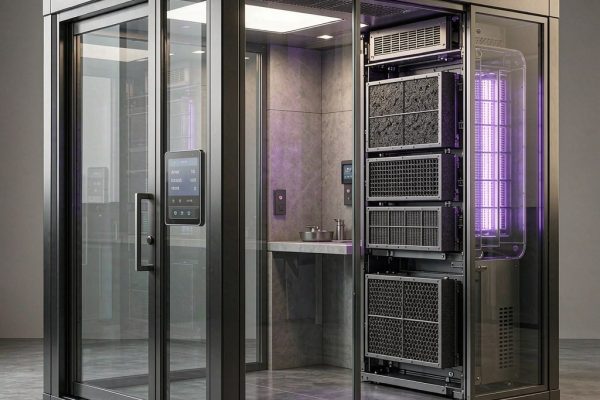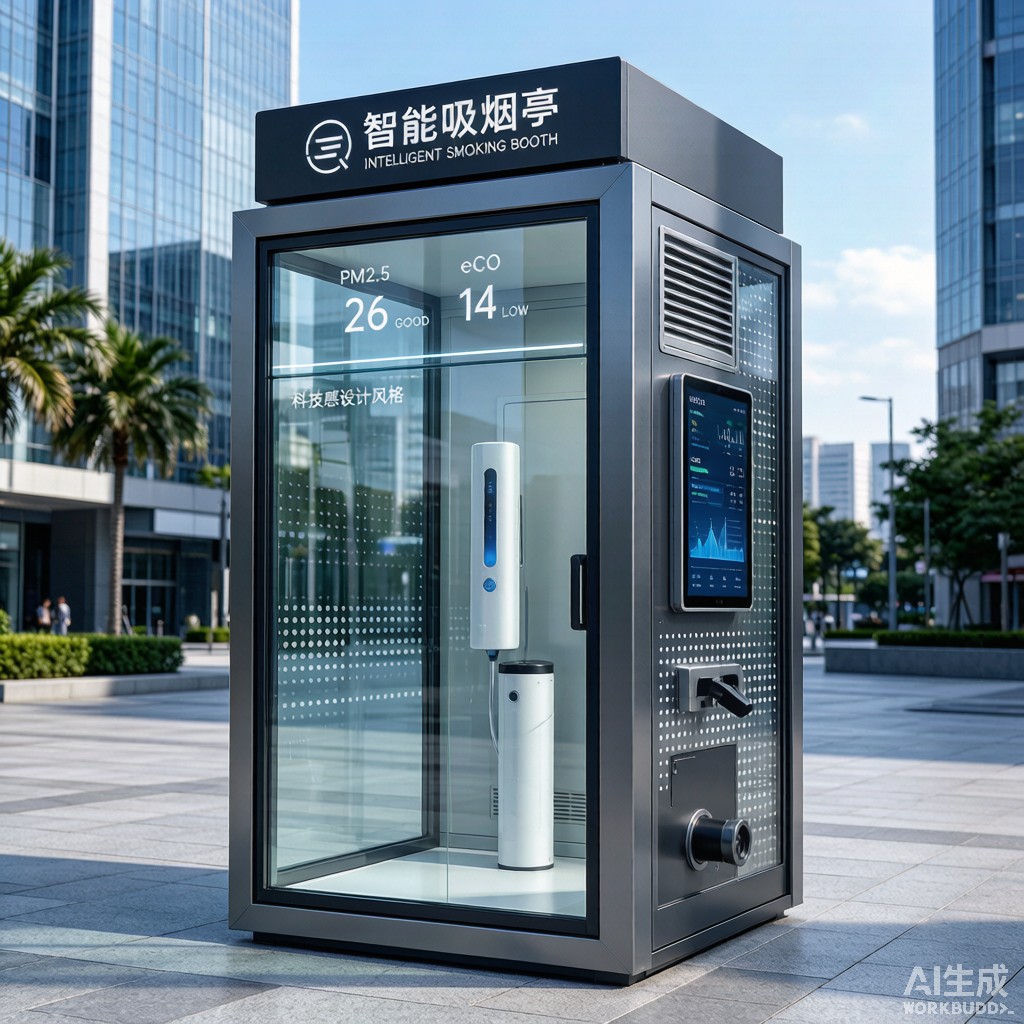
Modern commercial smoking booths must deliver more than basic ventilation—they must provide real-time, verifiable air quality assurance that meets regulatory standards and occupant health expectations. The integration of PM2.5 particulate sensors, exhaled carbon monoxide (eCO) detectors, and total volatile organic compound (TVOC) arrays into a cohesive monitoring network enables data-driven ventilation control, regulatory compliance documentation, and predictive maintenance. For installations across Southeast Asian transportation hubs, shopping malls, and commercial facilities, where ambient PM2.5 levels frequently exceed WHO 24-hour guideline of 15 µg/m³ by 3-10 times, the smoking booth’s sensor network becomes the critical differentiator between a compliant facility and a liability.
PM2.5 Particulate Sensing Technology
Laser Scattering Principle
PM2.5 sensors in smoking booth applications employ laser scattering photometry. A 650 nm (visible red) or 940 nm (near-infrared) laser diode illuminates a sensing chamber through which sampled air is drawn at 0.5-2.0 L/min by a micro-fan. Particulate matter in the 0.3-10 µm aerodynamic diameter range scatters light according to Mie scattering theory. A photodiode positioned at 60-90° off-axis detects scattered intensity, which is proportional to particle number concentration and size.
Sensor Performance Specifications
Commercial-grade PM2.5 sensors suitable for smoking booth deployment must meet the following performance criteria:
- Measurement range: 0-1,000 µg/m³ (smoking booth peak levels reach 300-800 µg/m³ during active use)
- Resolution: 1 µg/m³
- Accuracy: ±15% of reading or ±10 µg/m³ (whichever is greater) when calibrated against gravimetric reference
- Response time (T63): <6 seconds for real-time ventilation feedback
- Operating conditions: 0-50°C, 0-95% RH (non-condensing)
- Calibration interval: 12 months minimum, with on-board reference filter verification
Humidity Compensation
In tropical environments at 75-95% RH, water droplets in the 0.3-2.5 µm range produce false particle counts, inflating PM2.5 readings by 50-200%. Effective compensation requires: (1) a heated inlet (Nafion tube or silica gel desiccant) reducing sample RH to <40% before entering the sensing chamber; (2) algorithmic compensation using simultaneous RH measurement and empirical correction curves derived from Köhler theory. Without compensation, smoking booth PM2.5 readings in Singapore or Bangkok environments would routinely report 200-400 µg/m³ even during unoccupied periods.
Exhaled Carbon Monoxide (eCO) Detection
NDIR Spectroscopy Principle
Exhaled CO is the most specific biomarker of smoking booth occupancy and activity level. NDIR (Non-Dispersive Infrared) sensors measure CO concentration by passing infrared radiation through a sample chamber at 4.26 µm (CO fundamental absorption band) and detecting attenuation via a pyroelectric detector. Unlike electrochemical CO sensors that degrade through continuous exposure to high CO concentrations (smoking booth peaks: 15-50 ppm), NDIR sensors are non-consumptive and maintain calibration stability over 3-5 year service intervals.
eCO Sensor Specifications
- Range: 0-100 ppm (ambient: 0-2 ppm; smoking booth peaks: 15-50 ppm)
- Resolution: 0.1 ppm
- Accuracy: ±2 ppm or ±5% of reading
- Response time (T90): <30 seconds
- Drift: <2 ppm per year
- Service life: 5-10 years (NDIR source degradation dependent)
Occupancy Inference from eCO
eCO concentration provides a more reliable occupancy proxy than passive infrared (PIR) motion sensors, which fail to detect stationary smokers. Typical eCO profiles in a 1.5×1.5×2.3 m smoking booth with 10 ACH ventilation:
- Unoccupied: 0.5-2.0 ppm (ambient background)
- Single occupant (light smoking): 8-15 ppm within 3 minutes, steady-state 12-18 ppm
- Single occupant (heavy smoking): 20-35 ppm, steady-state 25-40 ppm
- Two occupants: 35-55 ppm, with ventilation response lag of 15-30 seconds
TVOC Sensor Array
Metal Oxide Semiconductor (MOS) Technology
TVOC sensors use a heated metal oxide semiconductor (typically SnO₂ or WO₃) whose resistance changes in proportion to reducing gas concentration. Smoking generates a complex VOC cocktail including formaldehyde (0.1-0.5 ppm), acetaldehyde (0.3-1.2 ppm), acrolein (0.05-0.3 ppm), benzene (0.02-0.15 ppm), and pyridine (0.1-0.8 ppm). MOS sensors provide aggregate TVOC readings (mg/m³ equivalent) rather than speciated analysis, but the rapid response (T90 <10 seconds) and low cost ($5-15 per sensor) make them ideal for ventilation feedback control.
Cross-Sensitivity Mitigation
MOS sensors exhibit cross-sensitivity to humidity (30-50% reading shift across 20-90% RH), temperature (10-20% per 10°C), and interfering gases (ethanol, hydrogen, cooking emissions). A sensor array approach using 3-4 MOS sensors with different dopant formulations (Pt-doped for CO sensitivity, Pd-doped for H₂, undoped for VOCs) enables algorithmic cross-sensitivity compensation via multivariate calibration models.
Ventilation PID Feedback Control
Multi-Parameter Control Strategy
The sensor network feeds a PID (Proportional-Integral-Derivative) controller that modulates EC (electronically commutated) fan speed via 0-10 V analog signal or Modbus RTU digital command. The control strategy prioritizes parameters in order of health impact:
| Parameter | Setpoint | Action Threshold | Control Response |
|---|---|---|---|
| PM2.5 | <25 µg/m³ | >75 µg/m³ | Fan → 100%, bypass damper open |
| eCO | <3 ppm | >20 ppm | Fan → 100%, HEPA pre-activation |
| TVOC | <0.5 mg/m³ | >2.0 mg/m³ | Fan → 100%, carbon filter activation |
| Occupancy | N/A | Occupied | Fan → 60% baseline |
Energy Optimization
Without sensor-driven control, smoking booth ventilation operates at constant 100% fan speed, consuming 150-300 W continuously. PID feedback control with occupancy inference reduces average fan speed to 40-55%, cutting energy consumption by 45-60% while maintaining air quality within setpoint during occupancy. A
ual energy savings at $0.15/kWh: $110-240 per booth, with ROI on the sensor package ($200-400 installed) in 12-24 months.
Regulatory Compliance and Data Logging
ASHRAE 62.1 and WHO Air Quality Guidelines
The WHO Air Quality Guidelines (2021) specify a 24-hour PM2.5 limit of 15 µg/m³. ASHRAE 62.1-2022 Ventilation for Acceptable Indoor Air Quality requires smoking-permitted spaces to provide 30 CFM per person of outdoor air (versus 5 CFM for non-smoking). The sensor network provides continuous compliance documentation through tamper-proof data logging at 1-minute intervals, with 24-month onboard storage and cloud upload via MQTT protocol over 4G LTE or Wi-Fi. For Southeast Asian facilities subject to local workplace smoking regulations (Singapore Workplace Safety and Health Act, Malaysia Occupational Safety and Health Act), the logged data provides defensible evidence of compliance during inspections and liability claims.
Predictive Maintenance Alerts
The sensor network enables predictive maintenance through trend analysis: PM2.5 baseline drift >10 µg/m³ over 30 days indicates HEPA filter loading (replace at 2x initial pressure drop); eCO response time degradation >60 seconds indicates sensor inlet occlusion; TVOC baseline drift indicates activated carbon saturation (>30% of initial mass lost). Automated alerts via SMS or email enable scheduled maintenance before air quality degrades below compliance thresholds, preventing both regulatory violations and occupant complaints.