From Static Shelter to Intelligent Node
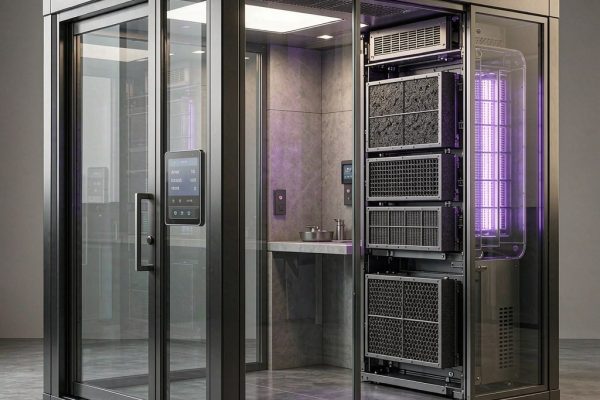
Traditional guard booths are little more than weatherproof boxes with a window and a heater. Modern smart guard booths function as integrated security nodes, combining biometric access control, AI-powered video analytics, environmental monitoring, and centralized IoT management. For industrial campuses, residential estates, and commercial complexes, these intelligent booths reduce staffing costs while improving incident response time.
Structural Foundation
Before electronics, the physical enclosure must perform:
- Panel construction: Insulated steel-faced sandwich panels (50–100 mm PU or rock wool) provide thermal insulation (U-value < 0.4 W/m²K) and ballistic resistance (up to NIJ Level IIIA with ceramic composite cores).
- Foundation: Prefabricated booths require a level concrete pad (minimum 150 mm reinforced concrete) with anchor bolts at 1.2 m spacing; seismic zones need base isolation pads.
- Weatherproofing: EPDM gaskets at panel joints, sloped roof (≥ 5°) with gutter and downspout, and corrosion-resistant hardware (316 stainless or hot-dip galvanized).
Access Control Systems
Biometric Authentication
- Fingerprint sca
ers:
Optical or capacitive sensors with liveness detection; 1:N matching for up to 10,000 templates in standalone mode. - Facial recognition: IR-enhanced cameras with 3D depth sensing; effective under low light and through vehicle windshields for driver identification.
- License plate recognition (LPR): ANPR cameras capture plates at up to 60 km/h; integration with visitor management systems allows automatic barrier opening for pre-registered guests.
Credential Multi-Factor
High-security sites combine factors:
- Something you have: RFID card or BLE mobile credential.
- Something you are: Fingerprint or face.
- Something you know: PIN or one-time password (OTP) sent to registered mobile.
Video Surveillance and AI Analytics
Camera Placement
- Perimeter: 180° or 360° panoramic cameras on 3–4 m poles for zone coverage.
- Entry/exit: Dual-lens cameras (wide + tele) capture vehicle overview and driver close-up simultaneously.
- Booth interior: Covert dome camera for guard safety and audit compliance.
AI Video Analytics
Edge AI processors (NVIDIA Jetson or HiSilicon) in the booth run real-time inference:
- Perimeter intrusion: Detect humans or vehicles crossing virtual lines; filter false alarms from animals or weather.
- Loitering detection: Flag individuals remaining in restricted zones beyond a time threshold.
- Object abandonment: Identify unattended bags or packages near entry points.
- Crowd density: Estimate queue length and trigger additional lane opening during peak hours.
Environmental and Safety Sensors
Smart booths monitor their own environment and surrounding area:
- Air quality: PM2.5, CO₂, and VOC sensors; data displayed on external LED screen and uploaded to city environmental networks.
- Noise monitoring: Class 2 sound level meters log ambient noise for compliance reporting.
- Weather station: Wind speed, temperature, and rainfall sensors feed into facility management systems.
- Gas leak detection: In industrial settings, H₂S, CO, and combustible gas sensors trigger alarms and auto-lockdown protocols.
IoT Co
ectivity and Power
Network Architecture
- Primary: Fiber optic or Ethernet for high-bandwidth video backhaul.
- Secondary: 4G/5G cellular router with dual-SIM failover for remote or temporary installations.
- Local mesh: LoRaWAN or Zigbee for low-power sensor networks (door contacts, panic buttons, environmental probes).
Power and Backup
- Main supply: 220/110 VAC with surge protection (Class II SPD) and earth bonding.
- UPS: 1–2 kVA online UPS provides 30–60 minutes runtime for cameras, access control, and network during outages.
- Solar: Off-grid booths use 400–800 Wp solar panels with 200 Ah lithium battery banks, sized for 3 days autonomy.
Operator Ergonomics
A smart booth is only as effective as its operator:
- Workstation: Dual-monitor setup (22–24”) for video management software and access control dashboard; anti-glare coating for daylight visibility.
- Climate control: Mini-split inverter AC (9000 BTU) with CO₂-based demand-controlled ventilation; underfloor heating in cold climates.
- Acoustics: Acoustic ceiling tiles and wall panels reduce reverberation for clear radio and phone communication.
- Panic button: Hardwired duress alarm with silent activation and automatic camera preset recall.
Integration and Central Management
Individual smart booths feed into a unified platform:
- PSIM (Physical Security Information Management): Correlates access events, video alarms, and sensor data into unified incident timelines.
- API integration: RESTful APIs co
ect with HR systems (automatic badge deactivation on termination), parking management, and visitor pre-registration portals.
- Digital twin: 3D facility models visualize booth status, camera fields of view, and alarm locations in real time.
Conclusion
Smart guard booths transform perimeter security from a passive checkpoint into an active, data-rich command node. By integrating biometric access, AI video analytics, environmental sensing, and robust IoT co
ectivity, these structures deliver measurable improvements in threat detection, operational efficiency, and guard safety across industrial, commercial, and residential deployments.