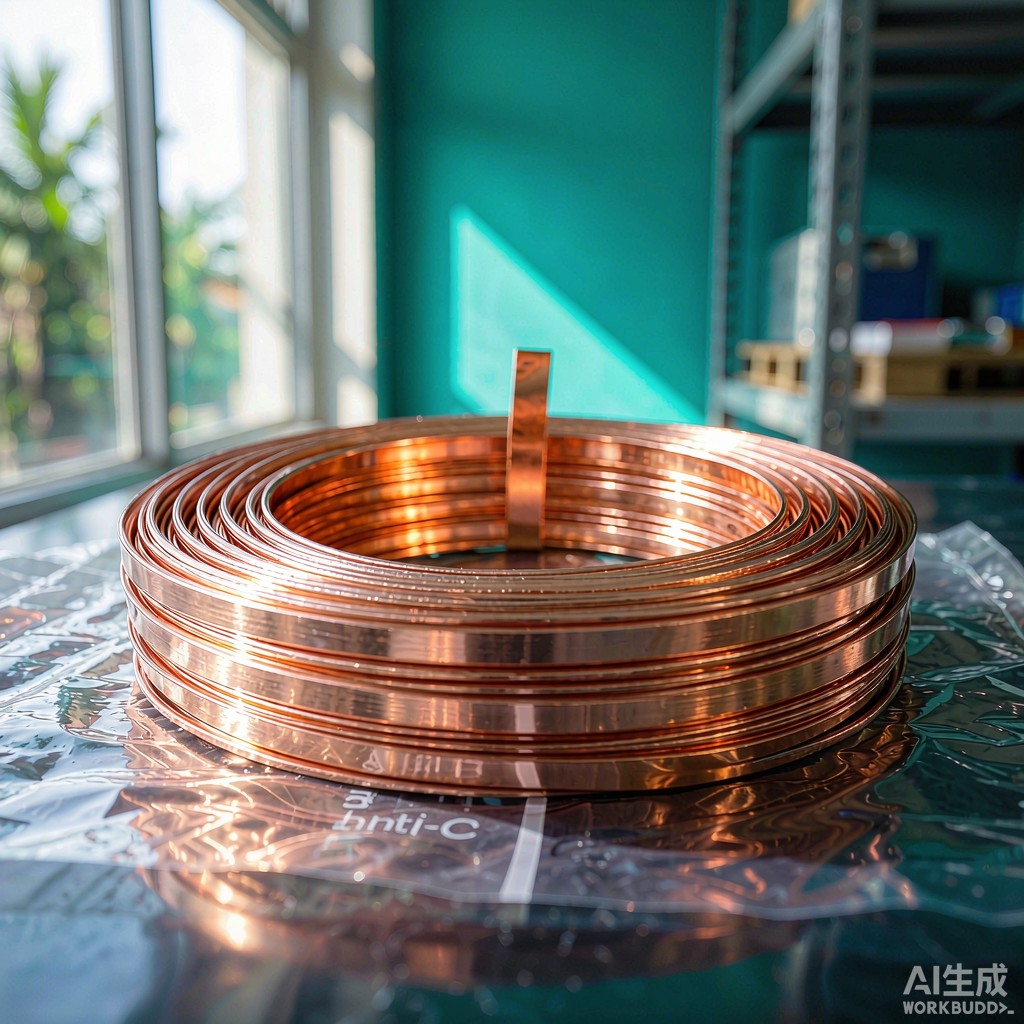
Bare SMT copper strip is the backbone of high-density electrical contacts, lead frames, and spring terminals. Its electrical conductivity, solderability, and formability are excellent when the surface is pristine. Yet in tropical warehouses across Southeast Asia, unprotected copper can develop a dull oxide film within days and green patina within weeks. Once oxidation advances, solder wetting deteriorates, reflow yield drops, and plating adhesion becomes unpredictable. This guide explains why copper oxidizes fast in humid climates and how to keep your SMT copper strip production-ready from receipt to stencil.
Why Copper Oxidizes Faster in Tropical Environments
Copper oxidation is an electrochemical reaction driven by moisture, oxygen, temperature, and airborne contaminants. The Arrhenius rule of thumb suggests reaction rates double for every 10°C rise above room temperature. In a warehouse held at 30°C with 80% relative humidity, bare copper can form a visible Cu₂O film in 24 to 72 hours. Chlorides and sulfides from coastal air or industrial pollution accelerate the process even further, producing CuCl or CuS stains that are harder to remove than simple oxide.
The problem is not merely cosmetic. Oxide thickness beyond 50 nm raises contact resistance and reduces solder joint strength. For SMT copper strip destined for reflow, an oxide layer interferes with flux activation and can cause balling or incomplete wetting. Pre-plating the strip with tin, nickel, or silver helps, but many applications specify bare copper for subsequent selective plating or bonding steps, so storage protection becomes critical.
Step 1: Specify the Right Surface Finish at Purchase
If your process allows it, specify a light passivation or antioxidant coating from the mill. Common options include:
- Benzotriazole (BTA) film: A monolayer organic inhibitor that slows oxide growth without affecting solderability. It is removed by standard no-clean fluxes.
- Chromate-free conversion coatings: Silane or zirconium-based treatments that add 1–3 nm of protection and meet RoHS/REACH.
- Edge-a
ealed oil film:
A light residual drawing oil that acts as a temporary barrier during transit, suitable if the oil is compatible with downstream cleaning.
Request that the supplier ship with a mill test report confirming surface cleanliness and oxide spot inspection. C11000 and C10200 grades for electronics should meet ASTM B152 or JIS H3100 brightness standards.
Step 2: Use VCI Packaging Correctly
Vapor corrosion inhibitor (VCI) film and paper are the most cost-effective storage solutions. However, effectiveness depends on application discipline:
- Wrap the coil or reel immediately after slitting; do not leave bare copper exposed on the shop floor.
- Use a VCI emitter inside the package and seal with adhesive tape or heat-sealed film.
- Calculate the volume of VCI needed based on package void space, not just coil weight.
- Avoid reusing VCI bags that have been open for more than a few hours.
VCI formulations for copper typically contain amine-carboxylate complexes that adsorb onto the metal surface. Check that the VCI is copper-specific; multi-metal VCIs designed for ferrous parts may not protect copper adequately.
Step 3: Control Warehouse Climate
Ideally, copper strip should be stored at 20–25°C and below 50% relative humidity. In tropical regions this usually requires air conditioning or industrial dehumidifiers. If capital investment is limited, prioritize climate control for the storage area rather than the entire facility. Use hygrometers with alarm outputs, and keep coils off concrete floors on pallets or racks to prevent moisture wicking.
Another simple measure is nitrogen purging. For high-value precision strip, place reels in sealed drums or cabinets and back-fill with nitrogen to less than 5% oxygen. This dramatically extends shelf life but is practical only for small, critical lots.
Step 4: First-In-First-Out and Handling Protocols
Even with perfect packaging, storage time matters. Establish a FIFO system and label each coil with the date of receipt and recommended use-by date. As a general rule, bare copper strip stored in VCI at 30°C/70% RH should be consumed within 90 days; nitrogen-stored material can last six months or longer.
Handling also introduces contamination. Operators should wear lint-free gloves; fingerprints contain chlorides and acids that etch copper within hours. Cutting tools should be clean and free of coolant residues. When a reel is opened for production, only remove the amount needed for the shift and reseal the remainder promptly.
Step 5: Incoming Inspection and Reconditioning
Inspect incoming coils under consistent lighting for tarnish, spots, or stains. A quick pass/fail test is the water-break test: deionized water should sheet evenly across a clean copper surface; beading indicates organic contamination or oxide.
If light oxidation is found, reconditioning options include:
- Acid pickle: Diluted sulfuric or citric acid dip followed by thorough rinsing and drying. Suitable only if dimensional tolerance allows material loss.
- Abrasive brushing: Fine non-woven abrasive rolls that remove oxide without embedding particles. Effective for flat strip but can create surface roughness.
- Electrolytic brightening: Restores luster and removes oxide in a controlled ma
er, common for precision electronic strip.
Conclusion
Preventing oxidation on bare SMT copper strip is a chain of decisions that starts at the purchase order and ends on the shop floor. The right surface finish, sealed VCI packaging, climate-controlled storage, disciplined FIFO handling, and rapid reconditioning when needed will keep copper bright, solderable, and reliable. In tropical electronics manufacturing, these precautions are not optional quality upgrades; they are the baseline for consistent SMT assembly yield.