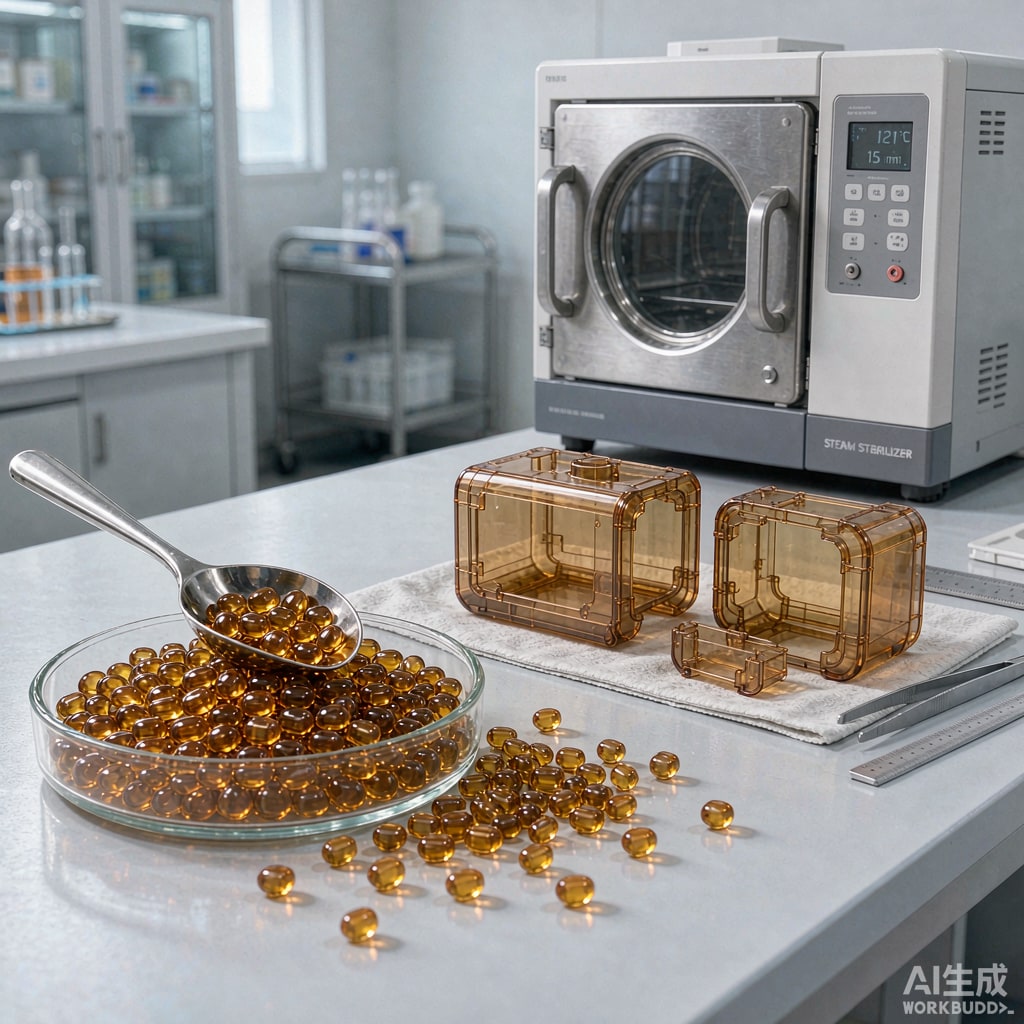
When an electronics enclosure must survive hundreds of steam autoclave cycles, repeated chemical disinfection, and still look presentable, the shortlist of plastics gets very short. Polyphenylsulfone, PPSU, sits at the top of it. For buyers sourcing plastic pellets for sterilizable medical device housings, surgical instrument trays, and industrial electronics that face aggressive cleaning regimes, this guide covers what PPSU offers, how it compares with PEI and PSU, and how to mold it without defects.
What PPSU Is and Why It Endures Steam
PPSU is the highest-performing member of the sulfone polymer family. Its aromatic backbone with diphenyl sulfone linkages gives it a glass transition temperature around 220 degrees Celsius, so it stays dimensionally stable far above autoclave temperatures of 121 to 134 degrees. Unlike aliphatic engineering plastics, the sulfone backbone does not hydrolyze in pressurized steam; medical-grade PPSU is routinely specified for more than 1000 autoclave cycles with only modest color drift from white toward amber. It is also inherently transparent in its natural form, BPA-free, and carries low extractables, which is why it dominates reusable medical consumables.
PPSU Compared with PEI and PSU
PEI, familiar from Ultem-type grades, offers higher stiffness and a slightly higher heat capability with a glass transition near 217 degrees, and it is the go-to for precision SMT reflow carriers. But PEI is more sensitive to repeated alkaline cleaning chemistries and shows notch brittleness relative to PPSU. PSU, the economy sulfone, tolerates steam but loses gloss and mechanical margin after fewer cycles and is more prone to stress cracking in aggressive disinfectants. The practical rule: pick PPSU when the part sees steam sterilization plus impact and repeated chemical exposure; pick PEI when dimensional precision and stiffness dominate; pick PSU when cycle count and chemical severity are low and cost matters most.
Mechanical and Electrical Properties That Matter
Natural PPSU delivers notched impact strength an order of magnitude above PSU, continuous use temperatures around 180 degrees Celsius, and good dielectric properties through medical sterilization temperatures. Its flame retardance is inherent, typically meeting UL94 V-0 at common wall thicknesses without halogen additives, which simplifies compliance documentation. For electronics housings, static dissipation matters: conductive and static-dissipative PPSU compounds, filled with carbon fiber or carbon powder, provide surface resistivity targets from 10 to the 4th to 10 to the 9th ohm-square while retaining the steam endurance of the base resin, a combination few other chemistries match.
Molding Guidelines for Defect-Free Parts
PPSU is straightforward to process if you respect drying and thermal windows. Dry pellets at 120 to 140 degrees Celsius for 3 to 4 hours; residual moisture above about 0.02 percent produces splay and hydrolytic chain scission that embrittles the part. Melt temperatures run 340 to 380 degrees Celsius with mold temperatures of 140 to 170 degrees. High mold temperature is not optional: it controls surface finish and crystalline-like packing that determines chemical resistance. Purge the machine thoroughly between materials; sulfone polymers hold color and contamination tenaciously. Because the resin is amorphous, mold shrinkage is low and predictable, roughly 0.6 to 0.8 percent, which helps with housings that mate to metal subframes.
Design Notes for Sterilizable Housings
Avoid sharp internal notches, the classic initiation site for cracks in impact-tested sulfone parts; radiuse corners at 0.5 millimeter or more. Design snap features with generous root fillets and verify them after 500-plus autoclave cycles, because repeated steam exposure slowly reduces elongation at break. Keep gate locations away from thin hinge sections, and where the housing carries ESD-compounded grades, ensure gate and weld-line placement do not break the conductive network across sealing surfaces.
Applications Beyond Hospitals
The same property set serves industrial electronics: enclosures for food-processing sensors that face daily caustic washdown, airline galley electronics, dental and laboratory instruments, and sterilization trays for tooling that includes electronics modules. Anywhere steam, chemicals, impact, and dimensional stability converge, PPSU earns its premium over commodity and mid-tier engineering plastics.
Supply and Cost Considerations
PPSU carries a price premium of several multiples over commodity resins, so part design should use it where its endurance is genuinely needed and reserve ribs and bosses for load paths rather than uniform walls. Availability is good through major distributors in standard natural and black grades, with medical-certified lots tracked separately; demand certificates of analysis with each lot when the application is regulated. Lead-time risk concentrates in colored and specialty conductive compounds, so qualify an alternate colorant supplier early for high-volume programs.
Buyer Checklist
When sourcing PPSU pellets, confirm: medical or food-contact compliance certificates where the application requires them, ISO 10993 or USP Class VI documentation for medical grades; lot-to-lot melt flow consistency for your molder; available colors and natural resin clarity; and, for ESD grades, surface resistivity data measured per the relevant standard rather than catalog claims. Ask for a processing data sheet with the drying, melt, and mold temperature windows, and run a trial shot verification of impact strength after simulated autoclave cycling. Those steps separate a resin that survives 1000 sterilization cycles from one that fails at 150.



