Introduction: High Temperature Demands in Automotive SMT Co
ectors
Automotive electronics must survive under-hood temperatures, vibration, fluids, and repeated thermal cycling. Surface-mount co
ectors used in engine control units, transmission modules, LED headlight drivers, and electric vehicle battery management systems are exposed to reflow soldering peaks of 245–260 °C during assembly, followed by long-term service temperatures that can exceed 125 °C. Standard polyamides and polyesters may soften, hydrolyze, or lose mechanical retention under these conditions.
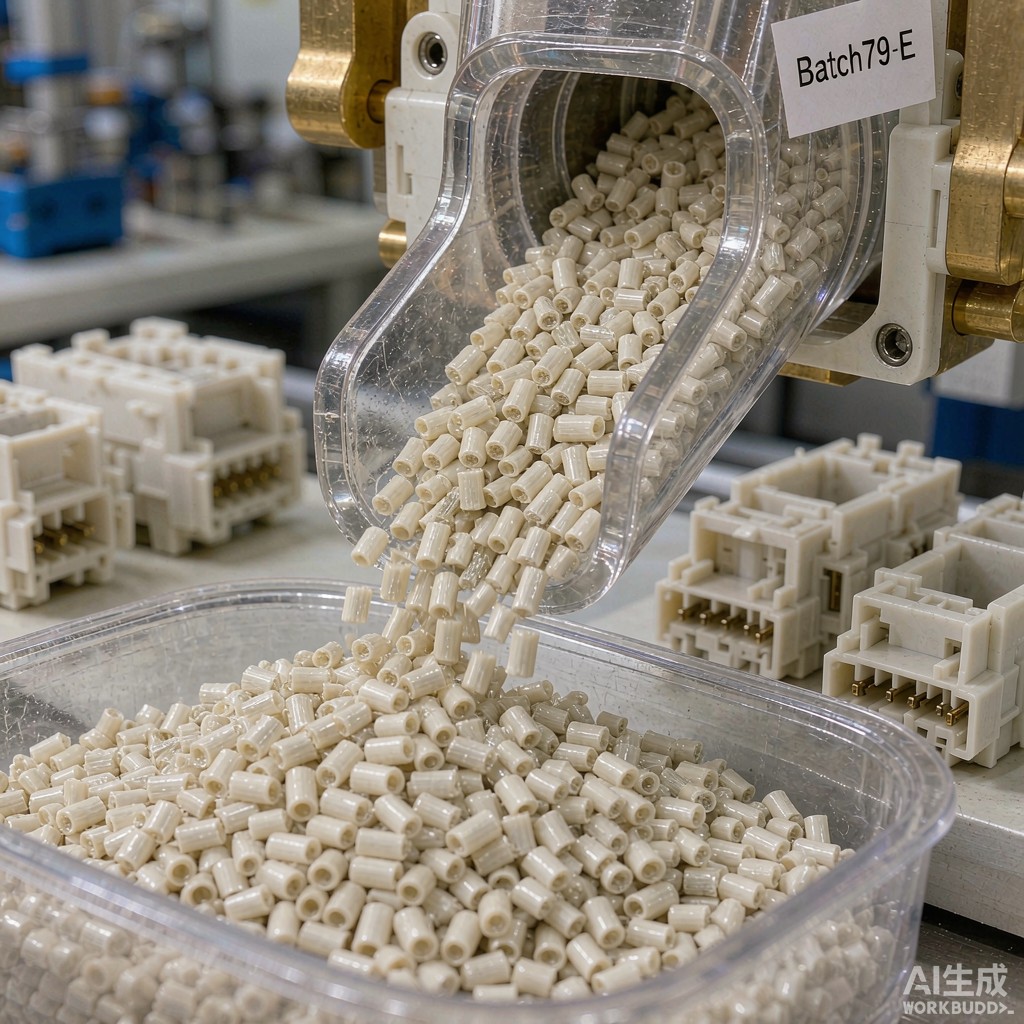
Polyphthalamide (PPA) reinforced with 35% glass fiber, commonly known as PPA-GF35, is a high-performance modified plastic pellet material developed for such demanding applications. This article examines the properties, advantages, and processing considerations of PPA-GF35 for automotive SMT co
ectors.
Material Structure and Heat Resistance
PPA is a semi-aromatic polyamide that combines the processability of aliphatic nylons with the thermal stability of aromatic polymers. The amide groups provide hydrogen bonding and crystallinity, while the aromatic rings raise the glass transition temperature and melting point. Unfilled PPA has a melting point around 310–325 °C and a glass transition temperature near 125 °C.
Adding 35% short glass fiber increases heat deflection temperature to approximately 280–300 °C at 1.8 MPa, well above lead-free reflow peaks. This allows SMT co
ectors molded from PPA-GF35 to maintain pin position and housing integrity during infrared and vapor-phase reflow. The material also retains strength and creep resistance at continuous operating temperatures up to 150 °C and short-term peaks to 180 °C.
Mechanical and Electrical Properties
Typical PPA-GF35 properties include tensile strength of 200–240 MPa, flexural modulus of 10,000–14,000 MPa, and notched Izod impact of 80–120 J/m. The high stiffness reduces terminal creep under contact normal force, maintaining reliable electrical co
ections over the vehicle lifetime. The coefficient of linear thermal expansion is low for a nylon, approximately 20–30 x 10⁻⁶ /K in the flow direction, which helps maintain dimensional stability across temperature cycles.
Electrical properties are also favorable for co
ectors. PPA-GF35 offers dielectric strength of 22–28 kV/mm, volume resistivity above 10¹⁵ Ω·cm, and comparative tracking index values of 600 V or higher for flame-retardant grades. These characteristics support miniaturized, high-voltage automotive co
ectors where creepage and clearance distances are tight.
Hydrolysis and Chemical Resistance
Automotive under-hood environments expose co
ectors to engine coolant, transmission fluid, brake fluid, oil, salt spray, and condensing humidity. PPA absorbs less moisture than PA6 or PA66, typically reaching equilibrium at 1.5–2.5% by weight under saturated conditions. Lower moisture uptake reduces hydrolytic degradation and dimensional change in humid climates.
For applications with prolonged water or coolant exposure, compounders offer stabilized PPA-GF35 grades containing hydrolysis stabilizers such as polycarbodiimide. These additives extend service life by scavenging acids and stabilizing chain ends. Combined with proper terminal sealing, stabilized PPA can meet the stringent requirements of electrified powertrain systems.
Comparison with PA66 and PBT for SMT Co
ectors
Engineers often compare PPA-GF35 with PA66-GF30 and PBT-GF30 when selecting co
ector housing materials. PA66-GF30 is lower cost and widely used, but its melting point of around 265 °C and moisture absorption of 2.5–3.0% make it marginal for modern lead-free reflow and long-term under-hood use. PBT-GF30 offers lower moisture uptake and good dimensional stability, but its heat deflection temperature of 200–215 °C limits applications near the engine or in LED headlight modules.
PPA-GF35 bridges this gap. It provides a melting point above 310 °C, heat deflection temperature near 290 °C, and moisture absorption below 2.5%. The trade-off is higher material cost and more demanding processing. For automotive SMT co
ectors where reflow survival, high-temperature retention, and hydrolysis resistance are critical, PPA-GF35 is often the most cost-effective choice over the vehicle lifetime.
Flame Retardancy and Regulatory Compliance
Automotive co
ectors often require flame-retardant materials rated UL94 V-0 at 0.4 mm or better. Halogen-free flame-retardant PPA-GF35 grades use phosphorus-based or nitrogen-based systems to achieve V-0 ratings without brominated additives. These materials support environmental regulations such as EU REACH and ELV directives while reducing corrosive smoke in the event of a fire.
In addition to UL ratings, automotive co
ector materials may need to comply with OEM specifications such as VW 60306, USCAR, and GMW 3172 for temperature, vibration, and fluid resistance. PPA-GF35 grades from major compounders are often listed under these specifications with defined color codes and regrind limits.
Injection Molding Guidelines
PPA-GF35 requires higher processing temperatures than standard engineering plastics. Typical melt temperatures range from 320 °C to 340 °C, with mold temperatures of 120–150 °C to promote crystallization and surface finish. Drying is critical because PPA is hygroscopic; pellets should be dried at 100–120 °C for 4–6 hours to reach moisture levels below 0.05%.
High injection pressures and fast fill rates help the glass fiber reach the ends of thin-walled co
ector cavities. However, overly high shear can break fibers and reduce mechanical properties. Hot ru
er systems with balanced manifolds are recommended for multi-cavity tooling. Because PPA can degrade if held at high temperatures too long, residence times should be minimized and regrind levels limited to 15–25%.
Conclusion
PPA-GF35 modified plastic pellets provide the heat resistance, mechanical strength, dimensional stability, and chemical resistance required for automotive SMT co
ectors. By selecting the right grade, drying thoroughly, and optimizing molding parameters, manufacturers can produce reliable co
ectors that survive both the reflow oven and the harsh under-hood environment.