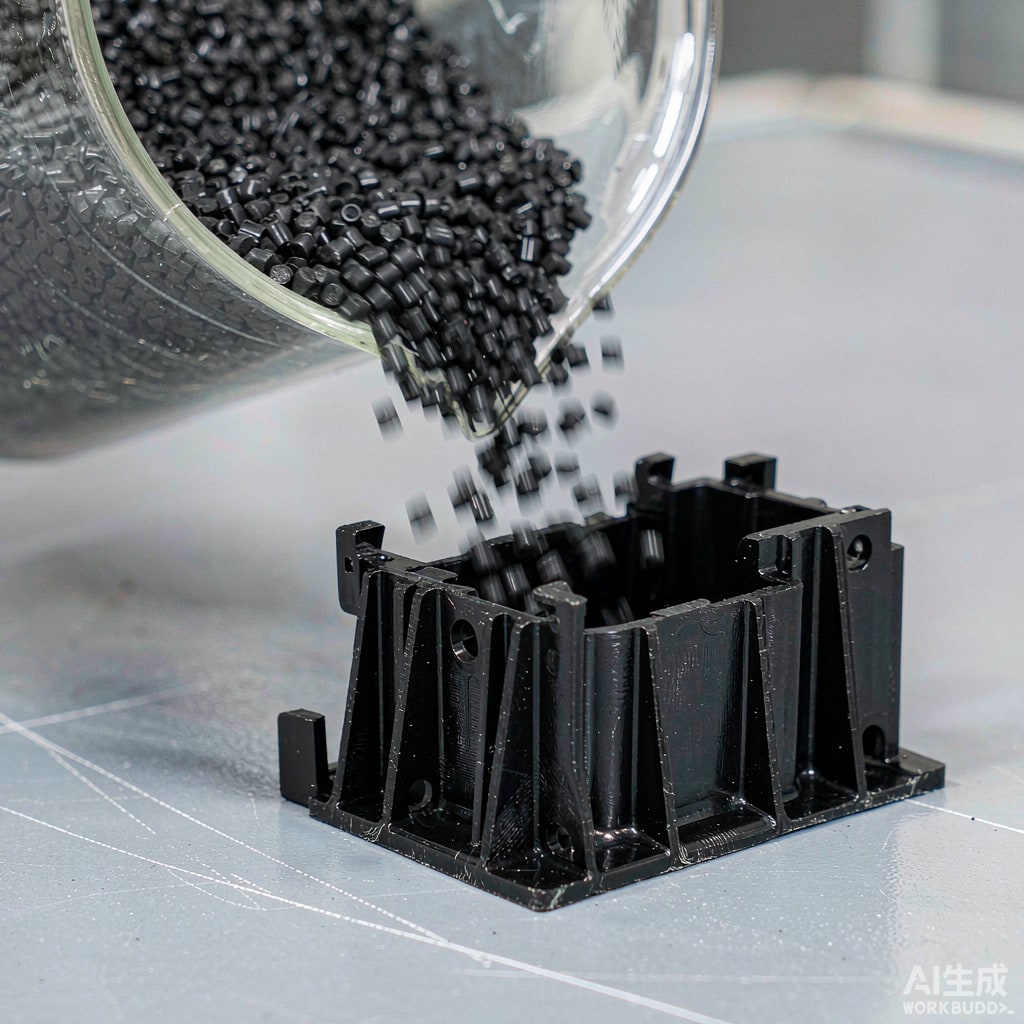
Unfilled polycarbonate is tough and transparent, but it creeps under load and its heat deflection temperature limits its use in structural parts. Adding 20% glass fiber transforms PC into a dimensionally stable engineering plastic suitable for load-bearing brackets, monitor arms, instrument housings, and battery module supports. This article covers the properties, processing, and design rules for PC GF20 plastic pellets used in electronics.
Why Glass Fiber in Polycarbonate
Glass fiber reinforcement improves three properties that matter for structural electronics parts: stiffness, heat resistance, and dimensional stability. A typical unfilled PC has a flexural modulus around 2,300 MPa and a heat deflection temperature near 130°C. With 20% short glass fiber, modulus rises to roughly 5,500–6,500 MPa and HDT can exceed 140–145°C at 1.8 MPa. The coefficient of thermal expansion drops by roughly 40%, reducing warpage and improving fit with metal chassis.
The trade-off is reduced impact strength and surface gloss. Glass fibers act as stress concentrators, so PC GF20 is less forgiving of sharp corners and notches than unfilled grades. It is also opaque, so it ca
ot be used where transparency is required. For structural brackets and enclosures, that is usually acceptable.
Flame Retardancy and Safety Ratings
Many electronics applications require UL94 V-0 flame retardancy. PC GF20 is available in both standard and flame-retardant versions. Brominated FR systems are common but face increasing regulatory pressure; phosphorus-based and sulfonate salt systems are growing alternatives. When specifying a grade, confirm the UL94 rating, glow-wire ignition temperature, and CTI tracking resistance if the part will carry high-voltage conductors or be used near live circuits.
Molding Considerations
PC GF20 pellets absorb moisture and must be dried before processing. A typical drying target is 0.02% moisture or lower, achieved with a desiccant dryer at 120°C for 3–4 hours. Inadequate drying causes hydrolysis, resulting in brittle parts with reduced molecular weight and splay marks on the surface.
Recommended melt temperatures are 280–310°C, and mold temperatures range from 80–110°C. Higher mold temperatures improve fiber orientation control and surface appearance but extend cycle time. Because glass fibers are abrasive, tooling should use hardened steel or wear-resistant inserts, especially for high-volume production.
Design for Strength and Appearance
Glass fibers align with flow direction during molding, creating anisotropic shrinkage. Shrinkage along flow may be 0.2–0.4%, while cross-flow shrinkage can be 0.5–0.8%. Designers should orient ribs, bosses, and mounting features to account for this difference and avoid differential shrinkage warpage.
Wall thickness should generally be 2.0–3.5 mm for PC GF20. Thi
er walls may not fill properly due to higher viscosity, and thicker sections can sink or develop internal voids. Avoid sharp internal corners; use a minimum radius of 0.5 mm to reduce stress concentration. Bosses for self-tapping screws should be designed with adequate wall thickness and metal inserts considered for frequent assembly cycles.
Surface Finish and Cosmetic Options
Glass fibers can migrate to the surface and create a rough, fibrous texture. For cosmetic housings, specify a low-gloss or textured finish, or consider painting after molding. Some grades include surface-enhancing additives that reduce fiber prominence. For parts that must be EMI shielded, PC GF20 accepts conductive coatings and vacuum metallization better than many unfilled resins because of its higher heat resistance.
Applications in Electronics
Common uses for PC GF20 in electronics manufacturing include:
- Structural brackets for power supplies and inverters.
- Monitor and display back covers requiring stiffness and HDT.
- Battery module frames and covers in energy storage systems.
- Industrial instrument housings exposed to elevated temperatures.
- Load-bearing clips and cable management features.
Conclusion
PC GF20 pellets bridge the gap between aesthetic unfilled polycarbonate and high-performance engineering thermoplastics. With proper drying, mold design, and fiber-orientation control, the material delivers stiff, heat-resistant parts that hold their shape under mechanical load. For structural brackets and enclosures in electronics, it is a practical and widely available choice when transparency is not required.



