Sustainability and cost pressure are driving electronics manufacturers to incorporate post-consumer recycled (PCR) and post-industrial recycled (PIR) content into PC/ABS and PC modified plastics used for SMT enclosures, co
ector housings, and structural brackets. However, recycled PC/ABS typically shows a 15-30% reduction in impact strength, 10-20% reduction in tensile strength, and visible color drift after 3-5 reprocessing cycles because of polymer chain scission, contamination from foreign polymers, and stabilizer depletion. The European Union WEEE Directive, US EPEAT, and the new Ecodesign for Sustainable Products Regulation (ESPR) are pushing OEMs to declare recycled content and to design for end-of-life disassembly and recycling. This article explains how to identify incoming recycled PC/ABS streams, validate property retention, and design SMT enclosures that tolerate the property scatter of recycled content without field failure.
Recycled PC/ABS Stream Classification
Source Categories and Property Implications
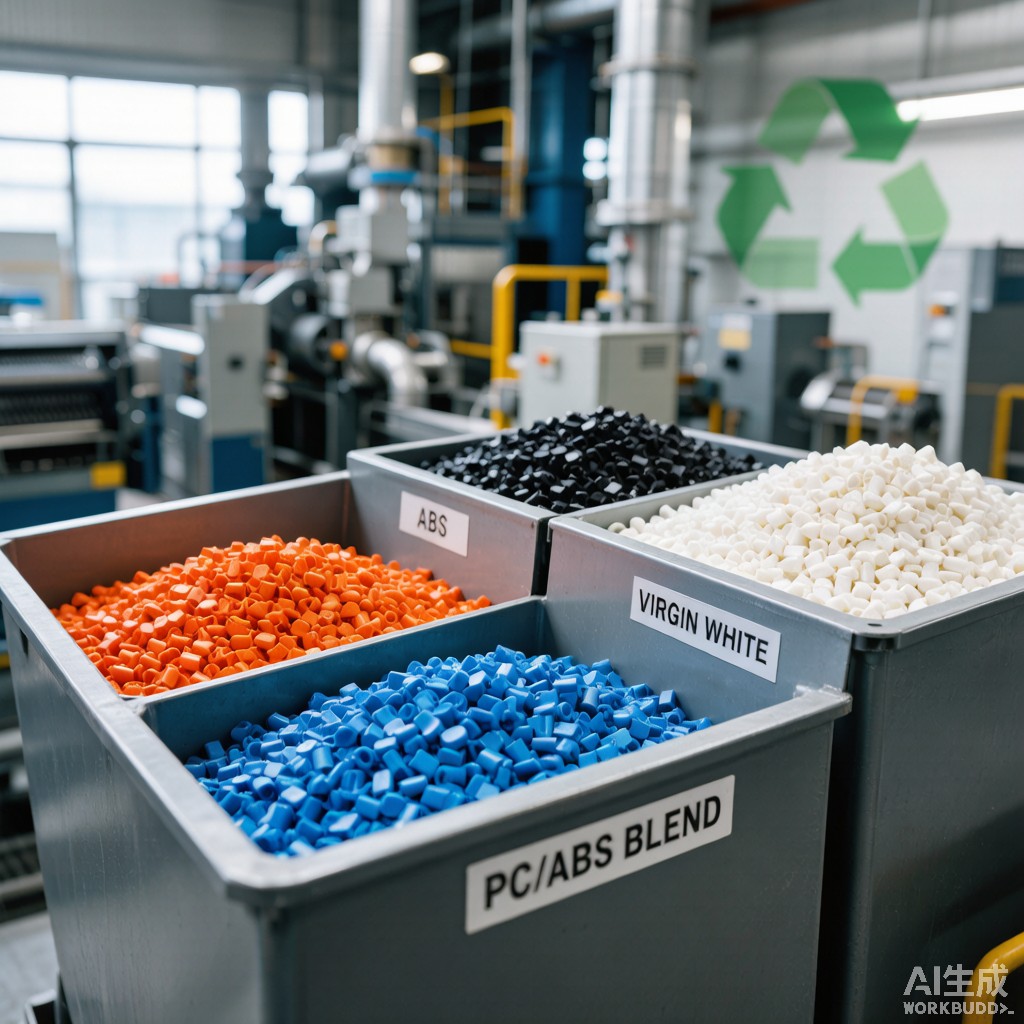
Recycled PC/ABS streams available to compounders and OEMs fall into three principal categories. Post-industrial recycled (PIR) is clean, single-source scrap from injection molding sprues, ru
ers, and rejected parts, typically with known formulation and minimal contamination; impact strength retention is 85-95% of virgin. Post-consumer recycled (PCR) is recovered end-of-life electronics, automotive shredder residue, or appliance housings, with variable contamination from paints, labels, metal inserts, and other polymers; impact strength retention is 60-80% of virgin. Ocean-bound plastic is a subset of PCR collected from coastal areas, with similar properties but more variable particle size and higher salt content requiring additional washing.
Identification by FTIR, DSC, and MFI
Each incoming lot of recycled PC/ABS must be characterized by Fourier-transform infrared spectroscopy (FTIR) to confirm polymer identity and detect contamination, by differential sca
ing calorimetry (DSC) to verify glass transition temperature (Tg 105-115°C for typical 70/30 PC/ABS blends), and by melt flow index (MFI) at 260°C/5 kg to assess molecular weight degradation. A typical QC acceptance window for SMT enclosure grade is: Tg 105-115°C (±2°C), MFI 18-25 g/10 min (±2 g), FTIR PC/ABS ratio 60/40 to 80/20 (±5%), contaminant content less than 0.1% by weight. Lots outside these windows should be reblended or downgraded to non-structural applications.
| Property | Virgin PC/ABS (70/30) | PIR PC/ABS | PCR PC/ABS (1 cycle) | PCR PC/ABS (3 cycles) | PCR PC/ABS (5 cycles) |
|---|---|---|---|---|---|
| Tensile strength (MPa) | 55-65 | 53-63 | 48-58 | 42-50 | 36-44 |
| Notched Izod (J/m) | 550-700 | 500-650 | 400-550 | 300-420 | 200-300 |
| HDT @ 1.82 MPa (°C) | 100-110 | 98-108 | 95-105 | 90-100 | 85-95 |
| MFI 260°C/5kg (g/10 min) | 18 | 20 | 25 | 35 | 55 |
Reprocessing Cycle Effects on Properties
Mechanism of Property Loss
Each reprocessing cycle subjects the PC/ABS to thermal-oxidative and shear degradation that reduces molecular weight, broadens the molecular weight distribution, and depletes the antioxidant and UV stabilizer package. For PC, chain scission occurs at the carbonate linkage through a hydrolytic mechanism accelerated by residual moisture; the rate constant is approximately 0.5-2.0 × 10⁻⁶ h⁻¹ at 280°C. For ABS, oxidative degradation of the polybutadiene rubber phase causes loss of impact modification, with the rubber particle morphology becoming less effective at craze termination. Combined, these mechanisms cause the property losses shown in the table above.
Stabilizer Replenishment
Reprocessed PC/ABS requires replenishment of the hindered phenolic antioxidant (e.g., Irganox 1076 at 0.1-0.3 wt%) and the phosphite secondary antioxidant (e.g., Irgafos 168 at 0.1-0.2 wt%) to maintain melt stability during the next injection molding cycle. Without replenishment, the melt flow index increases by 30-50% over 5 minutes of residence time at 280°C, causing flash and short shots. UV stabilizer (e.g., Tinuvin 770 or 1577 at 0.1-0.3 wt%) should also be replenished if the enclosure is for outdoor service, with the additional option of carbon black at 1-2 wt% for opaque black housings that do not require color match.
Design Rules for SMT Enclosures Using Recycled PC/ABS
Wall Thickness and Rib Design
Because recycled PC/ABS has lower impact strength and higher MFI than virgin, the wall thickness and rib design must be adjusted to compensate. Increase nominal wall thickness by 15-20% from the virgin design, for example from 2.0 mm to 2.4 mm on a typical SMT enclosure side wall, to maintain the same flexural rigidity. Reduce rib thickness to 50-60% of nominal wall (instead of the usual 60-70%) to minimize sink marks in the cosmetic surface. Increase corner radius from 0.5-1.0 mm to 1.0-1.5 mm to reduce stress concentration at the rib-to-wall junction, where recycled material typically initiates cracking.
Processing Window
Recycled PC/ABS requires a tighter processing window than virgin. Melt temperature should be reduced to 250-270°C (from the usual 260-280°C for virgin) to minimize further thermal degradation. Mold temperature should be increased to 80-100°C to improve surface finish and reduce internal stress. Injection speed should be moderate to avoid shear degradation, with a hold pressure of 50-70% of injection pressure. Drying at 90-100°C for 4-6 hours is mandatory because recycled material absorbs moisture more readily than virgin due to the porous morphology of the recyclate particles.
Qualification and Traceability
Material Certification Documentation
For OEM qualification, the recycler should provide a mill certificate showing: (1) source category (PIR / PCR / ocean-bound), (2) original polymer ratio and grade, (3) FTIR, DSC, MFI test results, (4) contaminant content, (5) reprocessing cycle count if available, (6) UV and antioxidant additive levels. A batch sample should be retained for 12-24 months for traceability in the event of field failure investigation. The enclosure manufacturer should perform an incoming QC check on every lot, including MFI and a 10-bar impact test, before releasing the material to production.
Field Validation and Warranty
Enclosures produced from recycled PC/ABS should be validated through accelerated aging at 85°C/85% RH for 1,000 hours, thermal cycling between -40°C and +85°C for 500 cycles, and UV exposure per ASTM G155 for 1,000 hours (for outdoor enclosures). Impact strength retention of 70% or higher after aging supports a 5-year warranty. Field failure rates should be tracked in a structured reliability database and compared against the equivalent virgin-grade enclosure to detect systematic property scatter before it affects a large population of installed units.
With proper stream identification, property characterization, stabilizer replenishment, and design margin, recycled PC/ABS can be safely used for SMT enclosures, co
ector housings, and internal brackets at 30-50% recycled content while maintaining 5-7 year service life and supporting OEM sustainability commitments.