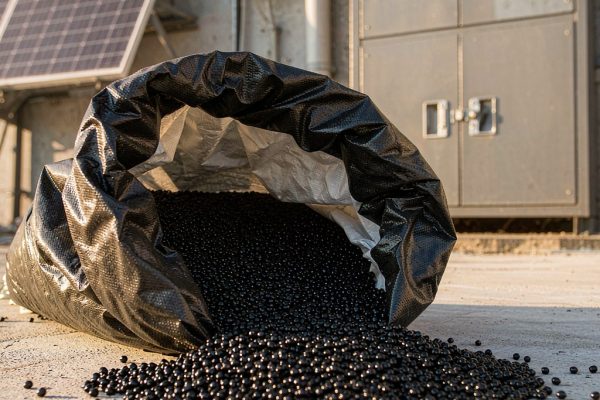
Why PA66-GF30 Pellet Moisture Control Is Critical
PA66-GF30 — nylon 66 reinforced with 30% glass fiber — is one of the most widely used modified plastics for SMT co
ector housings, terminal blocks, and structural enclosures. It offers high heat resistance (HDT at 1.8 MPa of 245-255 C for GF30 grades), excellent mechanical strength (tensile strength 170-190 MPa), and chemical resistance suitable for automotive and industrial electronics. However, PA66 is hygroscopic: it absorbs moisture from the atmosphere up to an equilibrium of 2.5-3.5% by weight at 50% relative humidity and 23 C.
This absorbed moisture causes two distinct problems during injection molding: cosmetic splay defects on the part surface and hydrolytic degradation of the polymer chain during melt processing. Both issues can be avoided by proper drying, but the drying window — the time between drying and processing — must be managed because the resin reabsorbs moisture rapidly once exposed to ambient air.
Moisture Equilibrium and Absorption Kinetics
PA66 absorbs moisture following Fickian diffusion kinetics. The equilibrium moisture content depends on the ambient relative humidity:
| Relative Humidity | Equilibrium Moisture (%) | Time to Reach 50% Equilibrium |
|---|---|---|
| 20% RH | 0.8-1.0% | ~6 hours |
| 50% RH | 2.5-3.0% | ~12 hours |
| 80% RH | 4.5-5.5% | ~18 hours |
| Saturated (100%) | 7.5-8.5% | ~48 hours |
The diffusion coefficient of PA66 at room temperature is approximately 2-4 x 10^-13 m²/s for unfilled resin, increasing to 5-8 x 10^-13 m²/s for GF30 grades because glass fibers create interfacial pathways. This means that even a 4 mm thick pellet can reach 50% of its surface moisture equilibrium within 2-3 hours of exposure to tropical ambient conditions (28-32 C, 70-80% RH).
Drying Parameters and Equipment
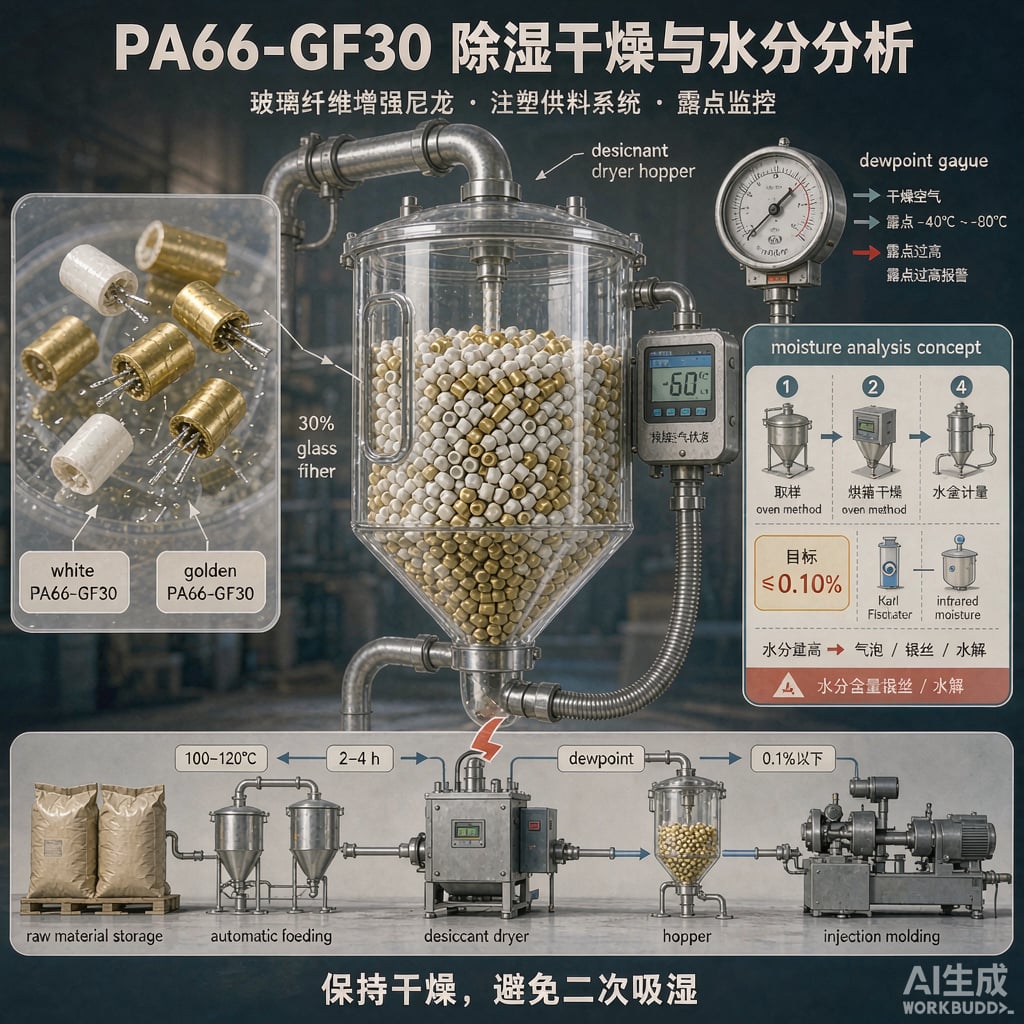
The recommended drying parameters for PA66-GF30 pellets are:
- Drying temperature: 80-85 C. Temperatures above 90 C risk surface oxidation and yellowing of the pellets; below 70 C, drying becomes impractically slow.
- Drying time: 4-6 hours for freshly opened bags, 6-8 hours for pellets that have been exposed to ambient conditions for more than 4 hours.
- Air dewpoint: -30 C or lower. A desiccant dryer with a honeycomb rotor (molecular sieve 13X) achieves dewpoints of -40 C. Hot-air dryers without desiccant ca
ot reduce pellet moisture below the ambient dewpoint and are unsuitable for PA66.
- Airflow: 0.8-1.2 m³/min per kg of resin, sufficient to carry away moisture vapor without fluidizing the pellets.
Target Moisture Before Molding
For cosmetic parts (visible co
ector housings), the target moisture is below 0.08% to prevent splay. For structural parts where cosmetics are secondary, moisture below 0.15% is acceptable and still prevents hydrolytic degradation. Measuring pellet moisture requires a halogen moisture analyzer or Karl Fischer titration; visual assessment of splay is a secondary indicator that moisture was already too high by the time the part was molded.
The Drying Window: Time Out of the Dryer
Once dried pellets are removed from the dryer and loaded into the molding machine hopper, they immediately begin reabsorbing moisture. The drying window — the acceptable time between drying and processing — depends on ambient conditions and the part’s cosmetic requirements:
| Ambient Conditions | Max Drying Window (Cosmetic Parts) | Max Drying Window (Structural Parts) |
|---|---|---|
| Dry climate (30% RH, 23 C) | 4-6 hours | 8-12 hours |
| Tropical climate (70% RH, 30 C) | 1-2 hours | 3-4 hours |
| Conditioned molding room (40% RH, 22 C) | 3-4 hours | 6-8 hours |
In tropical molding shops without air conditioning, the drying window for cosmetic PA66-GF30 parts is extremely short. The solution is a hopper dryer mounted directly on the injection molding machine, which maintains the dried pellets at 80-85 C with -30 C dewpoint air continuously from the desiccant dryer to the machine throat. This eliminates the drying window entirely and is the recommended practice for all PA66 molding in tropical climates.
Splay Defects: Causes and Remedies
Splay — also called silver streaks or moisture marks — appears as silver or white streaks radiating from the gate across the part surface. It is caused by water vapor bubbles that form in the melt when moisture-laden pellets enter the barrel at 280-300 C. The steam bubbles burst at the flow front, leaving visible streaks.
Aside from moisture, splay can also be caused by trapped air in the feed section (remedied by screw decompression before injection) or degraded gas from overheated resin (remedied by reducing barrel residence time or lowering melt temperature). The diagnostic approach is:
- Measure pellet moisture. If above 0.15%, dry the resin.
- If moisture is below 0.08% and slay persists, increase back pressure (5-10 bar) to compress trapped air.
- If splay still persists, reduce melt temperature by 10-15 C and check for excessive residence time.
Hydrolytic Degradation and Mechanical Property Loss
Beyond cosmetic defects, moisture in PA66 causes hydrolysis — the cleavage of amide bonds in the polymer chain by water molecules at processing temperature. Hydrolysis is irreversible and reduces molecular weight, which in turn reduces mechanical properties:
- At 0.10% moisture: tensile strength retention 95-98% of dry baseline
- At 0.20% moisture: tensile strength retention 85-90%
- At 0.50% moisture: tensile strength retention 60-70%, elongation at break reduced by 50%
For SMT co
ector housings that must survive reflow at 260 C and subsequent thermal cycling, hydrolytic degradation during molding is unacceptable. The target moisture content of 0.08% or below must be verified for every production run, especially when using regrind material (regrind has higher surface area and absorbs moisture faster than virgin pellets).
Regrind and Virgin Blend Considerations
Many molding operations blend virgin pellets with regrind to reduce material cost. Regrind particles have irregular geometry and higher specific surface area, causing them to reach equilibrium moisture faster. When blending 20-30% regrind, the blended batch should be dried as a mixture rather than drying virgin and regrind separately and combining them afterward. The blended drying time should be extended by 1-2 hours beyond the virgin-only schedule.
By understanding moisture equilibrium, implementing hopper-dryer integration, managing the drying window, and verifying moisture content before every production run, SMT molders can consistently produce PA66-GF30 co
ector housings with excellent cosmetics, mechanical properties, and reflow survival.