The Multi-Stress Demands of EV Charging Enclosures
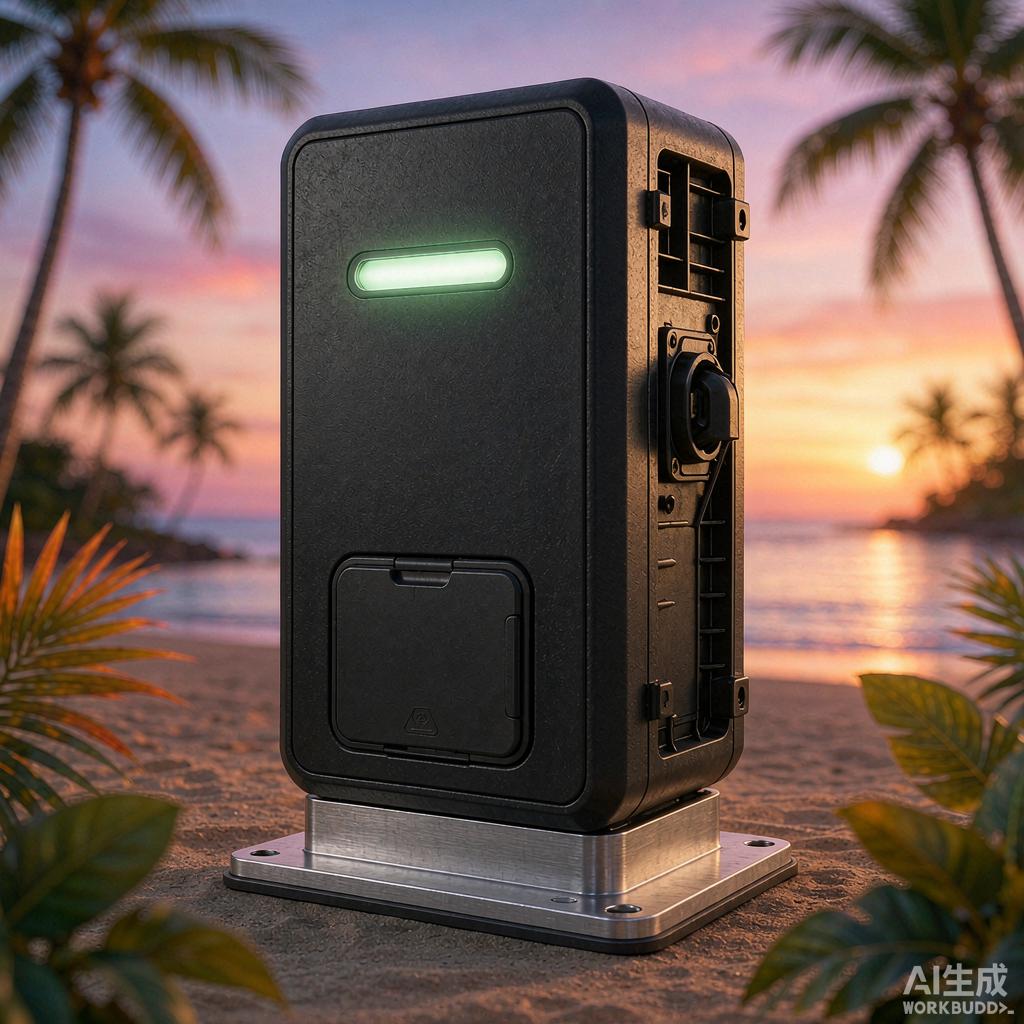
An outdoor EV charging pedestal sits at the intersection of polymer engineering challenges. The enclosure must survive a service life of 10 to 15 years in tropical sun, monsoon rain, salt-laden coastal air, and an internal electronics bay where temperatures reach 75 degrees Celsius at full 22 kW AC charging load. Material selection is therefore not a single-property decision but a coupled optimization across flame retardancy, hydrolysis resistance, UV aging, dimensional stability, and electrical insulation. At TechMart SE we supply glass-filled and flame-retardant engineering plastics to Tier 1 EVSE manufacturers across Southeast Asia and have developed a balanced PA66-GF25 FR V-0 formulation that meets the full stress matrix without the price penalty of high-end polyphthalamides.
Base Resin: PA66 with 25 Percent Glass Fiber
Polyamide 66 provides high melting point and mechanical strength, with a heat deflection temperature of 240 degrees Celsius at 1.82 MPa after glass fiber reinforcement. Twenty-five percent glass fiber by weight is the sweet spot for injection-molded enclosures up to 600 mm on the long side: it gives a tensile strength of 170 MPa, a flexural modulus of 8 GPa, and a CTE of 35 ppm per degree Celsius low enough to maintain PCB flatness at sustained electronics operation. Higher glass loadings like 35 to 50 percent improve stiffness but introduce severe warpage and require longer flow paths during molding.
Flame Retardancy Without Halogen
Outdoor charging enclosures sold into the EU must meet IEC 62606 and increasingly EU 2019/1021 POPs regulation halogen-free flame retardant requirements. Our formulation uses 18 percent by weight of a synergistic aluminum diethylphosphinate plus melamine cyanurate system, achieving UL94 V-0 at 1.5 mm wall thickness and GWFI 960 degrees Celsius. Smoke density per ISO 5659-2 stays below Ds,max 150, critical for indoor parking garage installations where smoke obscuration must remain low. The brominated alternative is faster to formulate but is being phased out across major OEM platforms.
Hydrolysis Stabilizer: Carbodiimide Chain Extender
Standard PA66 loses up to 50 percent of its tensile elongation after 1000 hours of 85 degrees Celsius plus 85 percent RH exposure because water attacks the amide bond and shortens polymer chains. We add 1.5 percent by weight of an aromatic polycarbodiimide such as Stabaxol P. The carbodiimide reacts with hydrolysed amide linkages to restore chain length, slowing tensile elongation loss to 15 to 20 percent over 3000 hours of 85/85 aging. This data matches well with the OV-A3 reference compound in IEC 60068-2-78 and is one of the strongest technical arguments for a purpose-formulated hydrolysis-grade PA66 versus off-the-shelf glass-filled resin.
UV Stabilization Package
Tropical sun exposure at the equator delivers 200 to 280 kLy per year, driving polymer chain scission and surface chalking. We combine a hindered amine light stabilizer at 0.5 percent with a benzotriazole UV absorber at 0.3 percent and a carbon black pigment at 0.8 percent. After 4000 hours of ASTM G155 cycle 1 xenon arc exposure, the formulation retains 65 percent of initial tensile elongation versus 30 percent retention for the same resin without the HALS package. Black pigmentation helps but ca
ot substitute for the HALS chemistry, because the surface still sees bond cleavage under UV photon absorption.
Comparison to PA66-GF35 and SMC Composites
Stepping glass from 25 to 35 percent raises the HDT to 255 degrees Celsius but doubles the warpage and lengthens cycle time by 12 to 18 percent. SMC sheet molding compound using glass mat gives better impact but ca
ot meet the same 1.5 mm wall flame rating at competitive cost. Choosing PA66-GF25 FR V-0 with full stabilizer package is therefore the best compromise for tropical outdoor enclosures where injection molding volume justifies tooling investment.
Processing Recommendations
Dry the molding pellets at 80 degrees Celsius for 4 to 6 hours to below 0.05 percent moisture. Melt temperature should stay between 285 and 300 degrees Celsius to avoid excessive glass fiber attrition. Mold surface temperature of 90 to 110 degrees Celsius promotes crystallinity and dimensional stability. A holding pressure of 80 to 100 MPa for 6 to 10 seconds compensates for the shrinkage differential between matrix and fiber, keeping enclosure flatness below 0.3 mm across the 600 mm long dimension.