Commercial smoking booths in Southeast Asia’s high-traffic environments—airports, shopping malls, corporate campuses, and hospitality venues—face a persistent challenge: tobacco smoke odor molecules persist in exhaust air even after HEPA filtration removes particulate matter. While HEPA filters capture 99.97% of particles ≥0.3 μm, gaseous odor compounds including nicotine, pyridine, acetaldehyde, and hydrogen sulfide pass through unimpeded. Ozone catalytic oxidation systems, particularly those employing manganese dioxide (MnO₂) catalysts, provide an effective solution for complete deodorization. This article examines the reaction chemistry, system design, and operational considerations for ozone-MnO₂ catalytic oxidation in commercial smoking booth air purification.
Smoke Odor Chemistry and Treatment Requirements
Key Odor Compounds in Tobacco Smoke
Environmental tobacco smoke contains over 4,700 identified compounds, of which approximately 60 are principal odor contributors. The most challenging species for air treatment systems include:
| Compound | Odor Threshold (ppb) | Primary Source | Health Concern |
|---|---|---|---|
| Nicotine | 14 | Tobacco leaf alkaloid | Respiratory irritant |
| Pyridine | 20 | Pyrolysis of proteins | Nervous system toxicant |
| Acetaldehyde | 4 | Combustion of sugars | IARC Group 1 carcinogen |
| Acrolein | 16 | Glycerin pyrolysis | Severe respiratory irritant |
| Hydrogen sulfide | 8 | Sulfur compound reduction | Olfactory fatigue at high levels |
| Ammonia | 5,300 | Protein combustion | Respiratory irritant |
| Benzene | 1,600 | Combustion of organics | IARC Group 1 carcinogen |
The extremely low odor thresholds—particularly acetaldehyde at 4 ppb—mean that even trace residual concentrations create perceptible odors. Effective deodorization must achieve >95% removal of these species, typically requiring oxidation to CO₂, H₂O, and inorganic salts.
Ozone Catalytic Oxidation Mechanism
Ozone Generation and Properties
Ozone (O₃) is a powerful oxidant with a standard reduction potential of +2.07 V (second only to fluorine at +2.87 V and the hydroxyl radical at +2.80 V). In smoking booth applications, ozone is generated on-site via corona discharge from dry air or oxygen:
3O₂ + energy → 2O₃ (corona discharge, 5-15 kV, 50-500 Hz)
Commercial ozone generators for air treatment produce 1-20 g/hr from ambient air, with concentrations of 0.5-5.0 ppm in the treated airstream. Higher concentrations risk residual ozone in the exhaust, which must be kept below 0.05 ppm (OSHA 8-hour TWA limit) for occupant safety.
MnO₂ Catalytic Reaction Pathways
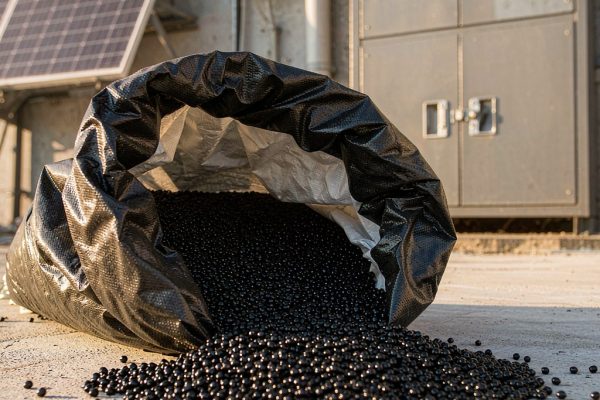
Manganese dioxide serves as a heterogeneous catalyst that accelerates ozone decomposition while generating highly reactive surface-bound oxygen species. The catalytic cycle proceeds through three steps:
- Ozone adsorption and activation: O₃ molecules adsorb onto MnO₂ surface oxygen vacancies, forming activated surface complexes (Mn-O₃*).
- Target compound oxidation: Adsorbed odor molecules react with activated oxygen species, undergoing complete oxidation to CO₂, H₂O, NO₃⁻, SO₄²⁻, and other mineralized products.
- Catalyst regeneration: Reduced Mn sites are reoxidized by gas-phase ozone, completing the catalytic cycle.
The overall reaction for acetaldehyde (representative VOC) is:
CH₃CHO + 2O₃ → 2CO₂ + 2H₂O + 2O₂ (catalyzed by MnO₂)
Catalyst Structure and Active Sites
The catalytic activity of MnO₂ depends strongly on its crystal structure and morphology:
| MnO₂ Polymorph | Crystal Structure | Surface Area (m²/g) | Ozone Decomposition Activity |
|---|---|---|---|
| α-MnO₂ | Tu
el structure (2×2) |
20-60 | High—abundant oxygen vacancies |
| β-MnO₂ | Rutile structure | 5-20 | Moderate—limited surface defects |
| γ-MnO₂ | Intergrowth of ramsdellite/pyrolusite | 30-80 | Very high—optimal defect density |
| δ-MnO₂ | Layered/birnessite | 100-250 | Very high—highest surface area |
For smoking booth applications, γ-MnO₂ and δ-MnO₂ offer the best combination of activity and surface area. δ-MnO₂’s layered structure provides the highest surface area (up to 250 m²/g) but may degrade faster under high humidity; γ-MnO₂ provides the best balance of activity, stability, and cost.
System Design for Commercial Smoking Booths
Process Flow Configuration
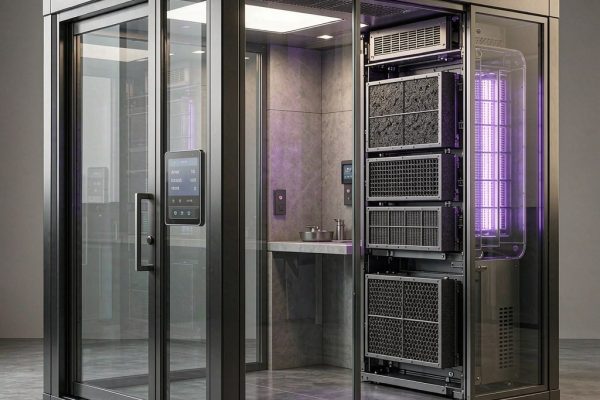
A complete ozone-MnO₂ deodorization system integrates with the smoking booth’s existing ventilation in a four-stage configuration:
- Pre-filtration (G4): Removes coarse particulates (PM>10) and protects downstream catalyst from dust fouling.
- HEPA filtration (H13/H14): Captures fine particulates including tobacco tar droplets and respirable particles. This stage must precede ozone injection to prevent oxidation of filter media.
- Ozone injection and catalytic reactor: Ozone is injected into the HEPA-filtered airstream at 1-3 ppm concentration, then passes through a packed-bed MnO₂ catalyst reactor with 0.3-1.0 second contact time.
- Residual ozone destruction: A downstream activated carbon or MnO₂ polishing bed ensures residual ozone <0.05 ppm before exhaust discharge.
Catalyst Bed Design Parameters
| Parameter | Design Value | Rationale |
|---|---|---|
| Catalyst loading | 0.5-2.0 kg per 100 m³/h airflow | Sufficient active surface for 95%+ VOC removal at design flow |
| Contact time | 0.5-1.5 seconds | Balances removal efficiency against pressure drop and reactor volume |
| Operating temperature | 20-40°C (ambient) | MnO₂ activity sufficient at room temperature; heating not required |
| Face velocity | 0.5-1.5 m/s | Prevents catalyst attrition and cha
eling |
| Bed depth | 100-300 mm | Multiple catalyst layers with support grids for structural integrity |
| Pressure drop | 50-200 Pa | Compatible with standard EC fan capabilities |
Performance Data and Operational Results
Removal Efficiency
Field testing in commercial smoking booths across Southeast Asia demonstrates consistent performance:
| Compound | Inlet Concentration (ppm) | Removal Efficiency (%) | Outlet Concentration (ppb) |
|---|---|---|---|
| Nicotine | 0.5-2.0 | 98-99.5 | <20 |
| Acetaldehyde | 2-8 | 95-98 | <200 |
| Pyridine | 0.1-0.5 | 97-99 | <10 |
| Ammonia | 1-5 | 90-95 | <500 |
| TVOC (total) | 10-50 | 93-97 | <2,000 |
The combined HEPA + ozone-MnO₂ system achieves overall odor reduction corresponding to 85-95% perceived odor intensity reduction in human panel testing (ASTM E544), meeting the stringent requirements for indoor air quality in commercial buildings.
Maintenance and Catalyst Lifecycle
Catalyst Deactivation Mechanisms
MnO₂ catalysts in smoking booth service experience three primary deactivation pathways:
- Tar and particulate fouling: Despite upstream HEPA protection, trace tar aerosols (<0.1% penetration) gradually coat catalyst surfaces. Periodic thermal regeneration at 200-250°C for 2-4 hours oxidizes deposits and restores 90-95% of initial activity.
- Moisture inhibition: Southeast Asian humidity (70-90% RH) competitively adsorbs on catalyst sites, reducing activity by 10-20%. Catalysts with hydrophobic surface treatment or operation at slightly elevated temperature (35-40°C) mitigate this effect.
- Sulfur poisoning: Sulfur compounds in tobacco smoke (H₂S, SO₂, thiophenes) form stable MnS surface species. Alkaline pre-wash or sulfur-tolerant catalyst formulations extend catalyst life in high-sulfur environments.
Replacement Scheduling
Typical catalyst replacement intervals for commercial smoking booths:
- High-traffic (>200 users/day): 12-18 months primary catalyst, 6-9 months polishing bed.
- Medium-traffic (50-200 users/day): 24-36 months primary catalyst, 12-18 months polishing bed.
- Low-traffic (<50 users/day): 48-60 months with a
ual thermal regeneration.
Safety and Regulatory Compliance
Ozone Exposure Control
The primary safety concern is residual ozone in the treated exhaust and potential leakage into occupied spaces. Engineering controls include:
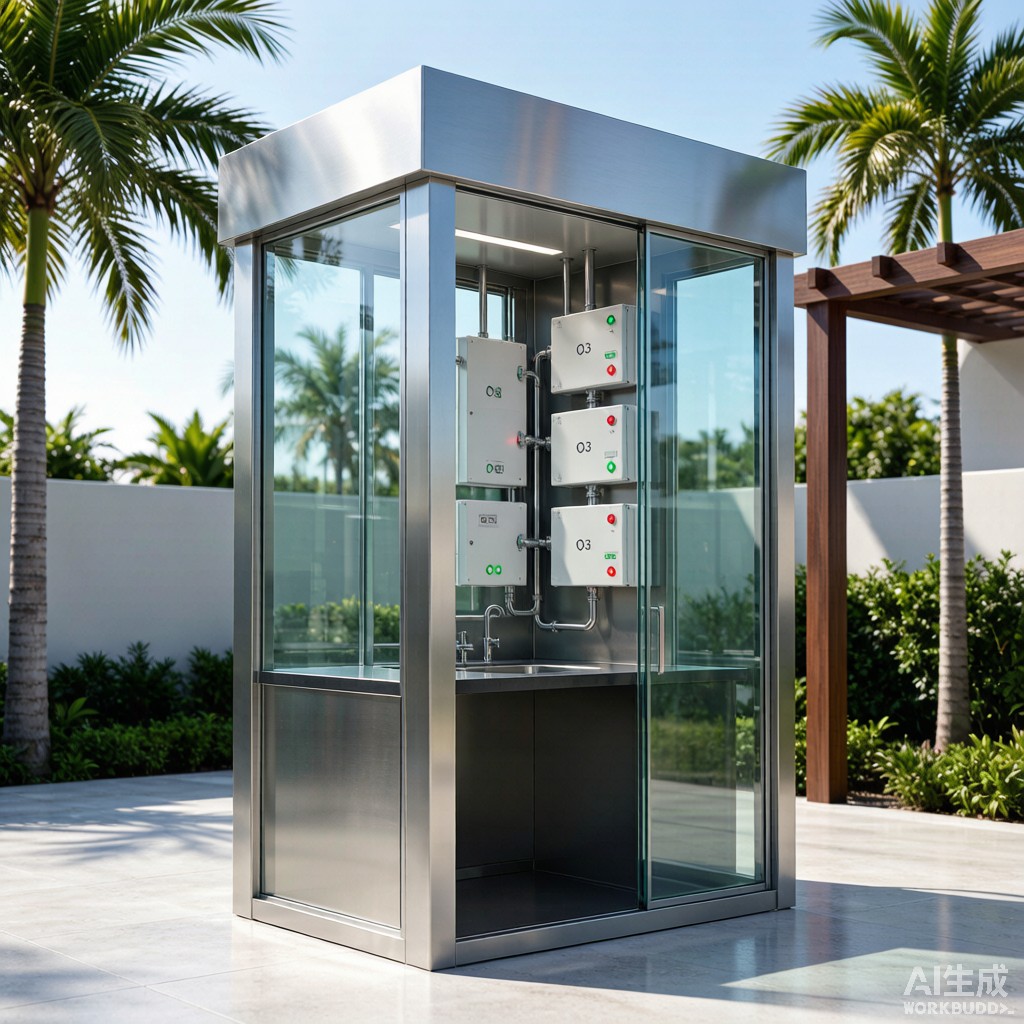
- Redundant ozone monitoring: Electrochemical ozone sensors at reactor inlet, outlet, and booth interior with interlocked shutdown at 0.1 ppm.
- Negative pressure containment: Smoking booth maintained at -5 to -10 Pa relative to adjacent spaces prevents ozone migration.
- Post-treatment ozone destruction: Activated carbon or heated MnO₂ bed ensures <0.03 ppm residual before discharge.
Southeast Asian Regulatory Context
While no ASEAN-wide standard specifically addresses smoking booth air treatment, relevant regulations include:
- Singapore NEA guidelines: Indoor ozone concentration <0.05 ppm (8-hour average).
- Thailand OQAV standards: VOC emissions from smoking areas <2.0 mg/m³ total non-methane VOC.
- Malaysia DOSH: Ozone exposure limits align with OSHA PEL of 0.1 ppm (8-hour TWA).
Conclusion
Ozone-MnO₂ catalytic oxidation systems provide a technically robust and economically viable solution for tobacco smoke odor control in commercial smoking booths. By combining the powerful oxidizing capability of ozone with the catalytic efficiency of manganese dioxide, these systems achieve >95% removal of principal odor compounds while maintaining safe residual ozone levels. For Southeast Asian installations, humidity-resistant catalyst formulations and redundant safety monitoring are essential design considerations. When integrated with upstream HEPA filtration, the complete four-stage treatment train delivers indoor air quality that satisfies the most stringent commercial building standards.