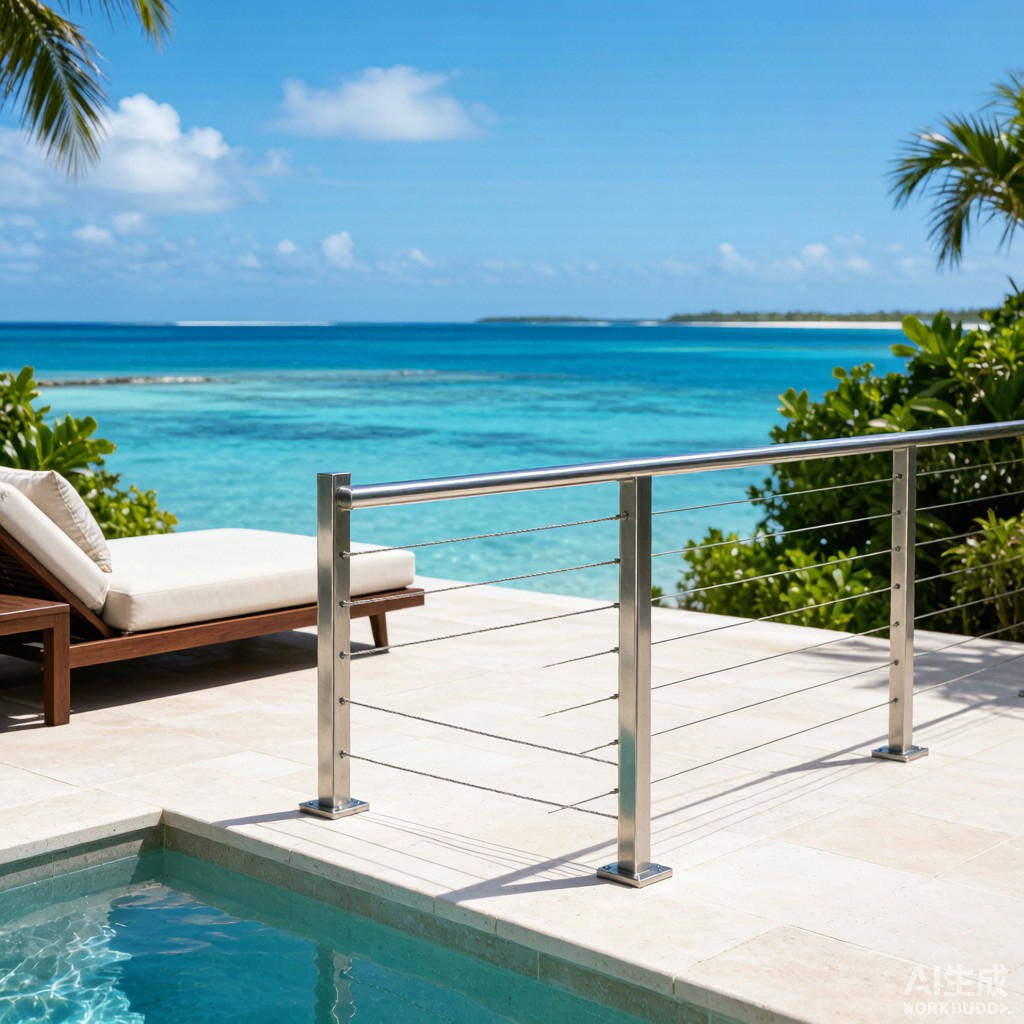
Outdoor lounge venues in tropical resort and hotel settings frequently incorporate stainless steel cable railing systems for pool perimeter, terrace edge, and elevated walkway fall protection. The combination of aesthetic appeal (minimal visual obstruction of ocean or pool view), code-compliant safety (typically 4-inch sphere passage test and 50-100 lbf concentrated load resistance), and corrosion resistance in salt-air marine exposure makes stainless steel cable railing the preferred specification over glass panel or aluminum picket alternatives for premium resort projects. However, the tropical marine environment — characterized by sustained 75-95% RH, 28-34°C ambient, daily salt aerosol deposition at 0.5-2.0 mg NaCl/m²/day in coastal resort settings, and elevated chlorination chemistry in pool splash zones — places extreme demands on the stainless steel alloy selection, fastener specification, and cable hardware design. This article examines the engineering principles, alloy selection, structural loading, and maintenance protocol for stainless steel cable railing in tropical marine outdoor lounge applications.
Stainless Steel Alloy Selection
Marine-Grade Alloy Comparison
Three stainless steel alloy families compete for cable railing marine service, each with distinct cost-vs-performance trade-offs:
| Alloy Family | UNS Designation | PREN (Pitting Resistance) | Salt Spray Rating (ASTM B117 hr to first rust) | Cost Index | Recommended Service Environment |
|---|---|---|---|---|---|
| Austenitic 316 | S31600 | 25-26 | 500-1,000 | 1.0x baseline | Indoor, mild outdoor |
| Austenitic 316L (low C) | S31603 | 25-26 | 500-1,000 | 1.05x | Welded assemblies >3mm |
| Austenitic 316Ti (Ti-stabilized) | S31635 | 26-27 | 800-1,200 | 1.4x | Welded high-temp rail posts |
| Duplex 2205 | S32205 | 35-36 | 2,000-4,000 | 1.8x | Coastal pool deck, marine splash |
| Super-duplex 2507 | S32750 | 42-43 | 4,000-8,000 | 3.2x | Direct seawater immersion |
| Austenitic 904L | N08904 | 34-36 | 1,500-2,500 | 2.6x | Premium tropical resort >20yr service |
Pool Splash Zone Considerations
Pool deck area within 5-10 m of pool edge receives both marine salt aerosol and chlorinated water splash carrying 1-5 ppm free chlorine plus 0.5-3 ppm cyanuric acid stabilizer. The combined chloride+chlorine exposure requires:
- Duplex 2205 stainless steel: 22% Cr, 5% Ni, 3% Mo, 0.14% N composition with PREN 35-36 achieves verified 30+ year service in pool splash zones per ASTM A276 / EN 10088-3 standards. 2205 is the workhorse alloy for premium tropical resort pool cable railing with 2x the pitting resistance of 316 at only 1.8x material cost premium.
- 316L with electropolishing: Cost-effective for projects on tight budgets; surface electropolishing reduces Ra from 0.4-0.8 µm (mill finish) to 0.05-0.15 µm, eliminating micro-crevices where chlorides concentrate and extending salt spray rating to 1,500-2,000 hours per ASTM B117.
- 316 with powder coating (PVDF or fluoropolymer): Provides barrier protection at lowest cost, but any coating breach leads to underfilm crevice corrosion within 6-18 months in tropical chloride exposure; not recommended for primary structural posts in pool splash zones.
Structural Loading and Code Compliance
Guard Rail Loading Standards
International code requirements for guard rail (railing) loading vary by jurisdiction, with the three primary reference standards summarized:
| Code | Top Rail Concentrated Load | Top Rail Uniform Load | Infill Concentrated Load | Sphere Passage (Max) | Min Cable Tension |
|---|---|---|---|---|---|
| US IBC 2021 (commercial) | 200 lbf (0.89 kN) | 50 plf (0.73 kN/m) | 50 lbf (0.22 kN) | 4 inch (100 mm) | 200 lbf (0.89 kN) |
| Singapore BCA | 1.5 kN/m uniform | 1.5 kN/m | 0.5 kN @ any point | 100 mm | 0.9 kN |
| Eurocode EN 1991-1-1 | 1.0 kN/m at handrail | 1.0 kN/m | 0.5 kN horizontal | 100 mm | 1.0 kN at end post |
| Australian NCC (Class A) | 1.5 kN concentrated | 0.75 kN/m | 0.5 kN horizontal | 125 mm | 1.5 kN |
Cable Tension Engineering
For a typical 42-inch (1,067 mm) tall cable railing post with 4-inch sphere passage code:
- Cable diameter: 5/32 inch (4 mm) 1×19 strand type 316 stainless for residential; 3/16 inch (5 mm) for commercial code compliance. 1×19 construction provides superior abrasion resistance and minimum stretch under sustained tension.
- Initial tension: 250-400 lbf (1.1-1.8 kN) per cable row achieves 100-150 lbf (445-668 N) horizontal deflection resistance at mid-span between posts. Tension measurement via cable tension gauge (TensionMate or similar) at installation is mandatory; field tension must remain above 75% of initial value to maintain sphere passage compliance throughout service life.
- Post spacing: Maximum 4 feet (1,219 mm) on-center for 5/32 inch cable with 36-inch run between cables; 5 feet (1,524 mm) requires 3/16 inch cable. End posts and corner posts must be upgraded to 2-inch (50 mm) minimum nominal diameter with thicker wall (3 mm+) to resist accumulated tension from continuous cable runs.
- Cable row spacing: Maximum 3-7/8 inch (98 mm) clear opening between cable rows for sphere passage code; typically 11 rows of cables in a 42-inch rail height with 95 mm spacing plus closure at top and bottom.
Post Anchor Engineering
Post base plate co
ection to the structural deck represents the most common failure mode in tropical cable railing installation:
- Embedded anchor: M12 stainless steel chemical anchor (Hilti HIT-RE 500 V4 or equivalent) into 4,000 psi reinforced concrete deck achieves full tension load transfer. Embedment depth 100-150 mm with 250 mm minimum edge distance.
- Surface mount base plate: 1/4 inch (6 mm) thick 316L base plate with four M10 stainless through-bolts to embedded anchor cage; allows post replacement without deck demolition but creates crevice corrosion risk at plate-to-deck interface that must be sealed with marine-grade polyurethane sealant (3M 5200 or equivalent).
- Core-drilled post: For elevated concrete slab or post-tension deck where chemical anchor is not feasible, 50 mm diameter core-drilled post socketed 200 mm into slab with non-shrink epoxy grout provides direct load transfer with minimal hardware.
Hardware Specification for Tropical Marine
Cable End Fittings
Cable end hardware in pool splash or marine-aerosol exposure requires careful alloy upgrade over standard 316 specifications:
- Threaded tensioner body: Forged 2205 duplex stainless with electropolished finish, designed for 1×19 cable diameter 4-5 mm. Tensioner body acts as structural element transmitting full cable load to post; must match cable material corrosion resistance.
- Swage terminal: Hydraulic swaging of 316 cable to 316L terminal barrel at 35-45 ton swaging force creates permanent cold-forged mechanical joint. Inspect swaging with bore gauge; target barrel diameter reduction 1.5-2.5% from free state. Failure mode from under-swaged cable typically appears as cable slippage at 60-90% of rated breaking load.
- Mechanical grip terminal: Field-installable wedge-type grip terminal avoids hydraulic swaging equipment; convenient for repair and retrofit work but achieves only 70-80% of cable breaking strength versus properly swaged joints.
Fastener Torque Specification
Torque specification for tensioner lock nut and jam nut determines long-term cable tension retention:
| Fastener Size | Cable Diameter (mm) | Initial Torque (N·m) | Re-torque Interval (Tropical) | Stainless Grade |
|---|---|---|---|---|
| M6 jam nut | 3-4 | 8-12 | 6 months | A4-80 (316 class) |
| M8 jam nut | 4-5 | 15-22 | 9 months | A4-80 |
| M10 jam nut | 5-6 | 28-40 | 12 months | A4-80 |
| 6-8 | 45-65 | 12 months | 2205 duplex |
Stainless Steel Selection Pitfall: Galvanic Compatibility
Mixed-alloy installation must avoid galvanic corrosion. Critical compatibility matrix:
- 316 post + 2205 tensioner: Compatible. Both alloys in similar austenitic-ferritic family; galvanic potential difference <0.05 V produces negligible galvanic current in pool splash chloride exposure.
- 316 cable + 316 tensioner (standard): Compatible with no galvanic risk; preferred cost-effective combination for non-pool zone installation.
- 316 post + carbon steel bolt (anchor): Avoid. Steel-to-stainless galvanic couple with 0.4-0.6 V driving potential and chloride electrolyte produces rapid bolt corrosion and post-attachment failure. Use only stainless anchors (A4-80 or higher) within the railing assembly.
- 316 cable + brass or copper alloy fitting: Strict avoidance. Brass dezincification and copper-stainless galvanic couple causes rapid failure in chloride exposure within 12-24 months.
Inspection and Maintenance Protocol
Routine Inspection Schedule
Recommended inspection frequency and content for tropical marine cable railing installation:
- Monthly visual inspection: Visual check for rust staining at cable terminations, post base plate interfaces, and fastener heads. Any iron contamination from mild steel tooling or airborne sources should be removed with stainless steel passivation paste (Avesta 101 or equivalent) within 48 hours.
- Quarterly cable tension check: Cable tension gauge measurement at representative sample (10% of cable runs). Tension loss >25% from initial reading indicates terminal slippage or cable stretch; re-tension or replace.
- A
ual fastener torque audit:
Sample 10% of jam nut and tensioner body fasteners with calibrated torque wrench; re-torque to specification if any fastener falls below 80% of specified torque. - Bie
ial full system audit:
Detailed inspection of cable terminations for crevice corrosion, post-to-deck interface for sealant integrity, and post cap seal for water ingress. Replace sealants showing flexibility loss or adhesion failure.
Cleaning and Passivation
Tropical marine exposure deposits salt and chloramine residues that must be removed to maintain surface passivity:
- Monthly wash: Low-pressure freshwater rinse with soft brush, avoiding abrasive cleaners that damage the passive Cr₂O₃ layer
- Quarterly detergent wash: Mild alkaline detergent (pH 9-10) with soft brush, followed by freshwater rinse; removes organic deposits that can harbor chloride concentration
- A
ual passivation:
Citric acid or nitric acid passivation paste (Avesta 101 or similar) applied to stainless surfaces, allowed to dwell 30-60 minutes, then thoroughly rinsed. Restores Cr₂O₃ layer thickness to factory specification, providing up to 12 months of additional chloride resistance in marine exposure.
Code Compliance and Documentation
Engineering Calculation Record
For permitting and project documentation, maintain a calculation record showing:
- Post base reaction: Maximum combined tension from adjacent cable runs at corner or end posts, calculated for full cable tension at maximum design load (typically 1.5 kN per cable)
- Anchor pull-out resistance: Concrete anchor capacity per Hilti or DeWalt technical manual, reduced by safety factor of 2.5 for sustained tension or 4.0 for dynamic crowd loading
- Sphere passage verification: Field measurement of maximum clear opening between cable rows and between cable and post, achieved with cables under design tension
- Material traceability: Mill certificates (EN 10204 3.1) for posts, cables, and hardware, matching alloy specification to design intent
Conclusion
Stainless steel cable railing in tropical marine outdoor lounge applications requires 316L minimum baseline with duplex 2205 upgrade for pool splash zones, careful galvanic compatibility to avoid mixed-alloy corrosion, and rigorous tension maintenance to preserve code-compliant sphere passage. Cable diameter 5/32 to 3/16 inch 1×19 type 316 stainless at 250-400 lbf initial tension per row, combined with end post spacing ≤4 feet and mechanical anchor into structural concrete deck, achieves IBC / Eurocode / Singapore BCA / Australian NCC compliance for the top rail 200 lbf concentrated load at handrail and the 50 lbf infill concentrated load between cables. A
ual passivation cleaning and quarterly tension audit maintain chloride resistance and structural integrity across the 20-30 year design service life expected for premium tropical resort installation.