Outdoor lounges in tropical resorts, hotels, and rooftop venues increasingly rely on solar-powered lighting to reduce grid dependency, lower operating cost, and create flexible ambiance without extensive trenching and cabling. Modern systems combine photovoltaic panels, energy-efficient LED luminaires, lithium battery storage, and IoT controllers that enable scheduled dimming, motion activation, remote monitoring, and integration with building management systems. However, tropical climates present unique engineering challenges: high solar irradiance during dry seasons, extended monsoon cloud cover, high humidity, salt air in coastal locations, and ambient temperatures that accelerate battery aging. This article examines the system architecture, sizing methodology, and IoT control strategies for reliable outdoor lounge solar lighting in tropical environments.
System Architecture Overview
Off-Grid Solar Lighting Components
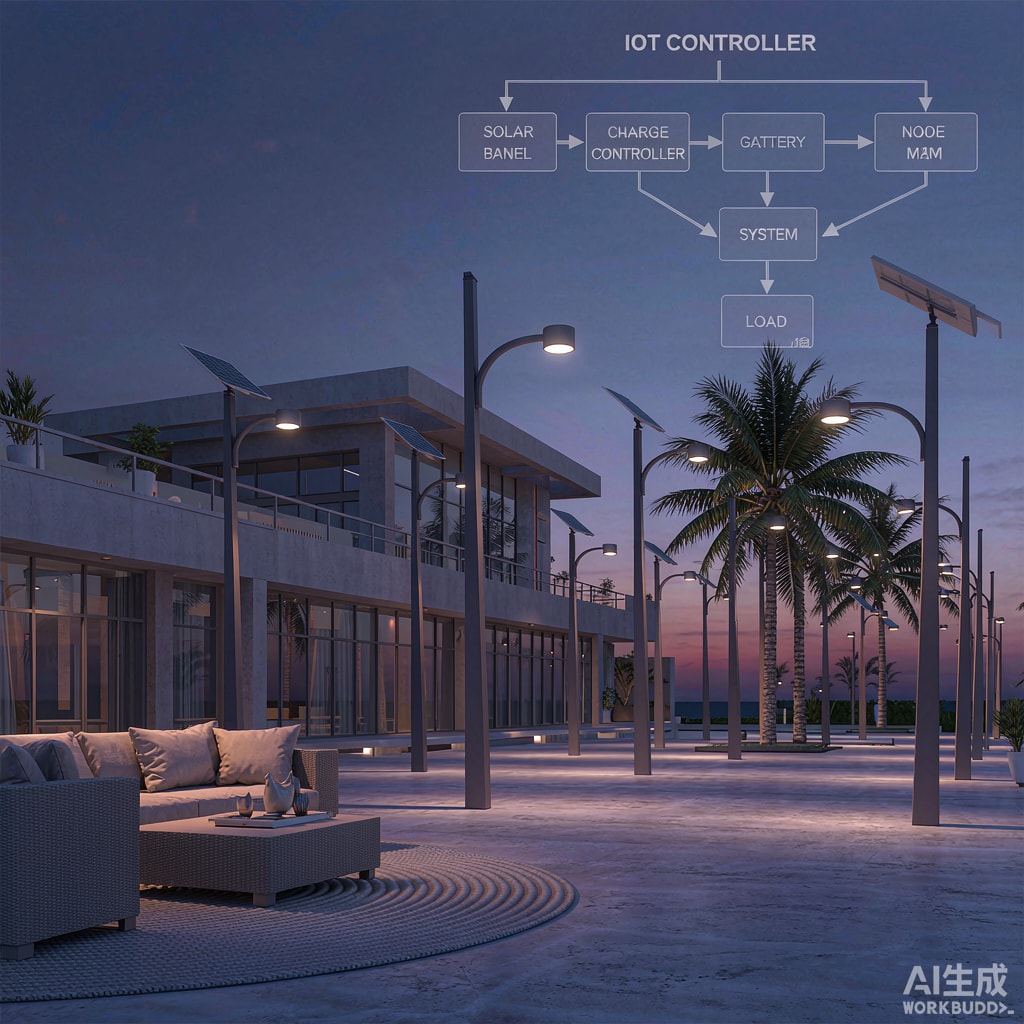
A typical integrated outdoor lounge solar lighting system consists of the following subsystems:
- PV module: 50-200 Wp monocrystalline or bifacial panel per pole or canopy segment, oriented for maximum evening-load capture.
- LED luminaire: 10-50 W high-efficacy LED (160-200 lm/W) with warm white (2700-3000K) or tunable white CCT for ambiance.
- Battery: 12.8V or 25.6V LiFePO₄ pack, 20-100 Ah per pole, sized for 2-3 days autonomy.
- Charge controller: MPPT controller with dusk-to-dawn, time-segment dimming, and load protection.
- IoT controller: LoRa, Zigbee, Wi-Fi, or cellular node for remote monitoring and control.
- Sensors: PIR motion, ambient light, temperature, and humidity sensors for adaptive operation.
The integration challenge is balancing capital cost against reliability. Oversized PV and battery ensure year-round operation but increase payback period; undersized systems fail during consecutive cloudy days and generate user complaints.
Load and Energy Budget
Daily Energy Consumption
For a resort outdoor lounge operating 6-10 hours per evening, the daily energy budget determines battery and PV sizing. Consider a 30 W LED luminaire with smart dimming:
| Time Segment | Power Level | Duration | Energy (Wh) |
|---|---|---|---|
| Dusk to 9 PM (peak occupancy) | 100% (30 W) | 3 h | 90 |
| 9 PM to 12 AM (moderate occupancy) | 60% (18 W) | 3 h | 54 |
| 12 AM to dawn (security/low use) | 20% (6 W) | 4 h | 24 |
| Daily total | — | 10 h | 168 Wh |
A 30 W luminaire with this dimming profile consumes 168 Wh/day rather than 300 Wh/day at full power, reducing both battery and PV requirements by 44%. Smart dimming is therefore the most cost-effective energy-saving measure in solar lighting design.
Photovoltaic Sizing for Tropical Conditions
Peak Sun Hours and Monsoon Correction
PV array size is calculated from daily load and available solar resource:
PV Power (W) = Daily Load (Wh) / (Peak Sun Hours × System Efficiency)
System efficiency accounts for battery charge/discharge round-trip (85-92%), MPPT efficiency (95-98%), wiring and temperature losses (85-90%), and dust/degradation (90-95%). A combined efficiency of 70-75% is typical for tropical outdoor lounge systems.
| Location / Season | Peak Sun Hours | Required PV for 168 Wh/day Load |
|---|---|---|
| Singapore / Dry season | 4.5-5.5 | 45-55 W |
| Singapore / Monsoon | 2.5-3.5 | 75-100 W |
| Bangkok / Dry season | 5.0-6.0 | 40-50 W |
| Bangkok / Monsoon | 3.0-4.0 | 65-85 W |
| Jakarta / Year-round | 4.0-5.0 | 50-65 W |
For monsoon reliability, the PV array should be sized for the worst-month sun hours rather than a
ual average. This often requires 50-80% more PV capacity than a dry-season-only design.
Battery Sizing and Autonomy
LiFePO₄ Capacity Design
Battery capacity must cover daily load during cloudy periods and limit depth of discharge to maximize cycle life:
- Daily load: 168 Wh for the example luminaire.
- Days of autonomy: 2-3 days for tropical locations with predictable monsoon patterns; 3-5 days for locations with erratic weather.
- Depth of discharge (DoD): Limit LiFePO₄ to 80-90% DoD for 3,000-5,000 cycles; 70% DoD extends life to 5,000-7,000 cycles.
- System voltage:
12.8V nominal for small poles; 25.6V for higher-power luminaires and reduced cable losses. For the 168 Wh/day load with 3 days autonomy and 80% DoD:
Battery Energy = 168 Wh × 3 / 0.80 = 630 Wh
At 12.8V nominal, this equals approximately 50 Ah. A 12.8V 50 Ah LiFePO₄ battery pack is therefore a well-sized choice for this luminaire in a tropical monsoon climate.
IoT Control and Dimming Strategies
Smart Protocols and Scheduling
IoT controllers add intelligence beyond simple dusk-to-dawn operation:
- Time-segment dimming: Pre-programmed brightness curves matching venue operating hours; reduces energy by 30-50%.
- Motion sensing: PIR or microwave sensors boost brightness to 100% when guests are present and dim to 10-20% during inactivity.
- Adaptive battery management: Controller reduces brightness when battery state-of-charge falls below 30-40% to prevent deep discharge.
- Remote monitoring: Cloud dashboard reports panel voltage, battery SOC, LED current, and fault codes; enables predictive maintenance.
- Group control: DMX, DALI, or wireless mesh protocols synchronize lighting across multiple poles and zones for uniform ambiance.
For tropical outdoor lounges, the combination of motion sensing and weather-adaptive dimming provides the best balance of guest experience and energy resilience. During monsoon weeks when charging is limited, the system can automatically extend low-brightness hours rather than shutting down entirely.
Tropical Reliability Engineering
Humidity, Salt, and Heat
Outdoor lounge solar lighting in tropical climates must be specified for environmental durability:
- Battery enclosure: IP65 minimum, with passive cooling and UV-stabilized enclosure; avoid direct tropical sun exposure where possible.
- Corrosion protection: Marine-grade aluminum poles and stainless steel fasteners for coastal sites; powder coating with C5-M corrosion category for severe marine atmospheres.
- Lightning protection: Surge protection devices (SPD) on PV input and LED output; proper grounding of pole and panel frame.
- Cleaning access: PV panel tilt angle ≥10° to allow rain self-cleaning; schedule quarterly cleaning during dry season.
- Temperature derating: LiFePO₄ charge current should be reduced above 45°C; specify battery with built-in BMS thermal protection.
A well-engineered tropical solar lighting system can achieve 8-12 year service life for the luminaire and 5-8 years for the battery before replacement, with availability above 95% even through monsoon seasons. The payback period against grid-powered lighting is typically 3-6 years, depending on local electricity tariffs and available solar resource.
Related Posts