## Introduction
Outdoor lounge pavilions have become signature features of resorts, beach clubs, and hotel pool decks across Southeast Asia and tropical resort markets worldwide. These structures range from simple shade canopies on four posts to fully engineered pavilions with retractable roofs, integrated lighting, misting systems, and audio-visual equipment. The engineering challenges are often invisible to the guest but determine whether the structure survives typhoon season, heavy monsoon rainfall, salt-laden coastal air, and years of UV exposure.
This article reviews the structural, material, and drainage engineering that determines the durability and code compliance of outdoor lounge pavilions in tropical climates.
## Structural Loads and Code Compliance
### Dead and Live Loads
The dead load of an outdoor pavilion includes the weight of the frame, roofing, lighting, and any fixed equipment. Typical aluminum-frame pavilions weigh 25–60 kg/m² of roof area. Live loads depend on the use. A lounge pavilion that is occupied only by seated guests and furniture typically uses a live load of 0.5–1.0 kPa, while a pavilion used for events may require 2.5 kPa or higher.
### Wind Loads in Typhoon-Prone Regions
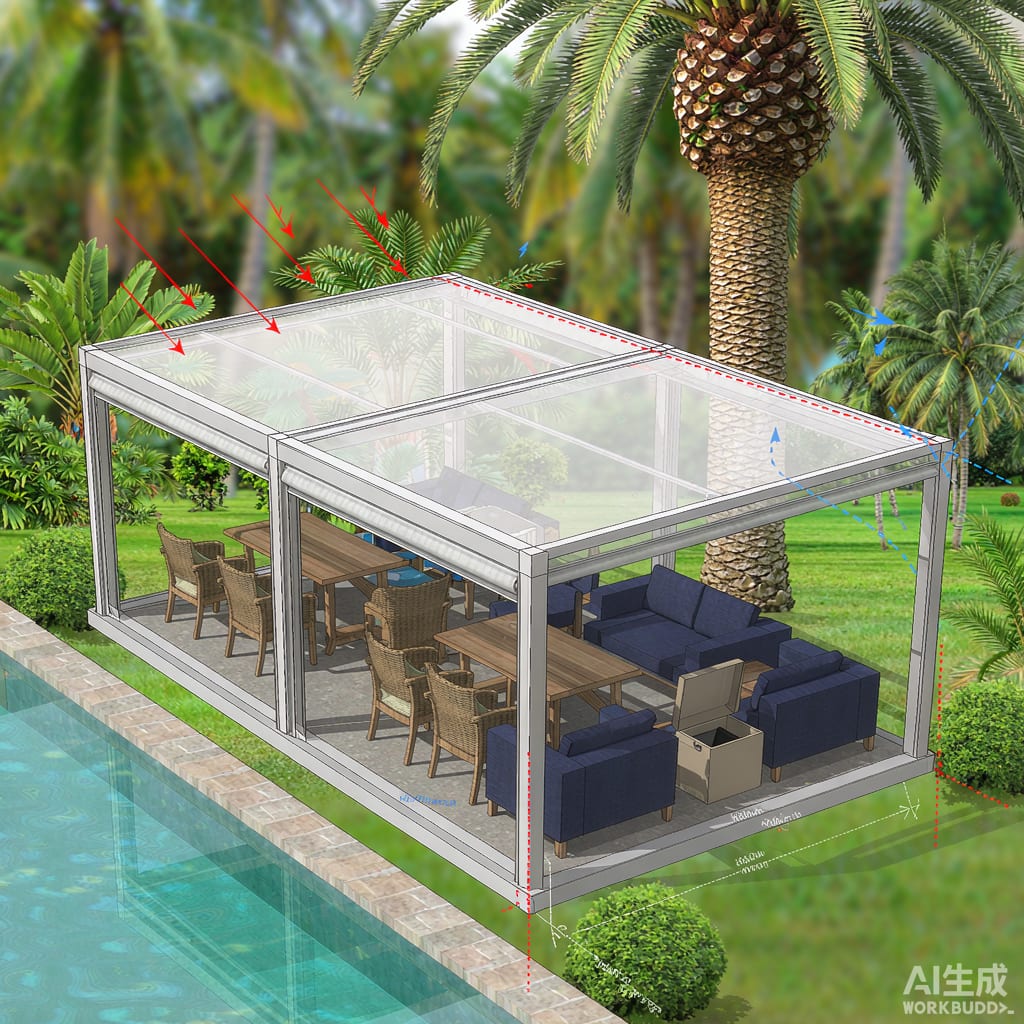
Coastal Southeast Asia, the Philippines, Taiwan, southern Japan, and southern China experience typhoons with sustained winds above 150 km/h and gusts above 200 km/h. Local building codes specify design wind speeds based on a 50-year or 100-year return period. For example, the Philippines Structural Code references a basic wind speed of 250 km/h or higher in exposed coastal areas.
Designers calculate the wind pressure on the roof and sidewalls using the formula:
p = 0.5 × ρ × V² × Cd × Kz
where ρ is air density, V is design wind speed, Cd is a shape coefficient, and Kz is an exposure factor. For an open-sided pavilion, the dominant loads are uplift on the roof and lateral force on the sidewalls. Uplift can exceed the dead load by a factor of three during a typhoon, which is why most pavilion failures occur by roof lift-off rather than by collapse of the frame.
### Snow Loads
For tropical climates, snow is not a design consideration. However, pavilions built for international hotel brands must sometimes comply with codes from snow-prone regions when the brand operates globally. A conservative design that includes a 1.0 kPa snow load in addition to wind and live loads adds robustness at minimal cost.
## Material Selection for Tropical Durability
### Aluminum Frame
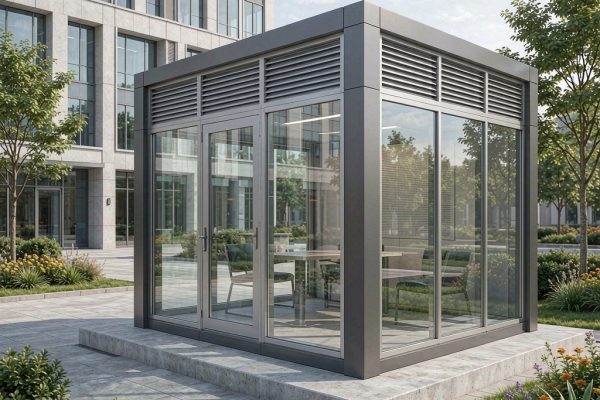
Aluminum is the dominant frame material for outdoor pavilions because it is lightweight, corrosion-resistant, and easy to fabricate. Marine-grade alloys such as 6061-T6 and 6063-T6 offer good strength with excellent corrosion resistance. Powder coating over a chromate or zirconium conversion coating provides additional protection.
For coastal locations within 1 km of the shoreline, designers often specify 6063-T6 with a thicker anodized or powder-coated finish. Stainless steel hardware (A4-80 or AISI 316) is used for fasteners.
### Stainless Steel Hardware
Fasteners, anchors, and co
ecting hardware are typically AISI 304 or 316 stainless steel. In salt-spray exposure zones, AISI 316 with molybdenum content above 2% provides significantly better corrosion resistance. Galvanic isolation between aluminum and stainless steel is achieved with plastic washers or EPDM gaskets at every contact point.
### Roofing Materials
Roofing materials range from architectural fabric (PTFE, PVC-coated polyester) to metal panels (aluminum, zinc, copper), polycarbonate, and glass. Each material has different wind-uplift ratings, thermal expansion behavior, and impact resistance.
PTFE and high-quality PVC fabrics offer excellent wind-uplift performance when properly tensioned. They allow natural light transmission and create the signature resort aesthetic. Metal panels are more durable against falling branches and hail but require careful design for thermal expansion.
## Drainage Design
### Roof Slope and Gutter Sizing
A minimum roof slope of 1–2% is recommended to ensure positive drainage. For larger pavilions, internal gutters sized for the local rainfall intensity must be specified. In tropical regions, design rainfall intensity can exceed 200 mm/h during monsoon storms.
The required gutter cross-section is calculated from the rational method:
Q = CiA
where Q is peak flow, C is the runoff coefficient, i is rainfall intensity, and A is the contributing roof area. A gutter that looks visually proportional but undersized will overflow during the first heavy storm, staining the surrounding pavement and potentially entering the pavilion.
### Downspouts and Grading
Downspouts should be sized for the same peak flow and routed to disposal points that do not allow water to pond near the foundation. Site grading must slope away from the pavilion at a minimum of 2% for at least 2 m beyond the drip line.
## Wind-Uplift Resistance
### Mechanical Anchoring
Roof-to-frame co
ections are the most critical structural detail. Engineers should specify either bolted co
ections with locking washers, welded co
ections, or cast-aluminum节点 with stainless pins. Adhesive anchors are rarely acceptable as the primary load path for wind-uplift resistance.
The number and spacing of anchors are determined by dividing the total uplift force by the allowable load per anchor. A safety factor of 2.5–3.0 is typical for typhoon regions.
### Removable or Retractable Roofs
Pavilions with retractable or removable roofs introduce additional complexity. The drive mechanism, locking system, and limit switches must all be rated for the design wind speed. Many owners add wind sensors that automatically retract or secure the roof when wind speed exceeds a threshold.
## Electrical and Lighting Integration
### Weatherproof Wiring
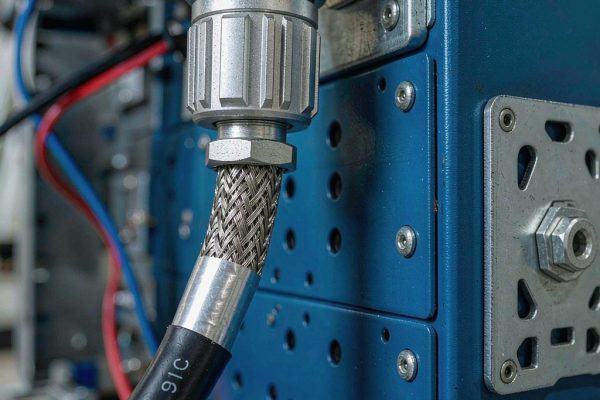
Outdoor lighting, fans, audio systems, and misting equipment require IP65 or IP66 rated junction boxes, conduit, and fixtures. In coastal locations, IP66 is preferred. Conduit should be UV-resistant PVC or stainless steel. All metal parts should be bonded to a grounding electrode.
### Lightning Protection
Tall pavilions in open ground should be assessed for lightning protection. A lightning air terminal at the highest point of the roof, co
ected to a grounding electrode with a conductor of at least 50 mm² copper, is the minimum. Bonding all metal frame members together reduces side-flash risk.
## Maintenance Pla
ing
A tropical-climate pavilion requires a
ual inspection of:
– Anchor torque and structural fastener condition
– Roof fabric or panel integrity
– Drainage system and gutter fastening
– Coating condition and corrosion spots
– Electrical bonding and grounding continuity
– Mechanical drive system on retractable roofs
A maintenance manual with inspection checklists should be provided to the owner at handover, along with as-built drawings showing all structural co
ections.
## Conclusion
Outdoor lounge pavilions in tropical climates must be designed for high wind loads, intense rainfall, salt corrosion, and years of UV exposure. Selecting marine-grade aluminum and stainless steel, sizing gutters for peak monsoon intensity, designing mechanical roof anchors for typhoon uplift, and integrating weatherproof electrical and lightning protection are the engineering fundamentals. A well-engineered pavilion becomes a signature feature of a hospitality venue for decades, while an under-engineered one becomes a liability after the first major storm.