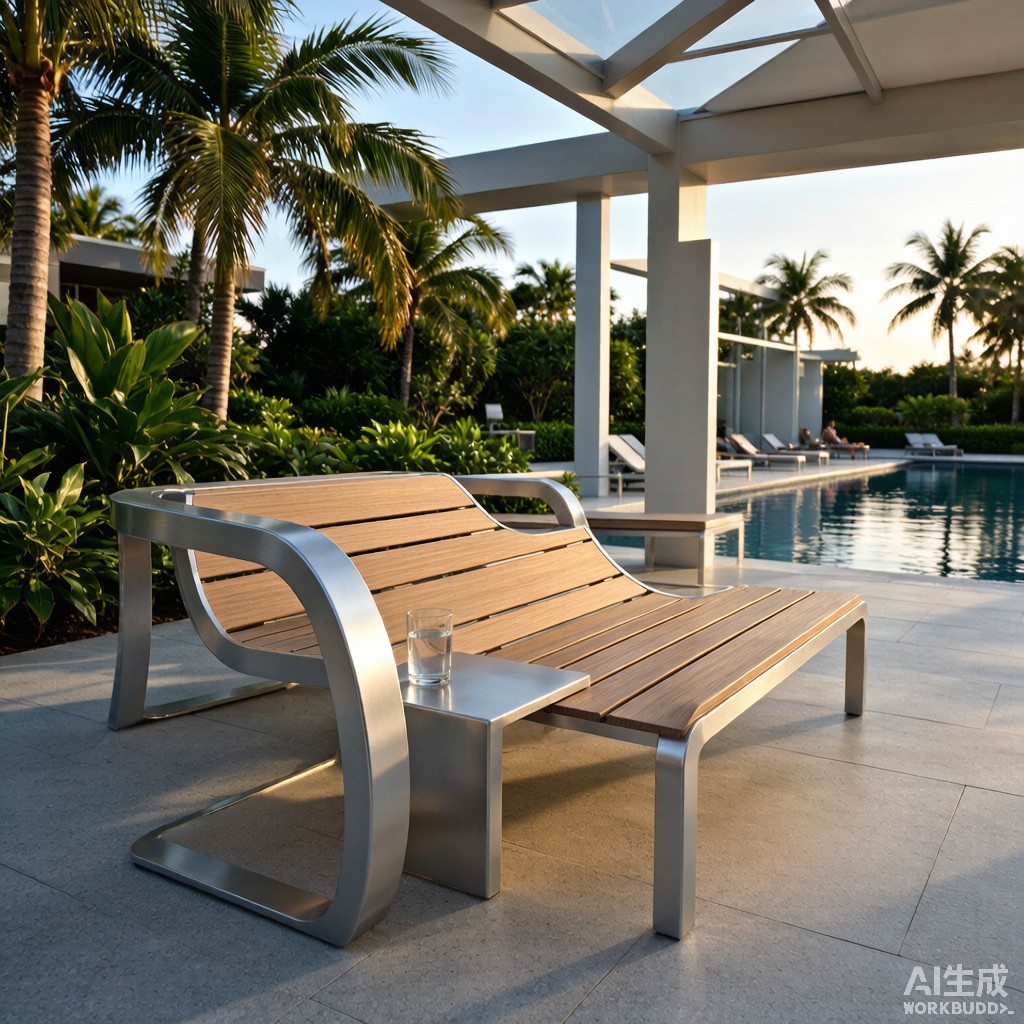
Outdoor lounge seating in tropical Southeast Asian environments faces a unique convergence of ergonomic and environmental challenges: sustained 30-38°C ambient temperatures, 75-95% relative humidity, intense solar radiation (800-1000 W/m² peak), and monsoon-season precipitation. A seat that performs adequately in temperate climates may become unusable within hours in tropical conditions due to thermal discomfort, material degradation, or biological growth. This article examines the ergonomic engineering principles, anthropometric data, thermal comfort metrics, and material science that govern outdoor lounge seat design for tropical extended-use applications in resort, commercial, and public space installations.
Anthropometric Design for Southeast Asian Populations
Body Dimension Database
Ergonomic seat design must accommodate the anthropometric range of the target user population. Southeast Asian anthropometric data (compiled from ISO 7250-1:2017 measurements across Thai, Malaysian, Vietnamese, and Indonesian populations) reveals distinct characteristics compared to European/North American standards:
| Dimension | SEA 5th %ile (female) | SEA 50th %ile | SEA 95th %ile (male) | Ergonomic Target |
|---|---|---|---|---|
| Sitting height | 765 mm | 830 mm | 895 mm | 895 mm (95th) |
| Popliteal height | 380 mm | 425 mm | 470 mm | 380 mm (5th) |
| Hip breadth (sitting) | 310 mm | 355 mm | 415 mm | 415 mm (95th) |
| Buttock-knee length | 540 mm | 595 mm | 660 mm | 660 mm (95th) |
| Sitting elbow height | 185 mm | 230 mm | 285 mm | 185-285 mm range |
Seat Dimension Derivation
Applying the ergonomic design-for-range principle (accommodate 5th to 95th percentile), lounge seat dimensions for Southeast Asian populations are derived as:
- Seat height (front edge): 380-420 mm. Below 380 mm creates difficulty standing for elderly users; above 420 mm creates foot dangle for 5th percentile females.
- Seat depth: 420-450 mm. Exceeds buttock-knee length of 5th percentile female (540 mm) by clearance, preventing popliteal pressure. Deeper seats force slouching and lumbar stress.
- Seat width: 500-550 mm minimum, 600 mm preferred. Accommodates 95th percentile male hip breadth (415 mm) with 85-185 mm lateral clearance for arm movement and thermal comfort.
- Backrest height: 450-550 mm for lounge (mid-back) configuration; 700-800 mm for full-recline relaxation. Lumbar support curvature at L3-L4 vertebra level: 180-220 mm above seat pan, with 20-30 mm convex protrusion.
- Backrest recline angle: 105-115° from vertical for active lounging; 115-125° for relaxation. Recline angles >125° require headrest extension to prevent neck hyperextension.
- Armrest height: 200-250 mm above seat pan. Accommodates 5th-95th percentile sitting elbow height range.
Thermal Comfort Engineering
Physiological Equivalent Temperature (PET)
PET is the air temperature of an indoor reference environment (20°C, 50% RH, 0.1 m/s air velocity, standard clothing) that produces the same physiological response as the actual outdoor environment. For tropical outdoor lounge seating, PET must be maintained below 35°C for acceptable comfort during 30+ minute sitting periods. Key thermal comfort factors:
- Solar radiation: Direct solar load of 800 W/m² on seated occupants increases PET by 8-12°C. Shading canopy reducing solar exposure to <200 W/m² is mandatory for PET <35°C in 30°C+ ambient conditions.
- Surface temperature: Seat surface temperature must remain below 40°C (skin contact comfort limit) under solar exposure. Dark-colored metal surfaces can exceed 60°C in tropical sun, causing first-degree burns within 3 seconds of contact.
- Air circulation: Perceived thermal comfort improves by 2-4°C per 1.0 m/s air velocity increase. Seat designs that cha
el prevailing winds or integrate low-speed fans (CEC compliant at <5 W) reduce perceived temperature significantly.
- Humidity: At 85-95% RH, sweat evaporation is severely limited, reducing the body’s primary cooling mechanism. Lounge designs must maximize skin-to-air contact through breathable seating materials and open-frame construction.
Universal Thermal Climate Index (UTCI) Assessment
UTCI provides a comprehensive thermal comfort metric integrating air temperature, humidity, wind speed, and radiation. For tropical Southeast Asian resort environments, typical summer UTCI values range from 32-42°C, classified as ‘strong heat stress’ (>32°C) to ‘very strong heat stress’ (>38°C). Effective outdoor lounge design targets UTCI reduction through:
- Shade structure: Pergola, cantilever umbrella, or tensile membrane canopy reducing UTCI by 4-8°C
- Misting system: Evaporative cooling reducing UTCI by 3-6°C in 80% RH tropical conditions)
- Thermal mass: Stone or water features absorbing heat during peak hours, releasing in evening for diurnal UTCI smoothing
- Vegetation: Transpiration cooling from adjacent vegetation reducing local UTCI by 2-5°C
Material Selection for Tropical Environments
Surface Temperature Management
Seat surface material selection is governed by solar absorptivity (α), thermal conductivity (k), and heat capacity (cp):
| Material | Solar Absorptivity (α) | Surface Temp at 800 W/m² | Comfort Rating |
|---|---|---|---|
| Anodized aluminum (dark bronze) | 0.85 | 62-68°C | Poor (burn risk) |
| Stainless steel 316L (brushed) | 0.50 | 48-55°C | Marginal |
| Teak wood (natural) | 0.55 | 45-52°C | Acceptable |
| HDPE recycled lumber (gray) | 0.60 | 48-55°C | Marginal |
| HDPE recycled lumber (white) | 0.25 | 38-42°C | Excellent |
| Woven synthetic rattan (light) | 0.35 | 40-45°C | Good |
| Textilene mesh (white) | 0.20 | 35-40°C | Excellent |
Corrosion and Biological Resistance
Tropical environments with 75-95% RH and 30-38°C temperatures create ideal conditions for microbial growth (mold, mildew, algae) and metal corrosion. Material selection must address:
- Aluminum frame: 6061-T6 or 6063-T5 with marine-grade anodizing (25 µm Type III hardcoat) or powder coating (polyester TGIC-free, 80-120 µm DFT). Coastal installations within 3 km of seawater require 316L stainless steel fasteners to prevent galvanic corrosion.
- Steel frame: Hot-dip galvanized (75 µm zinc) with epoxy primer and polyurethane topcoat. Bare steel corrodes at 30-80 µm/year in tropical coastal environments.
- Wood: Teak (Tectona grandis) contains natural oils (tectoquinone) providing inherent rot resistance. Ipe (Handroanthus) offers superior hardness (3680 Janka) but requires a
ual oil treatment. Softwoods require pressure treatment (CCA or ACQ) now restricted in many markets.
- Synthetic materials: HDPE recycled lumber is impervious to moisture, rot, and insects but expands 3-5 mm per meter at 40°C temperature swing. Textilene PVC-coated polyester mesh is UV-stabilized and drains instantly but loses 15-25% tensile strength after 5,000 hours xenon arc exposure.
- Antimicrobial treatment: Silver ion (Ag⁺) infused coatings (0.5-2.0 wt% silver zeolite) reduce surface bacterial colonization by 99% per ISO 22196, critical for shared commercial seating in tropical environments where fungal growth occurs within 3-7 days on untreated surfaces.
Physiological Considerations for Extended Sitting
Pressure Distribution and Ischial Comfort
Extended sitting (60+ minutes) on rigid outdoor surfaces produces ischial tuberosity pressure of 40-60 kPa, exceeding the 32 kPa capillary occlusion threshold. Sustained pressure above this threshold causes tissue ischemia, discomfort, and potentially deep tissue injury. Lounge seat designs must distribute load across the buttock-thigh contact area through:
- Suspension seating: Textilene mesh or elastic webbing distributes load across the seat pan, reducing peak ischial pressure to 15-25 kPa.
- Contoured seat pan: Polyurethane foam (35-45 kg/m³ density, ILD 80-120 N) with 50-70 mm thickness reduces pressure to 20-30 kPa. Open-cell foam with perforations improves ventilation in tropical climates, reducing sweat accumulation.
- Waterfall front edge: Seat front radius of 50-75 mm prevents popliteal artery compression behind the knee, improving lower leg circulation during extended sitting.
Ventilation and Moisture Management
In tropical climates, the body’s primary cooling mechanism—evaporative sweat cooling—is compromised by high ambient humidity. Seating materials that trap moisture against the skin (closed-cell foam, vinyl upholstery, solid plastic) create microclimate humidity of 95-100%, accelerating skin maceration and fungal growth. Breathable designs using open-cell foam with perforated covers, woven mesh, or slatted construction maintain microclimate humidity below 70%, significantly improving thermal comfort during extended sitting periods.
For Southeast Asian resort and commercial outdoor lounge installations, the integration of anthropometric design, thermal comfort engineering, and climate-appropriate material selection determines whether the seating delivers the intended relaxation experience or becomes a thermal liability. Light-colored HDPE recycled lumber, Textilene mesh surfaces, and marine-grade aluminum frames with integrated shade structures represent the optimal balance of comfort, durability, and maintenance economy for tropical deployment.