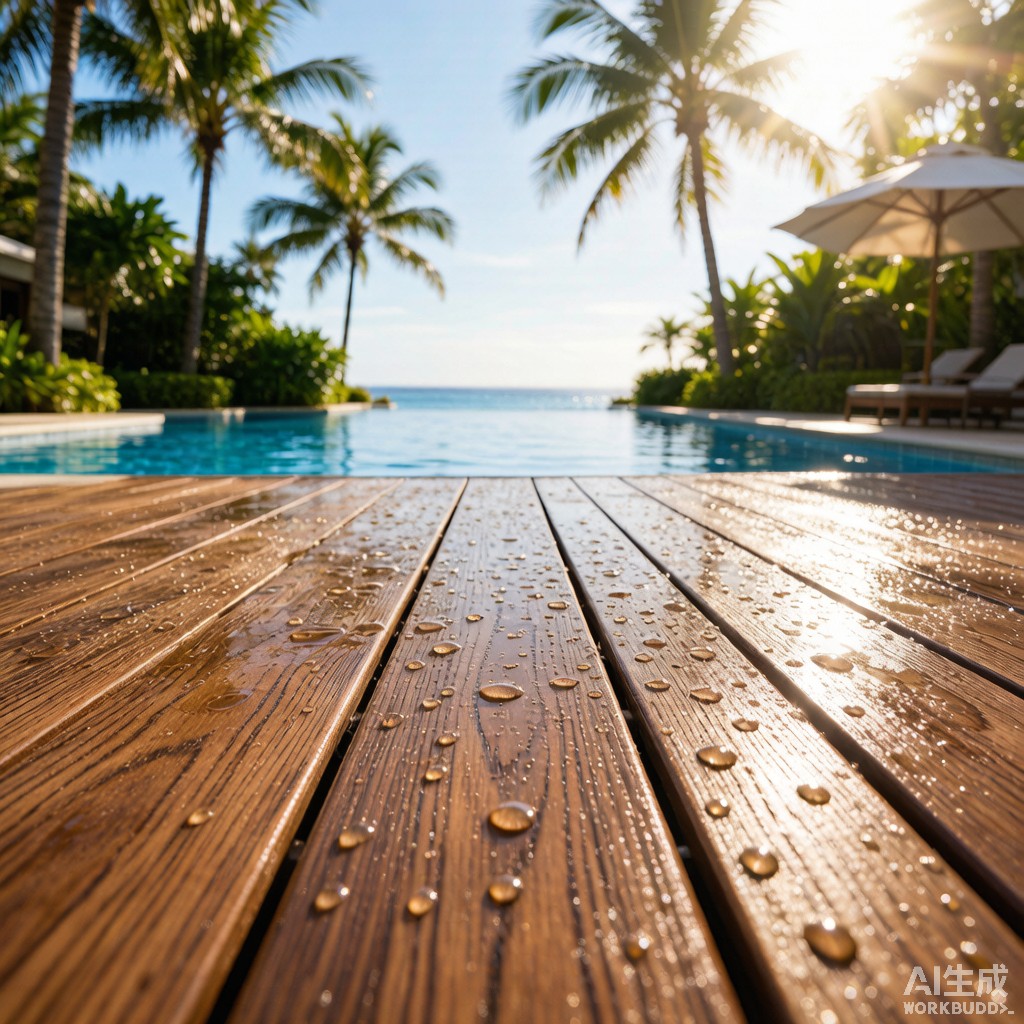
Pool surrounds, beachfront boardwalks, and outdoor lounge decks in tropical resorts and hospitality venues become extremely slippery when wet from rain, splashing, or condensation, and slip-and-fall accidents are among the most common liability claims in the hospitality industry. The German DIN 51130 industrial floor standard and the related AS/NZS 4586 pendulum test provide quantitative slip resistance ratings from R9 (lowest) to R13 (highest) based on the angle of inclination at which a test subject slips on an oiled or wet surface. Selecting the correct rating for a tropical outdoor deck requires balancing the slip resistance of the chosen material, the surface texture design (groove density, grit, embossed pattern), the maintenance regime, and the barefoot vs shod traffic pattern. This article explains the slip resistance rating systems, the achievable ratings for common decking materials, surface texture design, and the regional building code requirements for tropical hospitality installations.
Slip Resistance Rating Systems
DIN 51130 Inclining Platform Test
The DIN 51130 test measures the angle of inclination at which a test subject wearing standard safety footwear slips on a surface lubricated with motor oil. The critical angle is converted to an R-rating: R9 (6-10°, marginal), R10 (10-19°, low), R11 (19-27°, moderate), R12 (27-35°, high), R13 (>35°, very high). DIN 51097 provides a parallel barefoot test on a wet surface with no oil, classifying swimming pool surrounds and barefoot areas as A (12-17°), B (18-23°), or C (>24°). Most tropical resort pool decks should achieve at least R11 / B to handle wet barefoot traffic safely.
AS/NZS 4586 Pendulum Test
The pendulum test (also called the British Pendulum Test, BS 7976) measures the coefficient of friction by swinging a rubber slider across the surface and measuring the energy loss. The result is reported as a Pendulum Test Value (PTV) or British Pendulum Number (BPN). PTV 0-24 indicates high slip risk, 25-35 moderate risk, 36+ low risk. The Australian/New Zealand standard AS/NZS 4586 classifies wet barefoot areas using the pendulum slider 96 rubber: Class A (PTV 54). Singapore BCA, Malaysia UBBL 1984, and Indonesian SNI references for outdoor pool surrounds all require at least Class B / PTV 35+ for public assembly areas.
| Material | Surface Finish | DIN 51130 (Shod, Oiled) | DIN 51097 (Barefoot, Wet) | Typical Application |
|---|---|---|---|---|
| Smooth concrete | Troweled | R10 | A | Indoor residential |
| Broom-finished concrete | Brushed | R11-R12 | B-C | Pool surround, plaza |
| Exposed aggregate concrete | Washed, seeded | R12-R13 | C | Public pool, water park |
| Ceramic tile, smooth glaze | Glossy | R9-R10 | A | Indoor only |
| Ceramic tile, matte | Rough glaze | R10-R11 | B | Indoor, dry pool |
| Textured porcelain 20mm | Grip finish | R11-R12 | B-C | Outdoor pool, terrace |
| Wood-plastic composite (WPC) | Embossed wood grain | R10-R11 | B | Residential deck |
| WPC with deep grooves | Brushed + grooved | R11-R12 | B-C | Resort pool deck |
| IPE hardwood | Smooth planed | R10 | A | Dry residential |
| IPE hardwood | Rip-sawn or ribbed | R11-R12 | B-C | Outdoor deck |
Surface Texture Design for Slip Resistance
Groove Geometry and Spacing
For groove-and-groove decking, the slip resistance is dominated by the groove depth, width, and spacing. A typical R11/R12 surface has 2-3 mm wide grooves spaced 8-15 mm apart oriented perpendicular to the primary traffic direction. Grooves shallower than 1.5 mm fill with water and become ineffective; grooves deeper than 5 mm collect dirt and create cleaning difficulties. Spacing tighter than 6 mm reduces the effective contact area for bare feet and feels uncomfortable; spacing wider than 20 mm leaves large smooth areas that can be slippery when wet.
Embossed Patterns and Aggregate Exposure
Embossed patterns such as wood grain, slate, or sandstone can achieve R10-R11 without grooves but typically lose 20-30% of their slip resistance over 2-3 years as the embossed texture wears flat. For long-term slip resistance in high-traffic resort applications, an exposed aggregate surface with 1-3 mm granite or quartz particles protruding 0.3-0.5 mm above the cement matrix provides R12-R13 ratings that are stable for 10-15 years. The aggregate should be selected for hardness (Mohs 6+ for granite, 7 for quartz) to resist polishing under foot traffic.
Grit-Bonded Coatings and Anti-Slip Strips
For existing smooth surfaces that must be upgraded to higher slip rating, grit-bonded epoxy or polyurethane coatings with aluminum oxide or silicon carbide particles (grit size 16-30 mesh) can be applied at 1.5-3.0 mm thickness to achieve R12-R13. The coating must be renewed every 3-5 years as the grit wears and the binder erodes. Anti-slip strips 50-100 mm wide, installed perpendicular to the traffic direction at 0.5-1.0 m intervals, provide a low-cost R11-R12 upgrade for existing smooth timber or concrete decks, with the additional benefit of being replaceable individually as they wear.
Maintenance and Long-Term Performance
Cleaning and Algae Prevention
Slip resistance ratings in the table above are measured on clean, new surfaces. In tropical outdoor conditions, algae, biofilm, mold, and soap residue can build up within 3-6 months and reduce the effective slip rating by 2-3 grades. Routine cleaning with a pressure washer (1,000-1,500 psi) and a quaternary ammonium or sodium hypochlorite biocide every 4-8 weeks is essential to maintain the design slip rating. For WPC and natural timber decks, an algaecide pretreatment at installation and an a
ual re-application extends the cleaning interval and prevents biofilm establishment.
Wear and Replacement Cycle
Pool deck surfaces in tropical resorts typically show measurable slip resistance loss after 5-7 years due to a combination of wear, UV degradation, and biofilm accumulation even with regular cleaning. The recommended replacement or resurfacing cycle is 8-10 years for WPC, 10-15 years for textured porcelain, 15-20 years for exposed aggregate concrete, and 7-10 years for grit-bonded coatings. Specifying materials with a documented slip resistance test certificate from the supplier, and conducting an a
ual pendulum test on installed surfaces, supports a defensible safety program and reduces liability exposure for the resort operator.
With proper material selection (R11-R12 minimum for barefoot pool surrounds), correct surface texture design (groove or aggregate), consistent cleaning, and pla
ed replacement, outdoor lounge decks in tropical hospitality installations can be maintained at safe slip resistance levels for 15-20 year service life, protecting both guests and the operator from slip-and-fall liability.