Introduction: Solar-Powered Shade for Tropical Outdoor Spaces
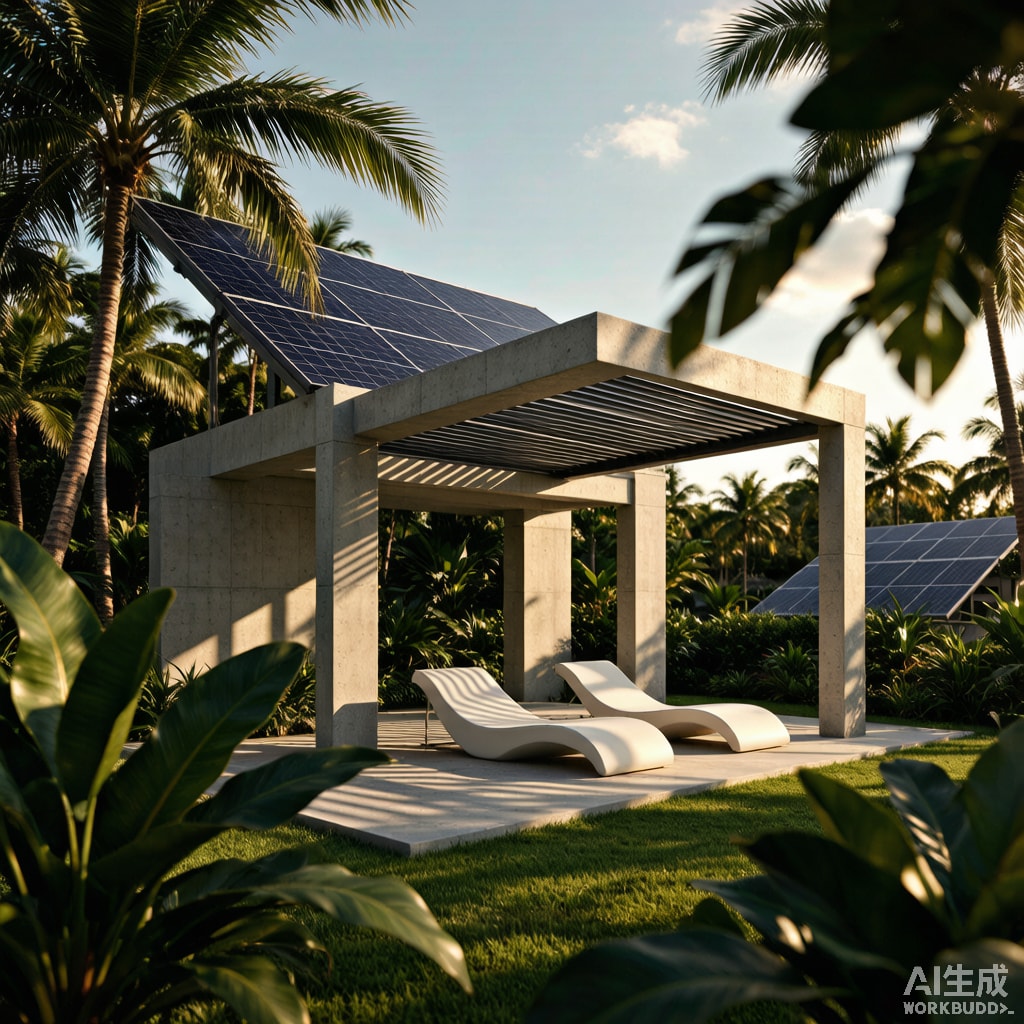
Outdoor lounges in tropical Southeast Asian climates face a fundamental challenge: providing comfortable shaded environments for guests while managing high solar radiation, humidity, and ambient temperatures that regularly exceed 32°C. Building-integrated photovoltaic (BIPV) pergolas offer an elegant dual-function solution, generating clean electricity while creating engineered shade structures that reduce thermal radiation exposure. This article examines the engineering design, thermal comfort analysis, and implementation of BIPV pergolas for resort and hospitality outdoor lounges in tropical climates.
BIPV Pergola System Architecture
Photovoltaic Panel Selection
BIPV pergolas integrate solar panels as the primary roofing/shade element, replacing conventional pergola materials. Three panel technologies are commonly deployed:
| Panel Type | Efficiency | Transparency | Power Output | Cost ($/Wp) |
|---|---|---|---|---|
| Monocrystalline PERC (full) | 20-23% | 0% | 400-450W per panel | 0.35-0.55 |
| Monocrystalline Bifacial | 21-24% | 0% (front) | 420-470W per panel | 0.45-0.65 |
| Semi-Transparent (a-Si/ CdTe) | 6-10% | 20-40% | 60-120W per m² | 0.80-1.50 |
| Building-Integrated Glass-Glass | 15-18% | 10-30% (laminated cells) | 300-380W per panel | 0.70-1.20 |
For outdoor lounge pergolas, semi-transparent or glass-glass BIPV panels are preferred because they allow controlled daylight transmission (creating a pleasant dappled light effect) while blocking 60-80% of solar radiation. The gap between cell strips in semi-transparent panels provides 20-40% visual transparency, creating an aesthetic similar to traditional pergola slats while generating power from the cell areas.
Structural Design and Wind Load
The pergola structure must support the dead load of solar panels (15-25 kg/m² including mounting hardware) plus live loads from wind uplift. In tropical cyclone-prone regions (Typhoon Belt: Philippines, Vietnam, southern China), the pergola must withstand design wind speeds per ASCE 7-22 or AS/NZS 1170.2:
- Tropical non-cyclone (Singapore, Malaysia): Basic wind speed 28-33 m/s, Vult = 33-39 m/s
- Tropical cyclone (Philippines, Vietnam coast): Basic wind speed 50-65 m/s, importance factor 1.15 for hospitality structures
- Wind uplift pressure: 1.5-3.5 kPa (uplift) for roof slope < 10° at roof edge zones
Structural members are typically hot-dip galvanized steel or 6063-T6 aluminum extrusions, sized to limit deflection to L/180 under full wind load. Foundation design uses reinforced concrete piers (300-450mm diameter, 1.0-1.5m depth) with chemical anchor bolts for the pergola columns. For cyclone zones, column base moment co
ections must resist 8-15 kN·m overturning moment per column.
Thermal Comfort Analysis: UTCI Index
Universal Thermal Climate Index
The Universal Thermal Climate Index (UTCI) is the international standard for outdoor thermal comfort assessment, integrating air temperature, humidity, wind speed, and mean radiant temperature (Tmrt). For tropical outdoor lounges, the UTCI target is below 32°C (no thermal stress) or at minimum below 38°C (moderate thermal stress), assessed at the worst-case summer noon condition.
Key UTCI input parameters for a tropical BIPV pergola at 1°N latitude, July 12:00 PM:
- Air temperature: 33-35°C
- Relative humidity: 75-85%
- Wind speed (under pergola): 0.3-1.0 m/s (pergola reduces wind compared to open area)
- Mean radiant temperature (Tmrt) without shade: 55-65°C
- Tmrt under opaque BIPV pergola: 36-42°C (reduction of 19-23°C)
- Tmrt under semi-transparent BIPV: 40-46°C (reduction of 15-19°C)
- Resulting UTCI under opaque BIPV: 30-33°C (no thermal stress to slight)
- Resulting UTCI under semi-transparent BIPV: 33-36°C (slight to moderate)
The primary mechanism of thermal comfort improvement is the reduction in Tmrt. Solar radiation contributes 600-900 W/m² of radiant load on a standing person at tropical noon. An opaque or semi-transparent BIPV panel above reduces this to 50-250 W/m² (transmitted and diffuse radiation), significantly lowering the radiant heat exchange and the UTCI.
Augmented Cooling Strategies
For lounges requiring UTCI below 30°C (thermal comfort zone), passive shading alone may be insufficient in the hottest hours. Augmented cooling strategies include:
- Misting fans: Evaporative cooling reduces air temperature by 4-8°C in dry tropical conditions, but limited effectiveness above 75% RH
- Cross-ventilation design: Pergola orientation aligned with prevailing wind direction (typically NE/SW in Southeast Asia) to maximize through-flow
- Radiant floor cooling: Embedded chilled water pipes in pergola floor slab, reducing contact surface temperature to 22-26°C
- Battery-powered portable fans: Powered by the pergola’s solar generation, providing 1-2 m/s air velocity at seating level
Power Generation and Energy Management
System Sizing
A typical outdoor lounge pergola (6m × 4m = 24 m² roof area) with semi-transparent BIPV panels at 80 W/m² yields approximately 1.9 kWp installed capacity. In tropical Southeast Asia (a
ual solar irradiation 1,500-1,900 kWh/m²/year, performance ratio 75-80%), this generates 2,100-2,900 kWh a
ually. For larger lounges or hospitality pool decks, pergola arrays of 50-100 m² can achieve 4-8 kWp systems generating 5,000-11,000 kWh per year.
Battery Storage and Load Matching
Solar generation peaks at solar noon (11 AM – 1 PM), coinciding with peak lounge occupancy and cooling demand. A battery storage system (lithium iron phosphate, LiFePO4) sized at 5-10 kWh stores excess midday generation for evening use (lighting, fans, charging stations). The charge controller, inverter, and battery management system are housed in a weatherproof enclosure (IP65) beneath the pergola structure.
Co
ected Loads
- LED ambient lighting: 150-400W (operated 6-10 hours evening)
- DC ceiling fans: 20-40W each × 4-8 units = 80-320W
- USB charging stations: 50-100W
- Misting pump: 100-150W (intermittent)
- Bluetooth audio system: 30-60W
- Total peak co
ected load: 500-1,000W (well within solar+battery capacity)
Material Durability in Tropical Environments
BIPV pergola components must withstand the aggressive tropical environment:
- PV panel encapsulant: EVA (ethylene vinyl acetate) or POE (polyolefin elastomer) with UV stabilizer, rated for 25-30 year tropical exposure
- Panel frame: Anodized aluminum 6063-T6 (15-25 μm anodized coating) or frameless glass-glass construction (eliminates corrosion risk)
- Junction box: IP68 rated with bypass diodes for partial shading tolerance
- Mounting hardware: Stainless steel 316 (A4-70 grade) for all fasteners in coastal/marine environments
- Cable management: UV-resistant cable trays (PA66 or UV-stabilized PE), solar DC cables per EN 50618 with tin-plated copper conductors
- Structural coating: Polyester powder coating (qualicoat class 1.5) on steel or fluorocarbon (PVDF) coating on aluminum for 15-20 year gloss retention
Salt Mist and Humidity
Coastal tropical pergolas must survive IEC 61701 salt mist corrosion testing (Severity 6: 96-hour salt spray). Stainless steel hardware and sealed junction boxes are mandatory within 1 km of the coastline. Panel edge sealing (butyl tape or silicone gasket) prevents moisture ingress into the cell-string area, which can cause PID (potential-induced degradation) reducing output by 5-15% over 5 years.
Economic Analysis and ROI
For a 4 kWp BIPV pergola system in Southeast Asia:
- Capital cost: $4,000-7,000 (panels, structure, inverter, battery, installation)
- A
ual energy generation: 5,000-6,500 kWh
- Grid electricity offset ($0.15-0.25/kWh): $750-1,625/year
- Avoided grid CO2: 3.0-4.0 tons/year (at 0.6 kg CO2/kWh grid emission factor)
- Simple payback: 3-8 years (varies with local electricity tariff and subsidy)
- NPV over 25-year life (5% discount rate): $8,000-18,000 positive
Beyond direct energy savings, the pergola provides architectural value (shade structure would need to be built regardless), enhanced guest experience, and sustainability marketing credentials for hospitality brands targeting eco-conscious travelers.
Conclusion
BIPV pergolas represent a mature, economically viable technology for tropical outdoor lounge applications. By integrating solar energy generation with engineered shade, these structures simultaneously reduce UTCI thermal stress for guests (from moderate thermal stress to no thermal stress during peak hours) and generate 2-8 kWp of clean renewable energy. The key engineering considerations are appropriate panel technology selection (semi-transparent for aesthetic dappled light, opaque for maximum power), structural design for tropical wind loads (including cyclone resistance), thermal comfort optimization through Tmrt reduction, and material durability for the aggressive salt-mist and UV tropical environment. With 3-8 year simple payback and 25-year design life, BIPV pergolas deliver both immediate thermal comfort and long-term sustainability returns for tropical hospitality and residential outdoor spaces.