Powering Remote Guard Booths Beyond the Grid
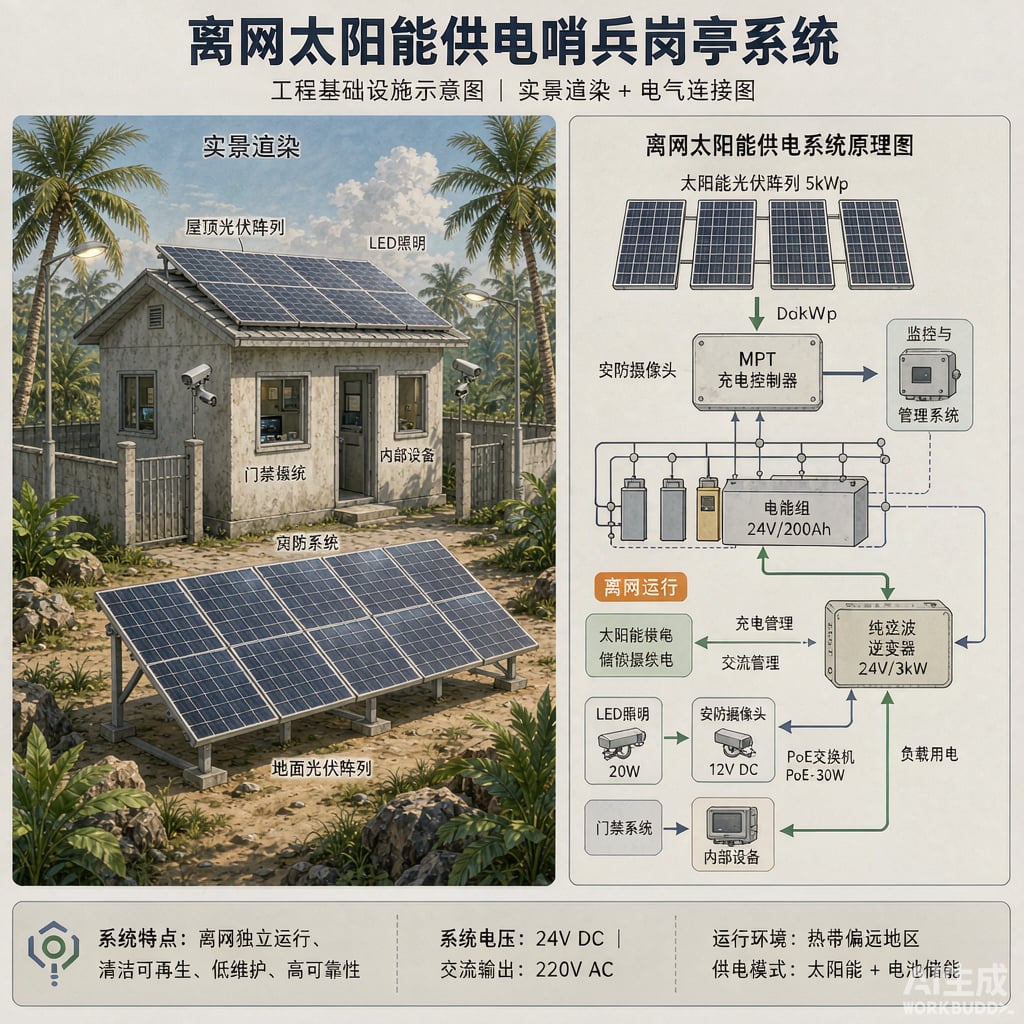
Security guard booths are often deployed at remote sites where grid power is unavailable or unreliable: pipeline checkpoints, mining perimeters, construction site entrances, and rural border crossings. In these locations, a photovoltaic off-grid power system provides the autonomy needed for 24/7 lighting, communication, surveillance, and climate control without the cost and logistics of ru
ing underground cable.
Designing a reliable solar power system for a guard booth requires careful load analysis, component sizing, and consideration of tropical environmental conditions including high temperature, humidity, cyclone exposure, and dust accumulation on panels.
Load Analysis: What Does a Guard Booth Consume?
The first step is to enumerate all electrical loads and their daily energy consumption. A typical remote guard booth with basic security equipment draws:
| Load | Power (W) | Hours/Day | Daily Energy (Wh) |
|---|---|---|---|
| LED interior lighting | 30 | 12 | 360 |
| LED exterior floodlight | 50 | 12 | 600 |
| CCTV cameras (2 units) | 20 | 24 | 480 |
| DVR / NVR | 25 | 24 | 600 |
| Intercom / radio | 10 | 8 | 80 |
| USB charging / fan | 15 | 8 | 120 |
| DC ventilation fan | 20 | 24 | 480 |
| Total | 170 | 2,720 |
With a system efficiency of 85% (accounting for battery round-trip, inverter, and wiring losses), the required daily PV generation is approximately 3,200 Wh. For a tropical site with 4-5 peak sun hours per day, the minimum PV array size is 3,200 / 4.5 = approximately 710 Wp. Designers typically add a 20% margin for panel degradation and soiling, yielding a target array size of 850-900 Wp.
PV Panel Selection and Mounting
For guard booths, two PV panel options are common:
- Monocrystalline PERC panels (450 W each): Two panels provide 900 Wp with high efficiency per unit area. Preferred when roof space is limited or aesthetics matter.
- Polycrystalline panels (330 W each): Three panels provide 990 Wp at lower cost per watt, but require more roof area.
Panels should be mounted at the local latitude angle (5-20 degrees for equatorial sites) or slightly flatter (10-15 degrees) to allow rain self-cleaning while minimizing wind loading. For cyclone-prone areas, panels must meet IEC 61701 salt-mist corrosion resistance and be secured with at least four mounting clamps per panel rated for 2,400 Pa wind uplift.
Dust accumulation on panels can reduce output by 15-30% in dry or construction-site environments. The design margin should account for local soiling conditions, or the system should include a weekly manual or automated panel-cleaning protocol.
Battery Storage Sizing and Chemistry
The battery bank must bridge the gap between PV generation (daytime) and load consumption (especially nighttime). The required storage capacity is:
Battery capacity (Wh) = Daily load (Wh) x Autonomy days / (Depth of discharge x Inverter efficiency)
For a 2-day autonomy target with LiFePO4 chemistry (80% DoD, 95% inverter efficiency):
Capacity = 2,720 x 2 / (0.80 x 0.95) = approximately 7,160 Wh = 7.16 kWh
Battery Chemistry Comparison
- LiFePO4 (Lithium Iron Phosphate): 3,000-6,000 cycles at 80% DoD, flat discharge curve, excellent high-temperature tolerance, no thermal runaway risk. The recommended choice for tropical remote sites. A 48 V / 150 Ah bank (7.2 kWh) fits the requirement.
- AGM Lead-Acid: 500-1,200 cycles at 50% DoD, lower initial cost but higher total cost of ownership over 5 years. Sensitive to high temperature (every 8 C above 25 C halves cycle life).
- Gel Lead-Acid: Better deep-cycle performance than AGM, but still limited cycle life and heavier per kWh. Suitable only when lowest initial cost is the overriding priority.
For tropical environments where ambient temperature may reach 45 C inside the booth battery compartment, LiFePO4 is strongly preferred because lead-acid cycle life degrades rapidly above 35 C.
Charge Controller and System Integration
An MPPT (Maximum Power Point Tracking) charge controller is essential for extracting 20-30% more energy from the PV array compared to a PWM controller, especially under partial shading or cloudy conditions. A 60 A MPPT controller can manage a 900 Wp array charging a 48 V battery bank with adequate headroom.
Key controller features for remote guard booths:
- Temperature compensation: Battery voltage setpoints adjust based on a remote temperature sensor at the battery, preventing overcharge in hot conditions.
- Load control: Low-voltage disco
ect protects the battery from deep discharge. Some controllers offer programmable load shedding to prioritize critical loads (CCTV, radio) over comfort loads (fan, lighting) when battery state drops below 30%.
- Remote monitoring: RS485 or cellular modem integration allows monitoring of battery voltage, PV current, and load consumption from a central security operations center.
Backup and Hybrid Options
For critical security installations where downtime is unacceptable, a hybrid system combining solar with a small backup generator or wind turbine provides redundancy. A 2 kVA diesel or LPG generator with auto-start triggered at 30% battery state of charge can extend the system through extended cloudy periods. Alternatively, a second battery bank provides N+1 redundancy at lower maintenance cost but higher capital expense.
Tropical Reliability Considerations
- Corrosion protection: All aluminum structural components should be anodized (Type III, 25 micrometers). Steel hardware must be 316 stainless steel or zinc-nickel plated.
- Ingress protection: Junction boxes, controller enclosures, and battery compartments should be rated IP65 or higher. Cable glands must use UV-resistant nylon or brass with O-ring seals.
- Thermal management: The battery compartment should be vented but shaded, with a passive thermal mass or small DC fan triggered above 40 C. Never place LiFePO4 batteries in direct sun.
- Lightning protection: Remote sites in tropical regions are often in high-lightning-density zones. A Class II DC lightning arrester on the PV string and a Class I AC arrester on any AC output protect the controller and loads.
By following this systematic approach to load analysis, component sizing, and tropical hardening, designers can deliver off-grid solar power systems that keep remote guard booths operational 24/7 with minimal maintenance and predictable lifecycle costs.