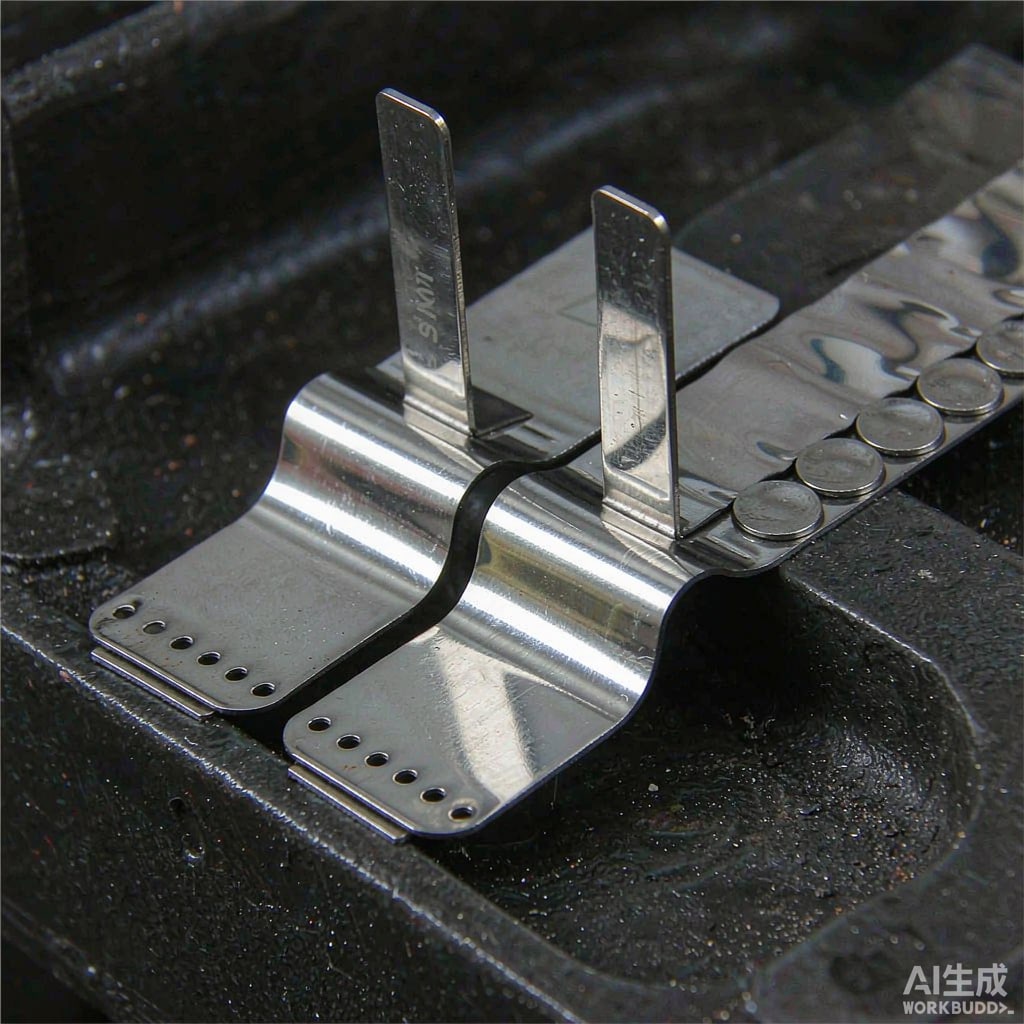
Why Nickel-Silver Strip Deserves a Place in Your SMT BOM
When engineers specify spring contact materials for SMT co
ectors, beryllium copper and phosphor bronze dominate the conversation. Yet nickel-silver strip — most commonly C7701 (Cu-Ni-Zn) — occupies a useful middle ground: spring performance better than brass, far lower cost than beryllium copper, excellent corrosion resistance without plating the base metal, and a naturally bright silvery finish. For SIM card contacts, battery springs in consumer devices, ante
a contacts, and shield can spring fingers, C7701 is a material worth understanding.
Composition and What It Buys You
C7701 is typically 54–58% copper, 16.5–19.5% nickel, and the balance zinc. The nickel in solid solution provides two critical benefits. First, it raises the elastic modulus and improves stress relaxation resistance compared with C26000 brass, particularly at elevated temperature. Second, it shifts the electrochemical potential of the surface toward nobility: nickel-silver does not dezincify the way unprotected brass can, and it resists tarnish in humid, mildly polluted environments typical of Southeast Asian and coastal deployments.
The trade-off is formability. C7701 is notably less ductile than brass at equivalent temper. Where C26000 half-hard strip bends 90 degrees over a radius equal to its thickness (R/T = 1) without cracking, C7701 typically needs R/T of 1.5–2 at the same temper, and grain direction matters even more: bends across the rolling direction should always be specified where geometry allows.
Temper Selection for Contact Springs
C7701 strip is supplied in a
ealed, 1/4-hard through extra-spring grades. For stamped SMT contacts that must hold normal force over thousands of insertion cycles, 1/2-hard to spring temper (roughly 400–550 HV) is the usual choice. The relationship you care about is stress relaxation: at 85°C, a 1/2-hard C7701 contact retains around 80–85% of its initial stress after 1,000 hours, versus roughly 70% for half-hard brass. At 105°C the gap widens further. If your contact lives inside a hot enclosure next to a power LED or a charging IC, that difference is the difference between a co
ector that still works at year three and one that develops intermittent faults.
Stamping and Forming Practice
Die Design Considerations
Nickel-silver work-hardens faster than brass, which affects progressive die strategy. Keep intermediate forming operations as gentle as possible and place the final calibration or coining hits late in the strip, when the material has already taken most of its shape. Burrs are similar in character to brass but slightly tougher; die clearance of 5–8% of strip thickness per side is typical, and sharp tooling with a wear-resistant coating (TiCN or similar) extends regrind intervals.
Because formability is the limiting factor, blank development should be validated with actual production-temper coil, not lab a
ealed samples. A contact that bends fine in samples can crack in production if the temper drifted half a grade. Specify bend-test requirements on the purchase order: e.g., “90° bend, mandrel R/T = 2, across grain, no cracks at 10× magnification.”
Springback Compensation
Expect higher springback than brass — the same modulus and yield combination that gives C7701 its stress relaxation advantage also makes it return more elastically after forming. In practice, plan for springback angles 10–20% greater than equivalent brass geometries and compensate with overbend or coining at the bend line.
Plating and Contact Finish
Although C7701 resists corrosion bare, electrical contacts still need a precious or solderable finish. Tin plating is standard for solderable contact tails; nickel plating 1–2 µm as a diffusion barrier under tin or gold prevents copper-zinc migration to the surface. For gold-plated contacts, the nickel underplate is not optional — without it, zinc diffuses through thin gold and forms a resistive oxide at the contact interface within months in humid climates. A common stack for consumer contacts is 1.3–2.5 µm nickel plus 0.05–0.15 µm flash gold on contact points only.
An important process note: nickel-silver’s work-hardened surface can carry forming lubricant residue that interferes with plating adhesion. A proper alkaline soak clean plus activation before plating is essential, and parts should be plated within a reasonable time after stamping to avoid oxide regrowth on the nickel-bearing surface.
Reliability and Testing
For SMT contact springs, validate three properties on finished parts rather than trusting material datasheets. First, normal force retention: age parts at 85°C for 168–1,000 hours and measure force decay on a force-displacement fixture. Second, insertion cycling: 5,000–10,000 cycles for battery or card contacts, checking force and contact resistance drift. Third, environmental exposure: 48–96 hours of salt spray (or better, mixed flowing gas testing for telecom-grade parts) with contact resistance monitored before and after.
Where C7701 Fits — and Where It Does Not
Choose C7701 when you need better spring performance and corrosion resistance than brass at a cost point well below beryllium copper, and when forming radii can be relaxed to R/T ≥ 2. Choose beryllium copper when stress relaxation at 125°C+ or extremely tight contact geometry demands it, and choose phosphor bronze (C5191) when solderability of long flat tails and moderate spring needs coexist. For mid-range SMT contacts — battery springs, shield fingers, card edges — nickel-silver strip frequently delivers the best performance-per-dollar in the tray.



