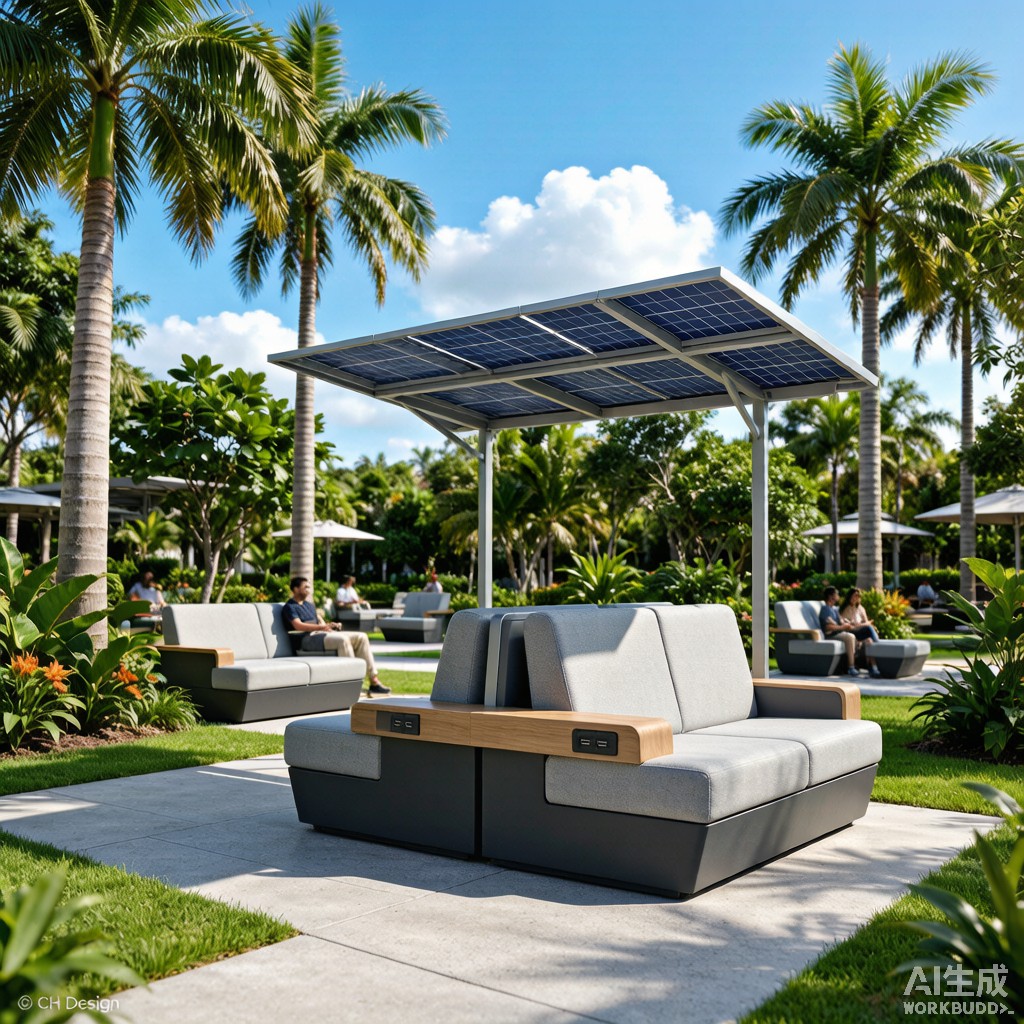
Urban parks and commercial outdoor spaces across Southeast Asia face a growing demand for comfortable seating that integrates digital co
ectivity and sustainable energy. Modular outdoor lounges with photovoltaic (PV) canopies address this need by combining shaded seating with USB charging capabilities powered entirely by solar energy. This article presents a comprehensive design guide for such integrated outdoor lounge systems, covering the PV canopy engineering, structural considerations, material selection for tropical climates, electrical system design, and installation best practices.
System Architecture and Design Concept
Integrated Function Zones
A complete PV canopy outdoor lounge system comprises four integrated functional zones:
- Seating module: Ergonomic bench or lounge chair construction supporting 150-200 kg per seat with weather-resistant cushions and drainage.
- PV canopy structure: Overhead solar panel array (typically 200-600W per module) providing shade while generating electrical power.
- Power and storage subsystem: Charge controller, lithium battery bank, and DC-DC converters housed in a weatherproof enclosure integrated into the seating structure.
- User interface: USB-A and USB-C charging ports (5V/2.4A per port, 18-30W USB-PD on premium models), LED ambient lighting, and optional WiFi hotspot or environmental sensor display.
PV Canopy Geometry
The canopy serves dual purposes—solar energy collection and user shade—requiring careful geometric optimization:
- Tilt angle: Fixed tilt of 10-15° facing equatorward (south in Northern Hemisphere, north in Southern Hemisphere) balances year-round energy generation with overhead rain shedding. For equatorial installations (Singapore, Kuala Lumpur, Jakarta), a near-horizontal 5-10° tilt is optimal.
- Height clearance: 2.1-2.4 m underside clearance provides comfortable headroom while maximizing structural compactness.
- Overhang: 0.3-0.5 m beyond seating footprint on all sides ensures shade coverage during morning and afternoon sun angles (30-60° elevation in tropical latitudes).
- Panel density: 60-75% coverage ratio (panel area to total canopy area) allows airflow and reduces wind load while maintaining sufficient generation capacity.
Photovoltaic System Engineering
Panel Selection for Tropical Conditions
Southeast Asian tropical climates impose specific requirements on PV panel selection:
| Specification | Requirement | Rationale |
|---|---|---|
| Cell technology | Monocrystalline PERC or TOPCon | Higher efficiency (20-22%) reduces panel area; better high-temperature performance |
| Temperature coefficient | <-0.35%/°C (Pmax) | Tropical ambient 30-40°C + panel heating = 55-70°C cell temp; coefficient critically impacts output |
| Front glass | 3.2mm tempered, low-iron | Impact resistance and high transmittance (>91%) |
| Frame | Anodized aluminum 6063-T5 | Corrosion resistance in humid/salty coastal environments |
| Junction box | IP67, bypass diodes | Protection against tropical rain and humidity |
| Warranty | 25-year performance, 12-year product | Long-term reliability for public infrastructure |
Energy Generation and Load Analysis
For a typical 4-seat outdoor lounge module with 400W PV canopy in Southeast Asia:
| Location | Daily Peak Sun Hours (PSH) | Daily Generation (Wh) | USB Load (Wh/day) | Battery Surplus (Wh/day) |
|---|---|---|---|---|
| Singapore | 4.2 | 1,344 | 320 (4 ports × 2h × 40W) | 1,024 |
| Bangkok | 4.8 | 1,536 | 320 | 1,216 |
| Jakarta | 4.5 | 1,440 | 320 | 1,120 |
| Manila | 4.6 | 1,472 | 320 | 1,152 |
| Ho Chi Minh City | 4.4 | 1,408 | 320 | 1,088 |
The substantial energy surplus supports LED lighting (30-50W for 6 hours = 180-300 Wh/day), environmental sensors (5W × 24h = 120 Wh/day), and WiFi hotspot (10W × 12h = 120 Wh/day) without grid co
ection. During monsoon periods with 3-5 consecutive cloudy days, a lithium battery bank sized for 3-day autonomy maintains full functionality.
Battery and Power Management
The energy storage subsystem employs LiFePO₄ (lithium iron phosphate) chemistry for safety and cycle life in public spaces:
- Battery capacity: 1.2-2.0 kWh per module (e.g., 4× 100Ah cells in 12V configuration)
- Cycle life: 3,000-5,000 cycles at 80% depth of discharge (DOD), equating to 8-15 years of daily cycling
- Charge controller: MPPT type, 20-30A rating, with temperature compensation
- DC-DC conversion: 12V battery → 5V USB (buck converter, 95% efficiency) and 12V LED lighting direct drive
- Battery enclosure: IP65-rated, ventilated steel cabinet with fire-resistant insulation, integrated into seating structure
Structural Engineering
Load Cases and Safety Factors
The canopy structure must withstand Southeast Asian environmental loads per relevant structural codes:
| Load Case | Design Value | Code Reference |
|---|---|---|
| Dead load (panels + structure) | 0.3-0.5 kN/m² | Self-weight calculation |
| Live load (maintenance worker) | 1.0 kN concentrated | AS/NZS 1170.1 |
| Wind load (3-second gust) | 0.8-1.5 kN/m² (region dependent) | ASCE 7-22 / MS 1553 |
| Seismic load | 0.2-0.4g PGA (Zone 2-3) | ASCE 7-22 Chapter 13 |
| Rainwater accumulation | 0.1 kN/m² (blocked drains) | Design allowance |
Frame Materials and Corrosion Protection
The structural frame must survive decades of tropical exposure without significant degradation:
- Primary structure: Galvanized steel RHS (rectangular hollow section) 50×50×3 mm or aluminum 6061-T6 extrusion 50×50 mm. Aluminum preferred for coastal installations due to superior salt spray resistance.
- Corrosion protection: Hot-dip galvanized steel (85 μm zinc) plus fluoropolymer topcoat (PVDF, 40 μm) achieves 15-25 year corrosion protection in C3-C4 environments per ISO 12944.
- Fasteners: A4-80 stainless steel (316) bolts and self-drilling screws; galvanized fasteners fail within 3-5 years in tropical humidity.
- Foundation: Reinforced concrete pad 400×400×300 mm at each column, or ground screw anchors (helical piles) for non-penetrating installations on paved surfaces.
Material Selection for Tropical Durability
Seating and Surface Materials
| Component | Material Options | Expected Lifespan | Key Properties |
|---|---|---|---|
| Seat slats | HDPE recycled plastic, FSC-certified hardwood (teak/merbau), WPC | 15-25 years | UV stabilized, moisture resistant, splinter-free |
| Frame/seat structure | Aluminum 6063-T5, galvanized steel | 20-30 years | High strength-to-weight, corrosion resistant |
| Cushions | Quick-dry foam + Sunbrella/solution-dyed acrylic fabric | 5-8 years | Mold resistant, fade resistant, drainable |
| Canopy backing | Aluminum composite panel (ACP) or perforated aluminum sheet | 20+ years | Rigid backing for panel mounting, reflective underside |
| USB port housings | Stainless steel 304 or ABS-PC blend | 10+ years | Vandal resistant, UV stable |
UV Stabilization
Tropical UV intensity (UV Index 10-12+) accelerates polymer degradation. UV stabilization strategies include:
- HDPE seating: 2.0-2.5% HALS (hindered amine light stabilizer) + 0.3-0.5% UVA absorber (benzotriazole type) maintains impact strength and color through 5,000+ hours QUV exposure (equivalent to 10+ years tropical exposure).
- Textile cushions: Solution-dyed acrylic (Sunbrella, Dickson) provides inherent UV resistance with 5-year color-fastness warranty; PVC-coated polyester degrades within 2-3 years.
- Cable insulation: Solar-rated XLPE or TPV (thermoplastic vulcanizate) with UV stabilizer package; standard PVC cracks within 2 years of direct tropical sun exposure.
Smart Features and IoT Integration
Available Smart Functions
Beyond basic USB charging, integrated outdoor lounges can incorporate intelligent features:
- Usage analytics: IR occupancy sensors count users and dwell time, transmitting data via LoRaWAN or 4G for park management optimization.
- Environmental monitoring: Integrated PM2.5, temperature, humidity, and noise sensors provide real-time air quality data to municipal dashboards.
- Adaptive lighting: Presence-activated LED lighting with circadian color temperature (4000K daytime / 2700K evening) reduces energy consumption by 60-70% versus always-on lighting.
- Emergency call point: IP65-rated intercom with direct co
ection to security/police, powered by the PV system with battery backup.
- Digital signage: E-ink display (zero power for static images) showing park maps, weather, or public service a
ouncements.
Power Budget for Smart Features
| Feature | Power (W) | Daily Energy (Wh) |
|---|---|---|
| USB charging (4 ports, 50% utilization) | 40 (peak) | 320 |
| LED lighting (adaptive) | 30 | 180 |
| IoT sensors + LoRaWAN | 5 | 120 |
| Emergency intercom (standby) | 2 | 48 |
| E-ink display (refresh only) | 10 (peak) | 20 |
| Total daily load | — | 688 |
With 1,344-1,536 Wh daily generation, the system maintains a comfortable 55-65% capacity factor even on cloudy days, ensuring uninterrupted smart feature operation.
Installation and Maintenance
Modular Assembly
The system ships as flat-pack modules for efficient transport and on-site assembly:
- Foundation preparation (concrete pads or ground screws)
- Column and frame assembly (bolt-together co
ections, no welding required)
- Seating module attachment
- PV panel mounting and electrical co
ection (MC4 co
ectors, plug-and-play)
- Battery and controller installation in integrated enclosure
- USB port and lighting fixture co
ection
- Commissioning and load testing
Two technicians can complete installation in 4-6 hours per module. No licensed electrician is required for low-voltage DC systems (<50V), though local regulations may vary.
Maintenance Schedule
| Interval | Task |
|---|---|
| Weekly | Panel surface cleaning (dust removal, especially during dry season) |
| Monthly | USB port functionality check, debris removal from seating |
| Quarterly | Battery voltage and state-of-health check, co
ection torque verification |
| A
ually |
Structural bolt inspection, corrosion assessment, seal integrity check |
| 5-yearly | Battery replacement (LiFePO₄), cushion fabric replacement |
Conclusion
Modular outdoor lounges with integrated photovoltaic canopies represent a convergence of sustainable energy, urban furniture design, and digital co
ectivity tailored to Southeast Asian tropical environments. By engineering each subsystem—PV generation, energy storage, structural frame, seating materials, and smart electronics—for the specific demands of tropical climate, these installations provide reliable shade, charging, and ambient lighting without grid co
ection. The modular flat-pack design enables rapid deployment across parks, campuses, commercial developments, and transportation hubs, turning passive seating into active infrastructure that enhances user experience while reducing municipal energy costs.