Rail transit vehicles—metros, light rail, high-speed trains, locomotives, and tramways—operate in enclosed tu
els and underground stations where any fire event can rapidly escalate into a life-safety catastrophe due to limited egress, high passenger density (200-1,000 per car), and the toxic combustion products of traditional polymer materials. Cable conduit, cable ties, co
ector housings, and equipment mounting brackets inside rail vehicles are increasingly specified in halogen-free flame retardant (HFFR) polyamide 66 (PA66) compounds to meet the stringent European railway fire safety standard EN 45545-2 (Railway applications – Fire protection of railway vehicles – Part 2: Requirements for fire behaviour of materials and components). This article examines the EN 45545-2 hazard level classification (HL1/HL2/HL3), R22 (interior) and R24 (underframe/exterior) product categories, cone calorimeter MARHE and critical heat flux testing, aluminum trihydrate (ATH) vs magnesium dihydroxide (MDH) flame retardant loading, glass fiber reinforcement interactions, and 600V DC third-rail cable conduit electrical insulation performance for modern rail transit rolling stock.
EN 45545-2 Framework
Hazard Levels HL1/HL2/HL3
EN 45545-2 defines four hazard levels (HL1, HL2, HL3) based on the operating category and fire risk of the rail vehicle route. HL3 is the most stringent, applicable to vehicles operating in tu
els, underground stations, and sleeping cars where evacuation is most difficult:
| Hazard Level | Operating Category | Examples | Test Requirements |
|---|---|---|---|
| HL1 | Standard surface vehicles, no tu
el >1 km |
Tram, suburban EMU on open track | Baseline toxicity and smoke |
| HL2 | Surface vehicles with short tu
els, sleeping cars |
Intercity train with limited tu
el sections |
Intermediate limits, R1-R7 categories |
| HL3 | Tu
els, underground, sleeping cars >4 hours |
Metro, subway, high-speed rail in tu
els, night trains |
Most stringent, R22/R23 HL3 limits |
For underground metro systems in Singapore, Hong Kong, Kuala Lumpur, Bangkok, and emerging Southeast Asia rail networks, HL3 is the default specification. Surface trams and elevated LRT systems typically meet HL2 with HL3 specified for tu
el sections.
Product Categories R1-R28
EN 45545-2 classifies railway vehicle components into 28 product categories (R1-R28) based on location and function. Cable conduit and co
ector housings typically fall under R22 (interior electrical equipment) or R24 (underframe and exterior equipment):
| Category | Application | Test Set (HL3 example) | Critical Limits |
|---|---|---|---|
| R1 | Interior surfaces, walls, ceilings | T02 + ISO 5658-2 + ISO 5660-1 | MARHE ≤ 90 kW/m², CIT ≤ 0.75 |
| R7 | Interior seats, upholstery | T02 + ISO 5658-2 + ISO 5660-1 | MARHE ≤ 60 kW/m², CIT ≤ 0.75 |
| R22 | Interior electrical equipment (small) | T02 + ISO 5658-2 + ISO 5660-1 | MARHE ≤ 90 kW/m², CIT ≤ 0.75 |
| R24 | Underframe/exterior equipment | T02 + ISO 5658-2 + ISO 5660-1 | MARHE ≤ 90 kW/m², CIT ≤ 0.75 |
For cable conduit in the underframe or exterior (R24), the same test set applies but with additional UV, weather, and chemical resistance requirements. For interior conduit and co
ector housings (R22), the focus is on flame spread, heat release, smoke density, and toxic gas emissions.
Test Methods & Acceptance Criteria
ISO 5660-1 Cone Calorimeter (T02)
The cone calorimeter test (ISO 5660-1) at 50 kW/m² incident heat flux is the primary reaction-to-fire test for HFFR PA66 qualification. The key measured parameters and HL3 acceptance limits are:
| Parameter | Symbol | HL3 Limit (R22/R24) | Typical HFFR PA66 Value |
|---|---|---|---|
| Maximum Average Rate of Heat Emission | MARHE | ≤ 90 kW/m² | 50-75 kW/m² |
| Time to ignition | TTI | No formal limit (lower is better) | 45-90 sec |
| Peak heat release rate | pHRR | No formal limit (lower is better) | 150-300 kW/m² |
| Total heat released | THR | No formal limit | 30-60 MJ/m² |
| Mass loss rate | MLR | No formal limit | 5-12 g/(m²·s) |
| CO yield | CO yield | No formal limit (lower is better) | 0.02-0.05 kg/kg |
MARHE (Maximum Average Rate of Heat Emission) is the single most important metric for EN 45545-2 R22/R24 compliance, calculated as the maximum average heat release rate over a 30-second window during the test. A well-formulated HFFR PA66 with 55-65 wt% ATH loading achieves MARHE 50-75 kW/m², comfortably below the 90 kW/m² HL3 limit.
Smoke & Toxicity (ISO 5659-2 + EN 17084)
Smoke density is measured by the NBS smoke chamber test (ISO 5659-2) at 25 kW/m² heat flux with or without pilot flame:
| Parameter | Test | HL3 Limit | Typical HFFR PA66 Value |
|---|---|---|---|
| Ds,max (4 min) — with pilot | ISO 5659-2 | ≤ 300 (R22), ≤ 600 (R24) | 100-180 (R22), 80-150 (R24) |
| VOF4 (smoke obscuration index) | ISO 5659-2 | ≤ 300 | 80-200 |
| CIT (Conventional Index of Toxicity) | EN 17084 (NF X 70-100) | ≤ 0.75 | 0.30-0.55 |
CIT (Conventional Index of Toxicity) per EN 17084 (referencing French NF X 70-100) is calculated from measured concentrations of 8 toxic gases (CO, CO₂, HCN, HCl, HBr, HF, NOx, SO₂) using a 30-minute exposure reference, weighted by their LC50 lethal concentrations. A CIT of 0.75 maximum is the HL3 limit; well-formulated HFFR PA66 compounds achieve 0.30-0.55, providing 30-50% margin.
Flame Retardant Chemistry & Loading
ATH vs MDH Comparison
Aluminum trihydrate Al(OH)₃ (ATH) and magnesium dihydroxide Mg(OH)₂ (MDH) are the two principal mineral flame retardants in HFFR PA66, working by endothermic decomposition releasing water:
| Property | ATH (Al(OH)₃) | MDH (Mg(OH)₂) |
|---|---|---|
| Decomposition temperature | 200-220°C | 300-340°C |
| Endothermic heat | -1,170 kJ/kg | -1,450 kJ/kg |
| Water release | 34.6 wt% | 31.0 wt% |
| Loading required for V-0 (UL 94, 0.8mm) | 55-65 wt% | 50-60 wt% |
| Specific gravity (cost driver) | 2.42 | 2.36 |
| Color stability | Excellent (white) | Good (white to gray) |
| Processing temperature limit | ≤ 200°C (melt degradation risk) | ≤ 280°C (PA66 compatible) |
| Cost (2026 SE Asia) | $1.20-1.80/kg | $1.60-2.40/kg |
MDH is preferred for PA66 because its higher decomposition temperature (300-340°C) is compatible with PA66 melt processing at 270-290°C, while ATH’s 200-220°C decomposition risks premature degradation and gas evolution during compounding and injection molding. The 50-60 wt% MDH loading required for UL 94 V-0 (0.8 mm wall) is consistent with EN 45545-2 HL3 performance targets.
Synergists & Specialty Additives
To enhance flame retardancy and reduce the high MDH loading that degrades mechanical properties, synergists are added:
- Zinc borate (2ZnO·3B₂O₃·3.5H₂O): 2-5 wt% loading, promotes char formation and reduces afterglow, synergistic with MDH at 3-5× effect multiplier.
- Melamine cyanurate: 1-3 wt% loading, releases nitrogen at 300-350°C, dilutes combustion gases and promotes intumescent char.
- Silicone-based char promoter: 0.5-2 wt% loading (e.g., Dow Corning 4-7081 resin), forms continuous silica-ceramic char layer that reduces heat transfer and smoke release.
- Red phosphorus: 6-10 wt% loading (microencapsulated for moisture stability), highly effective in PA66 (FR V-0 at 8-10% loading alone), but red color and limited to dark-colored parts.
- Carbon nanofiber: 0.5-2 wt% loading, improves char cohesion and electrical conductivity for anti-static applications.
A typical EN 45545-2 HL3-grade HFFR PA66 compound contains: 35-45% PA66 base resin, 50-58% MDH, 2-4% zinc borate, 0.5-1% silicone char promoter, 0.3-0.5% antioxidant (Irganox 1098 or similar), 0.2-0.4% processing aid, optional 0-2% carbon black for UV resistance and color.
Mechanical & Electrical Performance
Glass Fiber Reinforcement Trade-Off
Glass fiber (GF) reinforcement is common in PA66 for cable conduit (15-30 wt% GF for stiffness and impact strength) but interacts negatively with flame retardancy by wicking molten polymer and increasing heat release. The mechanical property profile of HFFR PA66 compounds at 25% GF vs unfilled:
| Property | HFFR PA66 (unfilled) | HFFR PA66-GF25 | Standard PA66-GF25 (no FR) |
|---|---|---|---|
| Tensile strength | 50-65 MPa | 110-140 MPa | 150-180 MPa |
| Flexural modulus | 3.5-4.5 GPa | 6.5-8.5 GPa | 7.5-9.5 GPa |
| Notched Izod impact | 30-50 J/m | 60-90 J/m | 90-120 J/m |
| Elongation at break | 10-20% | 3-5% | 4-7% |
| HDT @ 1.8 MPa | 80-100°C | 200-240°C | 240-260°C |
| Density | 1.45-1.55 g/cm³ | 1.55-1.70 g/cm³ | 1.30-1.40 g/cm³ |
| UL 94 (0.8 mm) | V-0 | V-0 | HB (no FR) |
| EN 45545-2 HL3 (R22) | Pass | Pass | Fail |
Glass fiber reduces the MARHE performance by 10-20% compared to unfilled HFFR PA66, but the addition of zinc borate and silicone synergists recovers most of the deficit. HFFR PA66-GF25 is the preferred grade for cable conduit where stiffness and impact strength are required for cable management in vehicle interior.
Dielectric Strength & Electrical Insulation
HFFR PA66 retains 80-90% of standard PA66’s dielectric strength despite the high mineral loading:
| Electrical Property | HFFR PA66-GF25 | Standard PA66-GF25 | Test Method |
|---|---|---|---|
| Dielectric strength | 25-30 kV/mm | 30-35 kV/mm | IEC 60243-1 |
| Volume resistivity | 1×10¹⁴ Ω·cm | 1×10¹⁵ Ω·cm | IEC 60093 |
| Surface resistivity | 1×10¹³ Ω | 1×10¹⁴ Ω | IEC 60093 |
| Comparative tracking index (CTI) | 400-500 V | 500-600 V | IEC 60112 |
| Dissipation factor @ 1 MHz | 0.015-0.025 | 0.010-0.020 | IEC 60250 |
For 600V DC third-rail cable conduit and 1.5 kV AC traction motor lead conduit, 1.5-3.0 mm wall thickness provides 35-90 kV breakdown strength, providing 20-60× safety margin at the rated operating voltage. CTI of 400-500 V (Class II per IEC 60112) is sufficient for indoor and underframe rail vehicle applications, but for high-pollution environments (e.g., coastal rail, mining rail), HFFR PA66 with CTI ≥600 V (Class I) is recommended.
Application Examples
Cable Conduit (R22 Interior)
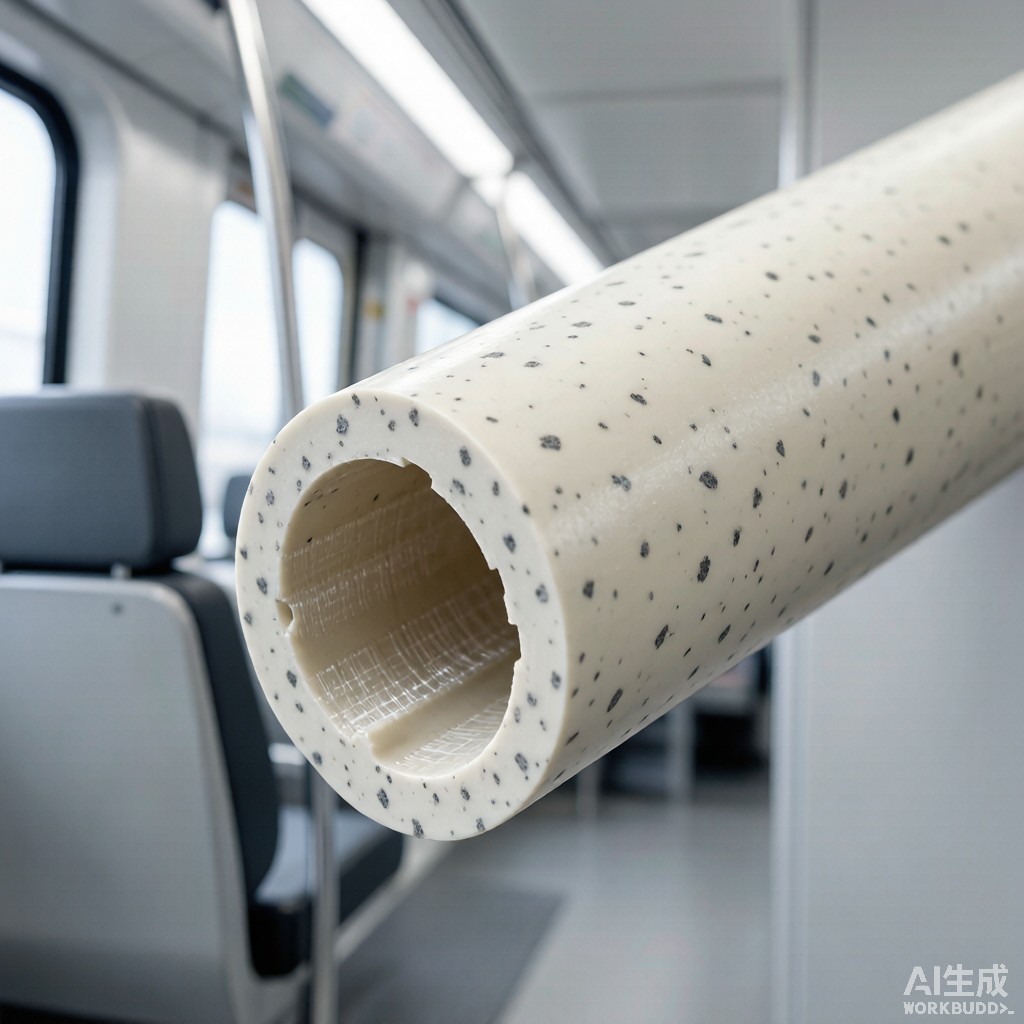
Interior cable conduit for passenger compartment and driver’s cab, in 20-50 mm diameter rigid or flexible corrugated configuration, requires:
- EN 45545-2 HL3, R22 (interior, <5 kg per part mass)
- UL 94 V-0 at 1.5-3.0 mm wall
- Operating temperature -40°C to +85°C (T3 climatic category per EN 50125-1)
- UV stabilized for window-adjacent installation (1,000 hr ASTM G155)
- Smoke density Ds,max 4-min ≤ 200 (well below 300 HL3 limit)
Typical compound: HFFR PA66-GF25, 50-55 wt% MDH, 3% zinc borate, 1% silicone, ISO 1043-1 designation >PA66-GF25(MDH50)<.
Underframe Cable Tray (R24 Exterior)
Underframe cable tray and conduit in 100-300 mm ladder or trough configuration, exposed to weather, salt spray, and road debris:
- EN 45545-2 HL3, R24 (underframe, exterior)
- UL 94 V-0 at 2.0-4.0 mm wall
- ASTM B117 salt spray exposure 500-1,000 hours (via cable tray metal hardware, not the polymer itself)
- Operating temperature -40°C to +125°C (underframe near traction motor)
- Chemical resistance to diesel, hydraulic fluid, brake cleaner
Typical compound: HFFR PA66-GF30, 45-50 wt% MDH, 2% zinc borate, 1% silicone, 1% carbon black UV stabilizer, with higher GF for stiffness to support 10-15 kg/m cable load.
Conclusion
Halogen-free flame retardant PA66 compounds based on 50-60 wt% magnesium dihydroxide flame retardant with zinc borate and silicone synergists achieve EN 45545-2 HL3 compliance for R22 interior and R24 underframe cable conduit in metro, high-speed rail, and tramway applications. MARHE 50-75 kW/m², CIT 0.30-0.55, Ds,max 100-180 are typical values for well-formulated compounds, providing 30-50% margin over HL3 limits. Glass fiber reinforcement at 25-30 wt% maintains 110-140 MPa tensile strength and 6.5-8.5 GPa flexural modulus required for cable management, while preserving UL 94 V-0 flammability rating. Dielectric strength 25-30 kV/mm and CTI 400-500 V support 600V DC third-rail and 1.5 kV AC traction motor lead conduit applications. The supply chain is mature (Celanese, BASF, Lanxess, Ascend Performance Materials, Radici, Solvay, Sabic, DOMO, China domestic: Kingfa, NHU, Wanhua), with 8-12 week lead times and $4.50-7.50/kg compound pricing for EN 45545-2 HL3 grades. Adoption is increasingly required for new-build rail vehicles in Europe, China, and Southeast Asia, with retrofit programs in older fleets to upgrade from non-compliant materials.