Introduction: The Construction Site Needs a Gatehouse That Moves With the Project
Construction projects are temporary by nature, but the security, access control, and reception functions they require are permanent. A multi-year high-rise development may have four or five distinct site phases—piling, substructure, superstructure, façade, fit-out—each with its own entry point, contractor list, and visitor flow. A traditional fixed-foundation guard booth ca
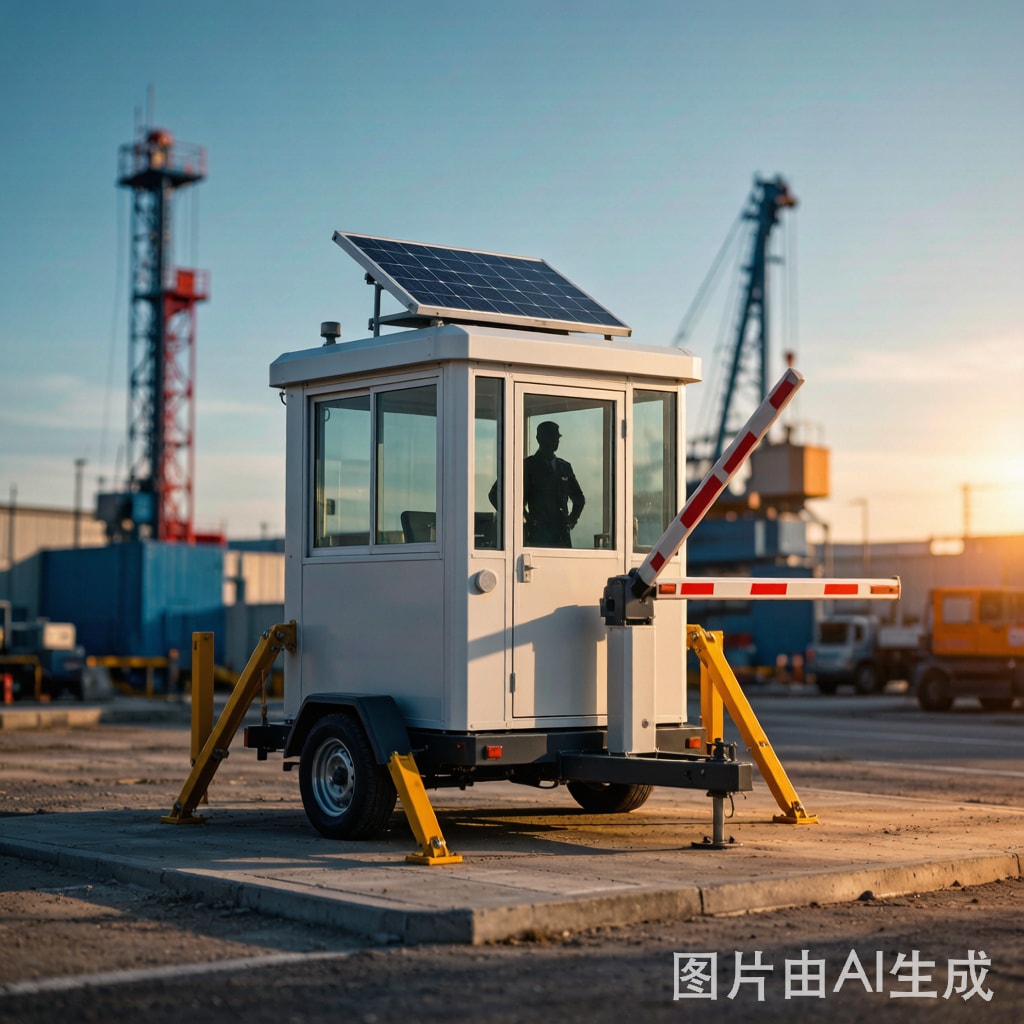
ot economically follow this migration. The mobile trailer-mounted guard booth has emerged as the industry standard solution: a fully self-contained security checkpoint that can be towed to a new location overnight, deployed by two workers in under two hours, and operated completely off-grid for weeks at a time. This article examines the design considerations, regulatory requirements, and engineering trade-offs that distinguish a properly engineered mobile guard booth trailer from a modified shipping container or improvised site office.
Trailer Chassis and Towing Configuration
Chassis Selection by Booth Size
| Booth Footprint (m) | Typical Use Case | Chassis Type | GVWR (kg) | Tow Vehicle Requirement | Max Highway Speed (km/h) |
|---|---|---|---|---|---|
| 1.2 × 1.5 | Single guard, basic check-in | Single-axle, 2.0 m wheelbase | 1500 | 1.5-ton SUV or pickup | 80 |
| 1.5 × 2.4 | Two guards, document check | Tandem-axle, 2.4 m wheelbase | 2500 | 3-ton truck | 80 |
| 1.8 × 3.0 | Three guards, search area | Tandem-axle, 3.0 m wheelbase | 3500 | 5-ton truck | 80 |
| 2.4 × 3.6 | Full checkpoint, X-ray capable | Tri-axle, 3.6 m wheelbase | 5000 | Heavy-duty truck | 80 (permits required above) |
Regulatory and Licensing Requirements
Mobile guard booth trailers are subject to vehicle roadworthiness regulations that vary by jurisdiction, but common requirements include:
- Lighting and reflectors: Side marker lamps, rear combination lamps, reflectors per UN ECE R7/R48 or FMVSS 108
- Brake system: Electric or hydraulic brakes on all axles for trailers > 750 kg GVW (UN ECE R13)
- Coupling and chains: Certified tow ball or pintle hook coupling, plus safety chains or breakaway cable
- License plate and identification: Rear license plate, VIN plate, and maximum speed sticker
- Width and height limits: Maximum 2.55 m wide × 4.0 m tall without special transport permits (most jurisdictions)
Trailers exceeding 3.5 tons GVW in EU jurisdictions require driver licensing beyond a standard Class B license, and any trailer exceeding 2.55 m width requires escort vehicles and time-restricted transport permits on most highways. North American regulations (DOT/FMCSA) are less restrictive on width but impose hours-of-service rules on the towing driver. Southeast Asian jurisdictions (Singapore LTA, Malaysia JPJ, Thailand DLT) have unique requirements including a
ual road tax and mandatory third-party insurance for the trailer as a separate vehicle.
Structural Design: Foundation-Free Stability
Outrigger Systems and Leveling
Unlike a fixed guard booth that sits on a permanent concrete foundation, a mobile unit must achieve stable, level deployment on uneven terrain—compacted soil, gravel, asphalt, or temporary concrete pads. The standard solution is four retractable outriggers (jacks) at the corners, each rated to 25% of the gross trailer weight:
Fjack ≥ 1.25 × GVW / 4
For a 3.5-ton trailer, each outrigger must support ≥ 1,090 kg. Standard landing legs are screw-type manual jacks (500–1500 kg capacity) or hydraulic auto-leveling systems (1500–2500 kg capacity) with self-leveling controls. The outrigger pad must be sized to the soil bearing capacity—soft clay at 50 kPa bearing capacity requires a 250 × 250 mm pad to support 1.5 tons without sinking, while competent gravel at 200 kPa requires only 100 × 100 mm.
Wind Loading on Deployed Units
A deployed mobile guard booth presents a 2.4 × 3.0 m flat surface to wind and is not protected by adjacent structures. Design wind loads follow the same ASCE 7-22 or Eurocode EN 1991-1-4 methodology used for permanent structures, but with two important differences:
- Higher safety factor (typically 1.5–2.0×) to account for the temporary deployment and uncertainty in anchorage
- Wind load applied to the full envelope including the trailer chassis, since the booth is supported only at the four outrigger points
For a Southeast Asian typhoon-zone deployment, the outrigger anchoring system should be capable of resisting 1.5–2.0 kPa horizontal wind pressure on the broadside. In practice, this means the outrigger pads should be staked to the ground with 25 mm diameter × 600 mm long ground anchors on each corner, or weighted with concrete ballast blocks (typically 200–400 kg per corner) for short-term deployments.
Off-Grid Power and Utilities
Electrical Power System
Mobile guard booths require power for lighting, HVAC, security equipment (CCTV, barrier controls, access readers), and IT (computer, radio, intercom). The standard off-grid power architecture combines solar panels, battery storage, and a backup generator:
| Component | Specification | Function |
|---|---|---|
| Solar array | 800 W–1500 W mono-Si, roof-mounted tilt frame | Primary power generation, 3–6 kWh/day typical yield |
| Battery bank | 10–20 kWh LiFePO4, 48 V DC | Night-time operation, 2–4 days autonomy without sun |
| Inverter | 3 kW pure sine wave, 230 V AC / 50 Hz (or 120 V / 60 Hz) | AC power for IT, barrier, lighting |
| Backup generator | 3–5 kW diesel or gasoline, auto-start | Extended cloudy weather, winter operation |
The solar array should be sized to deliver 30–50% surplus energy on a typical su
y day in the deployment region, providing buffer for unexpected loads and battery cycling losses. For Southeast Asian tropical deployment (5 peak sun hours/day average), a 1000 W array delivers approximately 4 kWh/day—sufficient to operate LED lighting (50 W), a small air conditioner (600 W for 8 hours), IT equipment (200 W for 12 hours), and barrier controls (50 W intermittent).
Water and Waste
For short-term deployments (days to weeks), a mobile guard booth typically does not require plumbing—drinking water is supplied in bottles, and any sanitation needs are met by portable chemical toilets located nearby. For longer deployments (months), a 200 L freshwater tank and a small sink with greywater collection may be fitted. HVAC condensate can be drained to a small collection tray for daily emptying.
Interior Layout and Ergonomics
Functional Zones
The interior of a mobile guard booth must accommodate multiple work functions in a compact 1.5 × 2.4 m to 2.4 × 3.6 m footprint. The standard layout includes:
- Guard workstation: Desk or counter with monitor, keyboard, radio, intercom, and document storage (typically 1.2 m × 0.6 m)
- Visitor processing area: Counter or pass-through window for badge issuance, document check
- CCTV monitoring station: Wall-mounted monitor with quad-view of site cameras
- Barrier control panel: Push-button or touchscreen for boom gate, traffic signal, warning siren
- Rest area: Small bench or stool for 10–15 minute breaks (especially important for 12-hour shifts)
- Storage: Locked cabinet for visitor badges, hi-vis vests, incident forms, first aid kit
HVAC and Thermal Comfort
Mobile guard booths in tropical climates face severe thermal challenges. Without insulation, the interior temperature can reach 50–60°C in direct sun, which is incompatible with sustained human occupancy. The thermal management strategy must include:
- Insulation: 50–75 mm rigid PIR or mineral wool in walls and ceiling, achieving R-value 2.5–4.0 m²·K/W
- Cool roof: White or light-grey external roof with SRI > 80, reducing solar heat gain by 30–40%
- Window glazing: Double-glazed low-E windows with solar heat gain coefficient (SHGC) < 0.3
- Air conditioning: 1.5–2.5 kW split system (or 12 V DC mini-split for off-grid operation), sized for the calculated cooling load
- Cross-ventilation: Operable windows or louvered vents providing natural ventilation when AC is not ru
ing
Security Features and Site Integration
Barrier and Access Control
The mobile guard booth is the control center for a construction site’s physical access control. Standard integrated systems include:
- Automatic boom barrier: 3–6 m arm length, 24 V DC actuator, integrated with the booth’s control panel and RFID reader
- Traffic signal: Red/green LED signal for entry/exit lanes, controlled by guard or induction loop
- Pedestrian turnstile: Full-height or waist-high turnstile for worker entry with badge reader
- CCTV system: 4–8 IP cameras covering site entrance, barrier, and queue area, with NVR storage in the booth (4–8 TB, 30-day retention)
- Intercom and PA: Hands-free intercom at visitor door, outdoor PA horn for a
ouncements and emergency
Ballistic and Forced-Entry Protection (Optional)
For high-risk deployments (extractive industry, conflict zones, government facilities), the mobile booth can be fitted with ballistic panels rated to NIJ Level III (7.62 mm rifle) or EN 1522 FB4. The panels add 800–1500 kg to the trailer weight and may require upgrading to a tri-axle chassis. Forced-entry protection includes laminated security glass, reinforced door with multi-point locking, and external steel mesh over windows. These hardened booths are typically used by military contractors, mining companies in West Africa or South America, and high-value infrastructure projects in politically sensitive regions.
Deployment and Logistics
Time from Arrival to Operational
The defining performance metric for a mobile guard booth is ‘time to operational’—the elapsed time from trailer arrival on site to fully staffed, powered, and security-active checkpoint. A well-designed mobile booth achieves this in 90–120 minutes with two workers:
| Step | Duration (min) | Resources Required |
|---|---|---|
| Position trailer, deploy outriggers | 15 | 1 worker, tow vehicle |
| Level and anchor | 15 | 1 worker, hand tools |
| Deploy solar array and co
ect batteries |
20 | 1 worker, basic tools |
| Co
ect barrier and access control |
30 | 1 worker, low-voltage tools |
| Test all systems and handover | 15 | 1 worker + supervisor |
Site Preparation Requirements
To achieve this rapid deployment, the construction site must provide:
- Level hardstand (compacted gravel, asphalt, or concrete pad) at the proposed gate location, minimum 4 × 8 m for a 2.4 m wide booth
- Access for the tow vehicle and trailer, including adequate turning radius (minimum 8 m)
- Power co
ection if off-grid power is not used (single-phase 230 V or three-phase 400 V depending on the load)
- Network co
ection (4G/LTE or fiber) for CCTV remote monitoring and access control integration
Conclusion: A Mobile Guard Booth Is a Designed System, Not a Trailer
The mobile trailer-mounted guard booth is the convergence of vehicle engineering, structural design, off-grid power systems, and security integration into a single deployable asset. A properly engineered unit—on a certified chassis, with stable outrigger system, solar/battery power, integrated security controls, and worker-comfort HVAC—serves the construction site as effectively as a permanent fixed facility, while providing the flexibility to relocate as the project evolves. The most common deployment failures trace back to under-specification of the chassis (causing roadworthiness issues), the outrigger system (causing wind instability), or the off-grid power (causing HVAC and IT failures). Selecting a mobile guard booth on these three critical subsystems, rather than on superficial aesthetic or price considerations, is the difference between a successful multi-year deployment and a frustrating series of field retrofits.